
0.9999 … and 1 are the same! For many people it is difficult to accept, but it is like this: 0,9 (0.9 periodical), that is 0.9999 … with infinite 9 after the comma, and 1 are the same real number. Or rather, they are two different representations of the same quantity. To read this equality 0.9999… = 1, it comes to think that there is some mistakes, because 0,9 It must necessarily be smaller than 1, being a decimal number made up of 0, … but there are several intuitive demonstrations that can help us understand this equality.
1. If 1/3 = 0.3333 … then 1 = 0.9999 …
We are all aware of the fact that 1/3 face 0.3 periodic. In fact, it is the writing of the same number, first in a fractional form and then in decimal form. Here, starting from this equality we can see that

We can do the same reasoning with 1/9, which if written in decimals is equal to 0.1111 … and which, if multiplied by 9, gives as a result 1, leading to the same conclusion above, that is, that 0.9999 … is equal to 1.
2. 1 – 0.9999 … gives the result 0
If we try to subtract 0.9 periodic from 1, the result is 0. Intuitively, we could be led to think that this subtraction gives a number, albeit very small, however different from 0 and that it has 0.0000 shape …001. What we must consider, however, is that 0.9 periodical has infinite 9 after the comma! This means that, in any position we try to position that single 1, there will certainly be a 9 in the subtraction that makes it “slip in place”. In short, that 1 “difference” will never come, and the result of the operation will be just 0.
3. The equation that leads to equality
Another type of demonstration shows us how, setting a simple equation, we arrive precisely to the equality we want. Let’s start by defining x = 0.9999 … and we consider that 10x = 9,9999 … Because, in multiplication by 10, simply move the comma of a single position. At this point with a simple subtraction, we get the following:
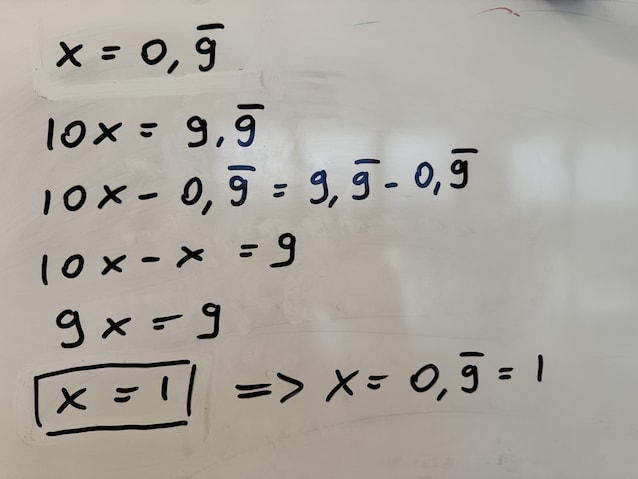
So we started from x = 0.9999 … to arrive ax = 1, from which equality.
4. The other demonstrations
The demonstrations, however, are countless, from the most mathematically rigorous to the most intuitive, like those we have just seen. We invite the most curious to visit the link in the sources.
