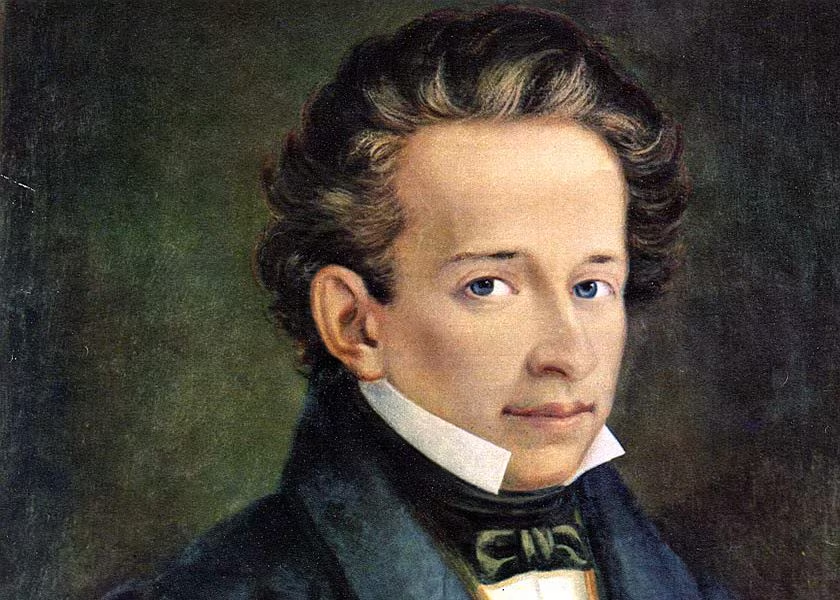
Perhaps the most famous Italian poet after Dante and certainly one of the most loved, Giacomo Taldegardo Francesco Salesio Saverio Pietro Leopardi (Recanati, 29 June 1798 – Naples, 14 June 1837) is the author of some of the highest masterpieces of Italian literature and a cornerstone of the school curriculum. At school we study his biography, we delve into his major works, but often many are lost small details of his life, which help to understand him and the context in which he lived.
1. He was the son of two cousins (one of whom was very much in debt)
Giacomo Leopardi was the first of ten children of Count Monaldo and Adelaide Antici, who were cousins of each other. At the time of the marriage, Countess Adelaide had the opportunity to see how Monaldo’s family fortune had remained heavily affected by risky speculations. After the union, with extremely rigorous management of economic resources, he managed to bring the family’s finances back into balance.
2. He also studied astronomy and mathematics
Leopardi was not only passionate about literature, but also about science: he tried his hand at astronomy and mathematicswhich is why he wrote some works on the topic at a young age. Among the most significant evidence of this youthful phase are the chemistry treatise written in collaboration with his brother Carlo and the History of astronomy from its origin to the year MDCCCXIIIa work that testifies not only to his early capacity for critical re-elaboration, but also to his desire to historically order the development of human knowledge. In these writings a fundamental characteristic of his method already emerges: attention to rationality, empirical data and the systematic construction of knowledge.
3. He was a polyglot
Leopardi knew the Latin (he had been writing in this language since he was nine); The ancient greeka language he learned self-taught; theJewish and numerous other modern languages such as FrenchtheEnglishit Spanish and the German. Not only that, in his Zibaldone there are also hints to other ancient languages, such as Sanskrit.
4. It was censored and placed on the Index of Prohibited Books
The Moral operettas by Giacomo Leopardi underwent a diffusion that was anything but linear, encountering numerous obstacles during the nineteenth century: they were censored several times by the authorities of the Kingdom of the Two Sicilies and the Papal State, limited in diffusion or subjected to editorial restrictions, until they were included in the Index of prohibited books, the instrument through which the Catholic Church reported texts deemed contrary to the doctrine. The motivation? The ideas materialist and pessimistic that they contained: in particular they proposed a profoundly critical vision of traditional religious consolations and questioned the idea of a benevolent providence.
5. He suffered from serious health problems
Rheumatism, partial blindness, scoliosis and pain accompanied him throughout his life. The most accepted hypothesis for a long time was that Leopardi suffered from Pott’s diseasea tuberculous spondylitis, or of juvenile ankylosing spondylitisautoimmune rheumatic syndrome. He also suffered, and from his youth, strong depressive crises.
6. He hated superstition
Son of a deeply religious woman, to the point of often being considered superstitious in the family and social environment in which he lived, Giacomo Leopardi developed over the course of his life an increasingly critical and intolerant attitude towards popular beliefs linked to luck, bad luck and any form of widespread irrationality. This distrust was not limited to a personal level, but also translated into a broader cultural and philosophical reflection on man’s tendency to rely on illusions and beliefs without a rational foundation: we can read it in The new believersa rhyming work from 1835 where he made a merciless satire against spiritualism Neapolitan.
7. Several scholars think she had an affair with a Freemason
In the 1830s Leopardi became close friends with Antonio RanieriNeapolitan exile and Freemason, who would become senator of the Kingdom of Italy. This friendship, which lasted until the death of the Recanati man and which is attested in an extensive correspondence, has led numerous scholars to think that there was a love relationship between them; although it is more likely to be intense platonic affection, as was common at the time.
8. He died before his father and was never reconciled in person
Giacomo never had a good relationship with his father Monaldo, who, due to his son’s poor health, would have willingly directed him towards an ecclesiastical career. He tried to run away from home several timesbefore having the family’s permission (and therefore the funds) to leave. For these reasons, relations remained tense for a long time. As he approached death, James softened, which we see in the transition from the “you” of the youthful letters to the “tu” of the mature ones. However, he did not have time to reconcile in person with his father, who died ten years after him.
9. We owe him many neologisms
I am none other than Giacomo Leopardi’s terms such as how “erupt”, “fratricidal”, “improbable” and “loom”: the poet recovered them directly from the Latin tradition and promoted their diffusion through his own literary use, contributing to enriching the vocabulary of the Italian language. This innovative trend, however, was not welcomed by everyone. The purists of the time, convinced that Italian had to strictly adhere to the model of the great authors of the fourteenth century, viewed any lexical innovation with suspicion and accused Leopardi of moving away from tradition. His linguistic choices therefore aroused numerous criticisms, even if over time many of the words he promoted permanently entered common use, confirming his linguistic sensitivity and his role in the renewal of modern Italian.
10. We are not sure if his remains are really his
Since Leopardi died prematurely in Naples (at not even 39 years old) in the midst of a cholera epidemic, his body should have been thrown into a mass grave, as per health practice of the time.
Thanks to Antonio Ranieri, who involved all his contacts in the Kingdom, his remains were buried in the crypt and then in the atrium of the church of San Vitale Martire, on the road to Pozzuoli near Fuorigrotta. Scholars are not sure whether this actually happened. The official version of National Center for Leopardian Studies is that the remains are found today at Vergiliano Park of Piedigrotta, miraculously saved from the bombings of the Second World War, and that part of the monument was brought to Recanati. The exhumation to do a DNA test, requested over twenty years ago, was however denied.
Sources
Pietro Citati, Leopardi, Milan, Mondadori, 2010
Paolo Abbate, The erotic life of Giacomo Leopardi, CI Edizioni, Naples 2000
The Republic
