In 2024 the global demand for energy reached a new record, 592 exajoulesdriven by Asian industrialization and the explosion of electricity consumption linked to artificial intelligence. Yet, despite the advance of renewable sources which set a record with an increase of 700 gigawatts and the return of nuclearfossil fuels remain the pillar of the system: oil, coal and natural gas continue to cover 86.7% of global needs.
The growth in global energy demand over the past year has increased almost double compared to its recent average. Demand in advanced economies is also returning to growth after years of declines, with a rapid expansion of electricity worldwide. In this sector, the innovations of the energy transition are intertwined with the challenges of an evolving world.
Global energy use has risen to 592 exajoules: between fossil and renewable sources
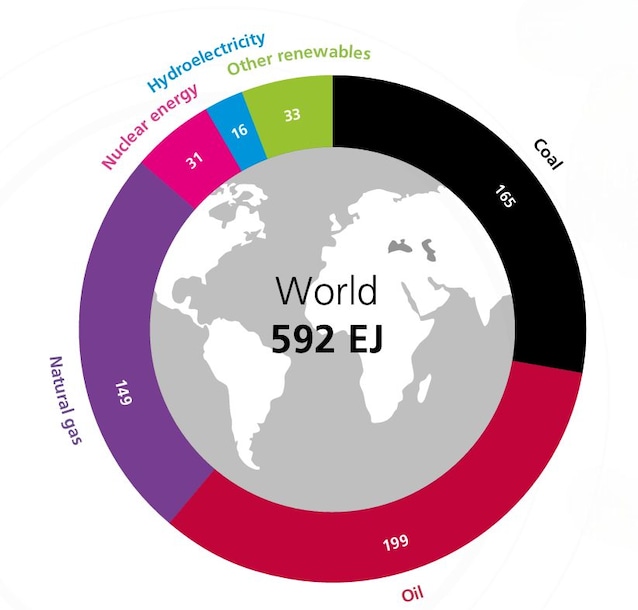
Global energy use rose to 592 exajoules in 2024, setting a new record in demand, according to data from the Energy Institute. Last year, oil, coal and natural gas together provided 86.7% of global energy needs: oil remained the main energy sourcerepresenting 199 exajoules, or 33.6% of the global supply. Coal follows with 27.9%, supported by increased consumption in emerging economies.
Natural gas, while cleaner than coal, provided 25.2%, recording the largest increase in demand among fossil fuels, with a growth of 115 billion cubic meters, equal to 2.7%, compared to an average of around 75 bcm per year over the last decade. Meanwhile, oil demand increased more slowly, rising 0.8% in 2024.
Low-carbon energy sources are also growing at a significant rate. In 2024, their combined share rose to 13.5%supported by an annual increase of 7%. In particular, they stood out wind and solargrowing by 16% and remaining the fastest growing energy sources in the world.
The capacity of new renewable energy installed in the world it rose to around 700 gigawattssetting a new record. Furthermore, thenuclear energy it accounted for 5.2% of supply, with France and Japan responsible for nearly two-thirds of its growth. According to the International Energy Agency’s Global Energy Review, 80% of the increase in global electricity generation in 2024 was provided by renewables and nuclear, which together contributed to 40% of total generation for the first time.
Major contribution: the electricity sector +4.3%
The International Energy Agency has highlighted that global energy demand grew by 2.2% last year, a faster increase than the average annual increase in demand between 2013 and 2023. Emerging and developing economies accounted for more than 80% of the demand increase in 2024, despite slower growth in China, where energy consumption increased by less than 3%.
Global energy demand growth accelerating in 2024 it was led by the electricity sectorwith electricity consumption increasing by nearly 1,100 terawatt-hours, or 4.3%. Overall, electricity demand has grown at twice the rate of total energy demand, indicating a major electrification of the economy. Regionally, Asia-Pacific (+5.4%) and the Middle East (+5.3%) recorded the fastest growth.
China, United States and India: energy and geopolitical competition
The world’s three largest electricity consumers (China, India and the United States) saw an increase generation from fossil fuels in 2024, while the fourth largest consumer, the EU, recorded a decline thanks to decarbonisation policies. In 2024 alone, in all forms of renewable energy, China added twice as much as the United States, Europe and India combined.
Excluding hydroelectric, China was responsible for nearly 60% of total new global renewable capacity installed in 2024. In addition to being the world’s leading producer of renewable energy, Beijing also has a dominance in the production of solar panels and wind turbinesgiving it significant influence over global supply chains.
The United States was the world’s largest oil produceraccounting for one-fifth of global production in 2024. American production is now essentially equal to that of Saudi Arabia and Russia combined. Under the presidency of Donald Trump, Washington has reversed course on the energy transitionaiming to boost fossil fuel production, reducing environmental regulations and promoting the use of coal and natural gas.
Also for theIndia fossils are a key resource: New Delhi has become the world’s largest buyer of Russian oilaccounting for more than 60% of Moscow’s maritime exports in 2024. A supply that has helped the country save at least $17 billion thanks to discounted prices. At the same time, after the outbreak of the conflict in Ukraine, Moscow had to give up to a large part of the European market. For the EU, energy has become a complex geopolitical challenge, connected to the need to reduce dependence on Russian supplies and at the same time guarantee energy security and the transition towards renewable sources.
