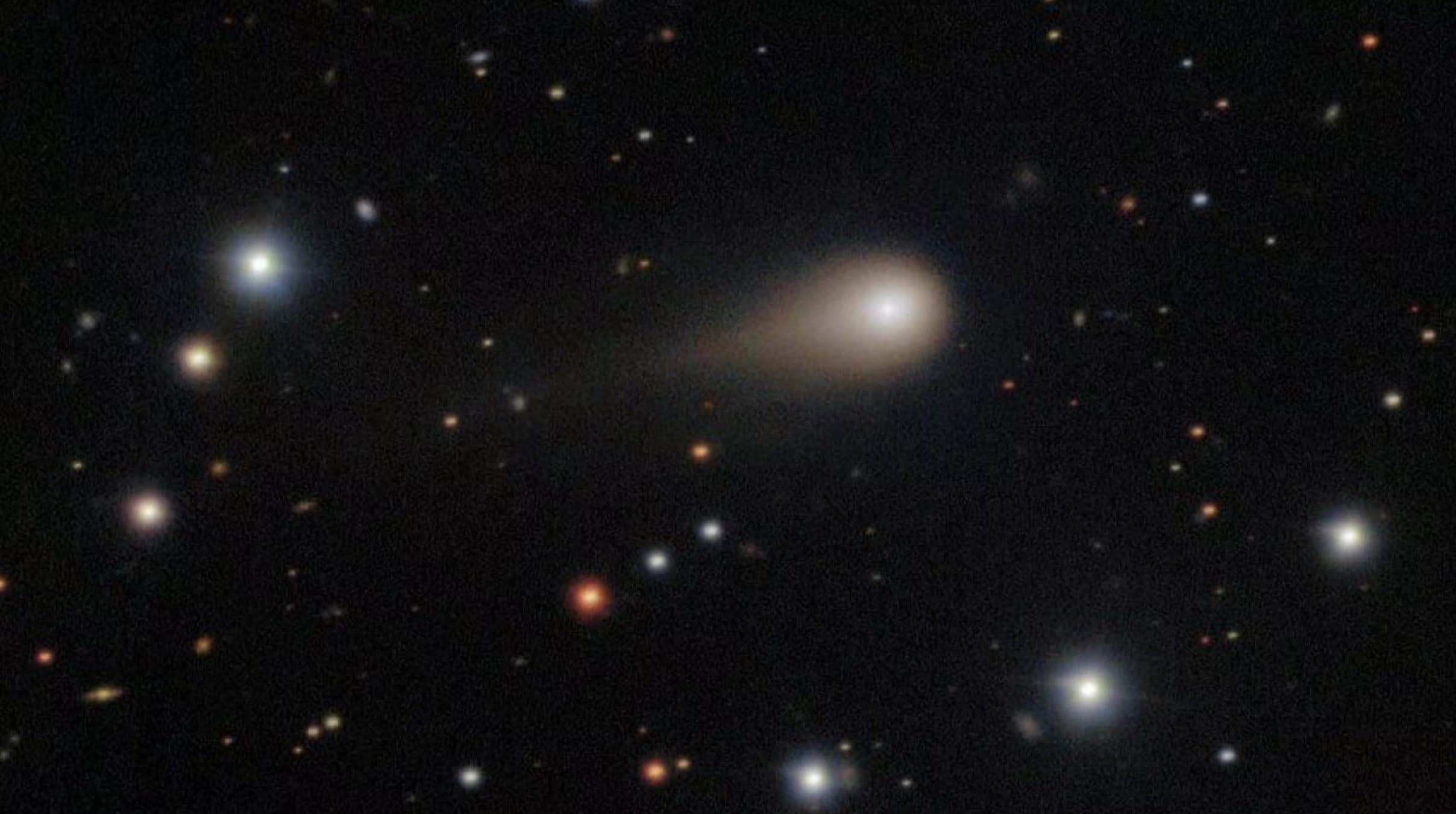
Harvard’s astrophysicist is back to talk about himself Avi Loebwho in recent days reiterated how according to him, the possibility that the interstellar comet cannot be excluded 3i/Atlas is actually a technological artifact of alien origin. A hypothesis very controversial that Loeb has advocated months ago, shortly after the discovery of the comet itself, on the basis of some anomalies in the trajectory and in the chemical composition of the celestial body. With a new study published a few days ago Loeb returns to this idea by identifying a new one probabilistic anomaly: 3i/Atlas is only the third interstellar comet discovered in our sun system, but according to the astrophysicist its size (at least 5 km) would be too big for not having already identified many more interstellar objects.
Loeb is a great caliber astrophysicist with a very high level career, but in recent years he has shown an attraction according to many a little too “fanatic” for everything that concerns extraterrestrial aliens and civilizations: already in 2021 he did the same thing with 1i/’Oumuamuathe first interstellar object, claiming that it would not have been unreasonable to assume that it was actually an alien spacecraft. The same then happened in 2023 with a interstellar meteorite Fallen in the Pacific. The speech is always the same: these objects would have anomalies that do not allow us to exclude an extraterrestrial artificial origin. To date, however, the scientific community is absolutely agreed in believing that 3i/Atlas is a “simple” and perfectly natural interstellar comet.
The study on the new 3I/Atlas anomaly
Loeb, together with colleagues Richard Cloete And Peter Verescompared the trajectory calculated for 3i/Atlas on the basis of the gravitational attraction of the sun, planets and other minor bodies of the Solar System with beyond 4000 observations of the position of the comet in the period between 1 July – the day of the discovery of the comet – to 23 September. The goal, typical of when you study a comet, is to identify any differences between the theoretical and real trajectory In order to estimate the component of the acceleration of the celestial body due to the sublimation of the volatile materials that constitute the crown and the tail of the comet.
Well, Loeb and colleagues have obtained an acceleration not gravitational practically nothing (less than 2 · 10–7 cm/s2). In the face of a mass loss of about 150 kg/sestimated by observations of the James Webb space telescope, this would mean that the mass of the comet is at least 33 billion tons. Assuming a reasonable density (0.5 g/cm3), a size of at least can be estimated for 3i/Atlas 5 kma consistent value with the initial estimates obtained thanks to the Hubble telescope.
Ok, so what is the problem? According to Loeb it would be astatistical anomaly. The first two interstellar objects discovered, 1i/’Oumuamua and 2i/Borisov, were much smaller and less massive than 3i/Atlas: about 10-20 times smaller and thousands or tens of thousands of less massive times. The problem is that larger bodies are much rarer than the smaller ones, so according to Loeb It is very unlikely to have a body of 5 km only as a third interstellar object.
The scientific article stops here. In a post on the portal MediumInstead, Loeb continues that given the distribution of the minor bodies of the Solar System in terms of size, we would have had to observe something of the order of 100,000 interstellar objects in our sun system before finding one of this size. And here the astrophysicist returns to sow the doubt: “3i/Atlas is an unusually massive comet (…) or an alien technology?”.
This anomaly, in the sense of statistical improbability, adds to others that Loeb identified last month, such as the improbable alignment with respect to the plane of the ecliptic, the unusual chemical composition and the close passage to various planets of the sun system but not the earth.
What does not return to the “alien” hypothesis of the interstellar comet
Let’s say immediately that if the artificial nature of 3i/Atlas was a hypothesis that Loeb can defend with convincing evidence, this hypothesis would be dealt with directly in the scientific article and not relegated to an intervention on Medium.
So why don’t Loeb talks about it in the scientific article? The reason is simple: because it knows very well – as an excellent scientist as it is – that of statistical anomalies, however improbable or well documented, they cannot in any way aim for the hypothesis of artificial origin of 3i/Atlas: the fact that the comet is an anomalous does not imply that it is an alien spacecraft. Of course, the alien hypothesis cannot be excluded: there is no evidence that it is not. And skepticism, you know, is a fundamental component of scientific thought. But this does not mean that it makes sense to actively investigate any hypothesis that we cannot exclude, especially when 3i/Atlas clearly shows all the signs of commercial activitycomplete with hair and tail. To consider such a strong thesis as the alien one we must have equally strong tests, according to the famous maximum of Carl Sagan:
Extraordinary Claims Require Extraordinary Evidence.
Here the tests are simply not there: we only have anomalies. The latter in particular, then, it would deserve an in -depth analysis: It is not clear, for example, how it was calculated that we should have observed 100,000 objects like ‘Oumuamua before discovering 3i/Atlas. First of all, we have no idea how many interstellar objects have actually passed through the sun system without having had the opportunity to observe them or understand that they were interstellar. Then there is the fact that, if on the one hand it is true that small objects are much more numerous than the larger ones, it is equally true that they are much more difficult to observe. Here too, it is not clear whether and how Loeb has taken into account it in calculating the number above.
More generally, the methodological problem is not so much related to anomalies as to their interpretation. Since only three interstellar objects passed through our Solar System, We can’t yet know for sure what is anomalous and what is not: our statistics is far from sufficient to talk about “normality”. Furthermore, we do not know enough about how the other planetary systems are made: it is a bit daring to take what is “normal” for our sun system and expect it to be representative also of what happens in other systems.
The fact that Loeb returns to re -propose the artificial hypothesis every time a new celestial body is discovered, creates a “Wolf wolf” effect which, in the long run, decreases the credibility of these statements and strengthens the perception of Avi Loeb as controversial In the scientific community despite his unquestionably prestigious career.
