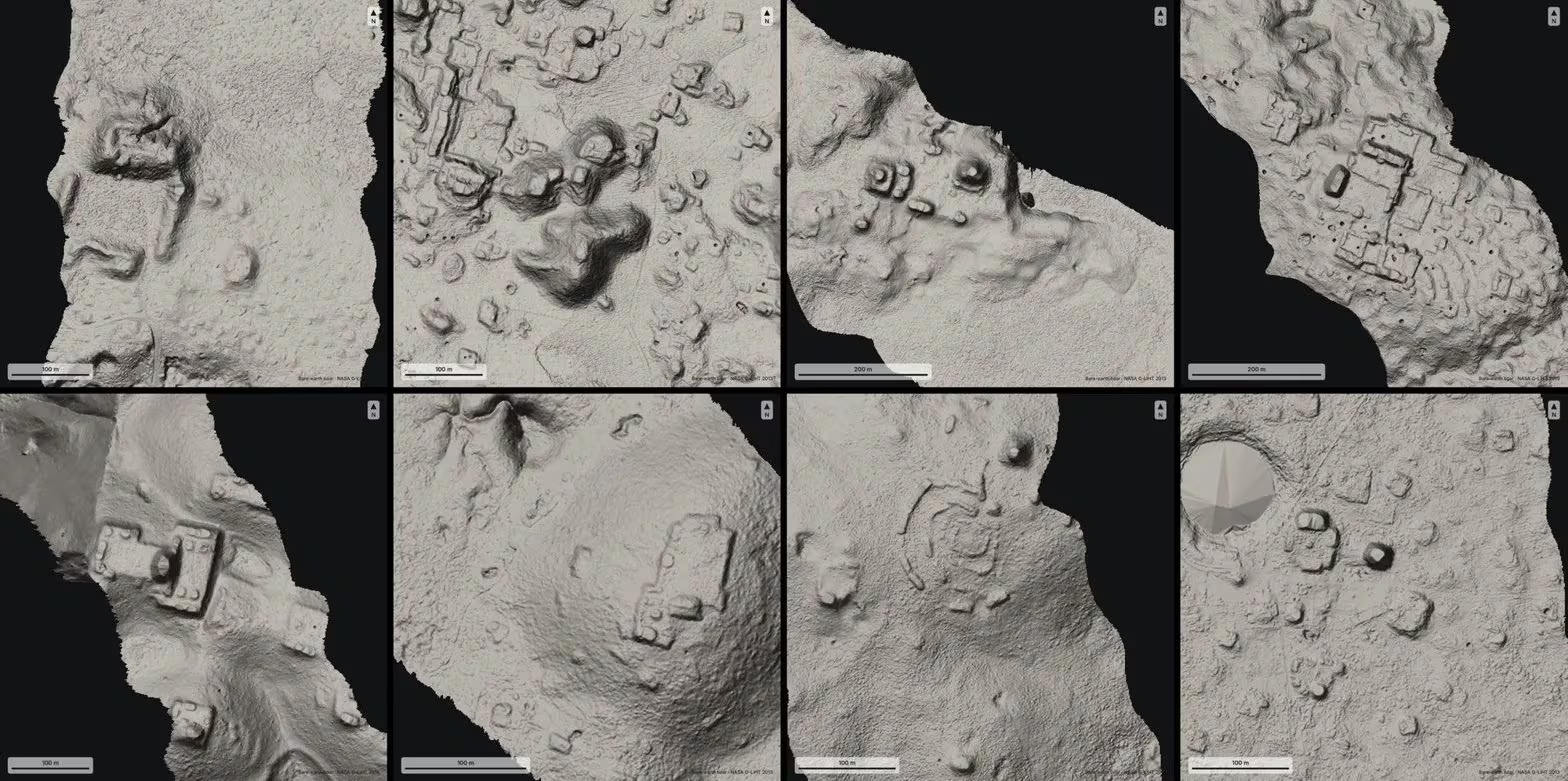
Artificial intelligence has identified Mayan structures in the jungle thanks to LiDAR data, but this is not a new discovery: this is why without expert verification the algorithms can make mistakes.
In the last few hours something has gone around on social media fascinating news, but imprecise: a researcher, Pietro Miotti, would have used 48 AI agents to analyze laser scans of the NASA in the Mexican jungle, announcing to having discovered an unknown Mayan sitecomplete with a square and pyramid.
However, that archaeological site was already known by local communities, and had been officially mapped and published by archaeologists Francisco Estrada-Belli, Marcello A. Canuto, Ivan Šprajc and Juan Carlos Fernández-Díaz on magazine Journal of Archaeology Science: Reports more than a year ago.
How the search for the archaeological site occurred using AI agents
Everything was born from a personal project of the Italian researcher Pietro Miottiwhich put a system of 48 AI agents to work on public data LiDAR from the NASAa laser technology that allows you to see through jungle vegetation creating high resolution 3D maps of the terrain.
The algorithms, in the space of a single nightthey combed an area of 1,200 square kilometers in Mexico, identifying several anomalies compatible with ancient Mayan structures.
But what did they actually do? The workflow was divided between several agents, each with specific tasks:
- Analysis of 3D maps: the algorithms examined the images of the “bare” ground obtained from NASA laser surveys (which filter the tree canopy), distinguishing the artificial reliefs from the natural conformation of the ground.
- Recognition of structures: by crossing the geometric shapes on the ground, the AI reported the most promising points, identifying a large settlement with a square and a pyramid about ten meters high.
- Synthesis and production of documentation: Once the data and coordinates were isolated, the agents compiled the technical documentation and even translated the report into Spanish to allow the researcher to send the report to the authorities.
Miotti then contacted theMexican National Institute of Anthropology and History (INAH), which responded in less than three days that it did not have that site registered in its official databases. However, Absence from a government registry does not mean a site is unknownand this specific case is confirmation of this: archaeologists authors of the original study they immediately made it known that the settlement it had already been identified, studied and described by them in the scientific literature the previous year.
The limit of AI in the archaeological field
AI agents were able to recognize geometric shapes of the mounds in laser data – a job that archaeologists have been doing for years with advanced software – demonstrating how the technology is increasingly precise and cutting-edge.
However, the artificial intelligence shows its own side for its own main deficiency: the verify precise and complete sources and of state of the art.
This partly happens also because, to avoid grave robbers and looters of finds, archaeologists never publish exact GPS coordinates of the sites in their publications, inserting only maps and images. The AI therefore, not being able to have access to this data, ends up passing off something as new that in reality had already been found.
Human competence is therefore confirmed as irreplaceable in this sense, as also recognized by Miotti, who updated his writing and data credit to researchers at the archaeological site.
As the UCL professor pointed out Elizabeth Grahamthe real challenge of archeology is not to “discover” new sites – given that there are already thousands known to local populations or identified on foot – but to have the funds to dig them, study them and protect them.
