
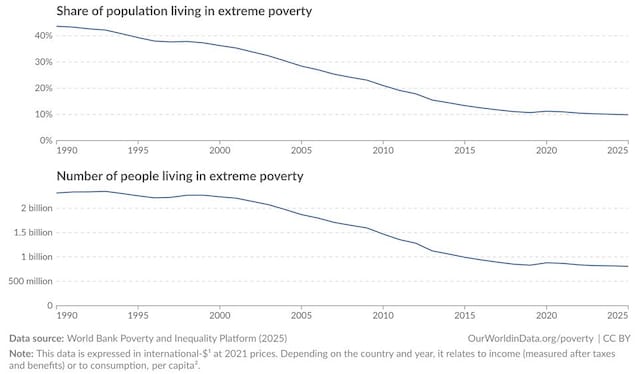
The number of people who live in conditions of extreme poverty in the world is fell from 2.3 billion to 800 million from 1990 to today, while we have the statistical proof that the ozone hole It is actually “closing”. In the meantime, the installation of solar panels globally, 64% increased in the first 6 months of the year and Mexico is repopulating jaguarsa key species for its role as a predator.
Our periodic appointment returns with 5 beautiful news, so as to re -acquire some hope on our country and the world around us.
1.5 billion people have come out of extreme poverty conditions in the last 35 years
Extreme poverty has decreased strongly in just a generation: from 1990 to today, 1.5 billion people they came out of conditions of extreme povertythat is, those who live less than 3 dollars a day.
Specifically, we have gone from a total of about 2.3 billion people in 1990 about 800 million in the first half of the 2025with a reduction in the rate of extreme poverty global from 43% to 9%. This means that, on average, this number has decreased by about 42.9 million per year, or about 118,000 people per day in these 35 years.
This improvement, among other things, also involved i children: According to UNICEF data, in 2024 there were about 412 million minors in conditions of extreme poverty (about 19% of the infantile population in the world), while in 2014 the share exceeded 507 million (24%).
It should be specified, however, that the number of people who live in conditions of extreme poverty has increased by about 50 million between 2019 and 2020 due to the Covid-19: as also confirmed by the data of the World Bank, since the following years, the progress in reducing extreme poverty have still taken up again, even if at a slower rhythm than in the past.
We have the statistical proof of the closing of the ozone hole
Scientists managed to obtain the statistical test of the “closure” of the ozone hole Over the past 20 years: this “hole” is nothing more than the thinning of the layer of ozone (or3)that is, the decrease in its concentration in the atmosphere. It is an important topic, among the most discussed of the last decades, given that ozone, a gas naturally present in the ozonosphere, protects us from ultraviolet rays from the sun (especially UVC), or i particularly harmful rays For our skin and vegetation.
In fact, for some time now it was known that the problem had been caused by the emissions of chlorophalocarburi, Also called CFC (banned with the 1987 Montreal protocol): for the first time, however, scientists obtained some quantitative tests that confirm that the problem of the acquaintance of the ozone layer (or3) has actually improved from 2005 to today.
Specifically, scientists used the method of fingerprinting To measure the effect of the reductions of pollutants Cfcto then compare the data obtained with the satellite images of the State of Ozone from 2005 to today.
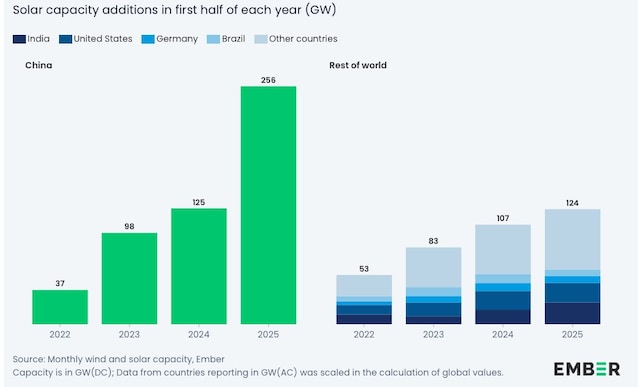
In the first six months of 2025, the number of solar panels installed globally grew by 64% compared to the same period of 2024: in practice, this means that global photovoltaic capacity has increased 380 GW. It is a constant growing trend in recent years: not surprisingly, even in 2024 global sun production has increased by 28% (i.e. 469 TWH more) compared to 2023, more than any other energy source.
There ChinaHowever, the global leader of this renewable energy is confirmed: in the first half of 2025, the installations of Chinese photovoltaic panels are more than doubled compared to the previous year. At the moment, the Asian power has about the 54% of all solar systems existing in the world.
Outside China, India are also growing (with 49% more solar panels than 2024), the USA (+4%), Germany and Brazil which, while remaining in the world top 5, recorded a small slowdown in the construction of photovoltaics.
Mexico is repopulating with jaguars
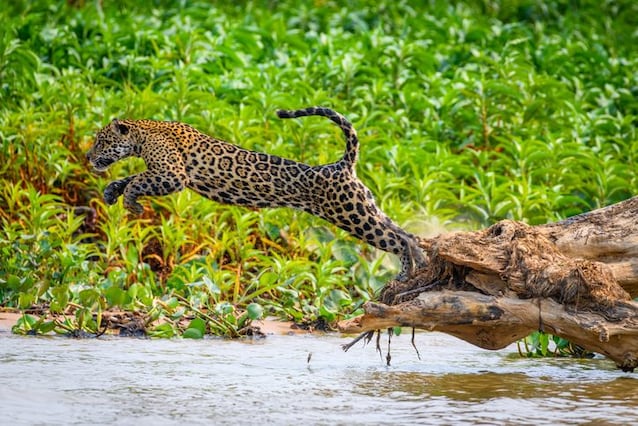
In Mexico, the population of jaguars has increased by about the 30% in 15 years. As reported by Nacional Para La Conservación del Jaguar (ANCJ), in 2024 the number of jaguars recorded in the country amounted to 5,326 specimens in freedom, with further growth of 11% compared to 4,800 of 2018.
It is an important fact, given that the jaguar, The greatest feline in America And a key species for its role as an apical predator, is still at risk of extinction: another 15 years of constant growth of the number of specimens will be needed (for a total of 30 years and about 8,000 in freedom) to be able to break down this risk.
The regions with the greatest number of jaguars are the peninsula of Yucatan (1,699) and that of Southern peaceful (1,541), followed by the north-east and the center of Mexico (813), the northern Pacific (733) and the Central Coast of the Pacific (540).
The increase over the past 15 years has been reached thanks to several campaigns of awareness aimed at the population, but the maintenance of protected natural areas and the greater repression against illegal trafficking of skin, claws and jaguar zanne have influenced.
The new Baeta material could help “capture” carbon dioxide
A team of researchers from the University of Copenhagen presented a new material, called Baetaobtained starting from plastic waste Pet (Polyethylene Tereftolato) and able to “capture” carbon dioxide. Specifically, compared to the traditional recycling method, this new process converts the PET into a dust, which chemically binds the CO₂ to 3,4 moles per kilograman efficiency that can be compared to existing technologies to capture carbon dioxide.
Baeta, which therefore has a dusty consistency, is able to maintain its effectiveness up to 150 ° C, which makes it ideal to be used even within the industrial plants. Once saturated, the Baeta material can be regenerated through a heating process during which he releases the caught Co₂, ready to be stored or reused in other ways. The authors of the study, among other things, underlined how this new compound is produced starting from the most difficult plastic to recycle, such as the colorful, degraded one or the one that pollutes the oceans.
