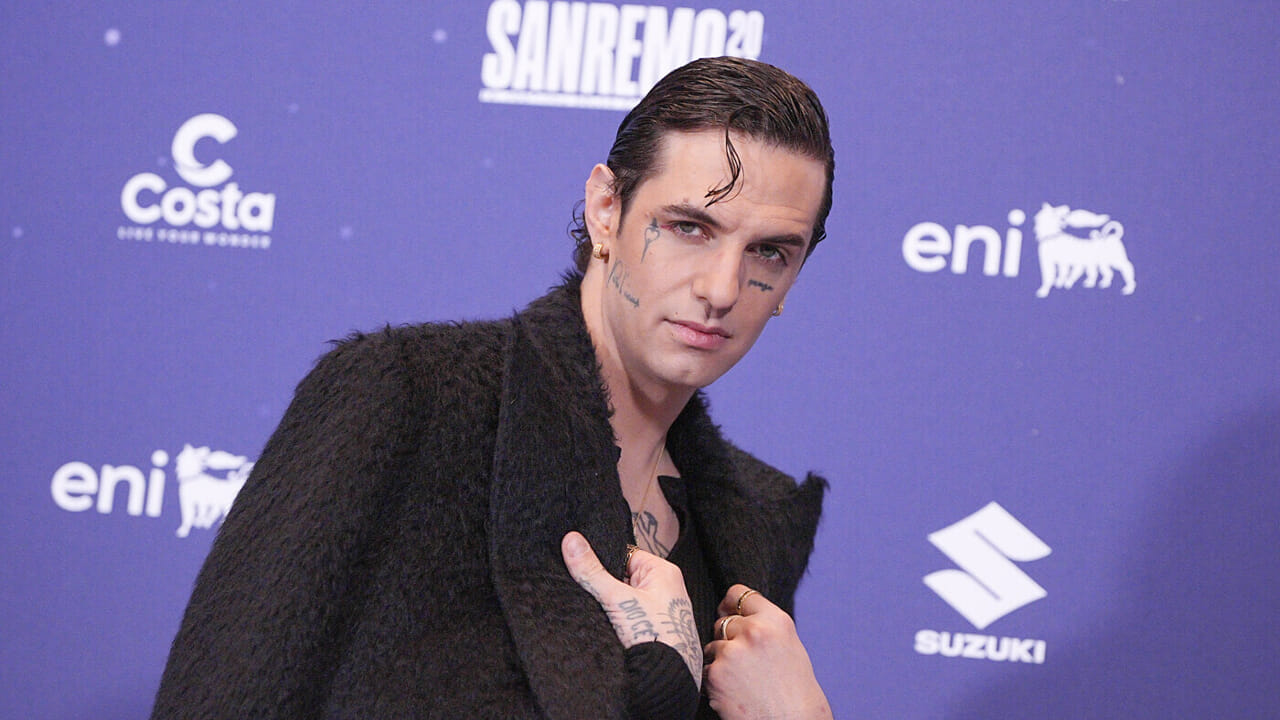
Everyone sings on March 16th. Achille Lauro, the last national-popular
The times when Achille Lauro was considered the Antichrist are definitely gone. At least from the most generalist and bigoted court in the country, of course: those viewers on the sofa who, once, branded him as an icon of profligacy, while today they look for him on the radio. The latest trend that exploded on TikTok in the weeks of Sanremo is enough to tell the story of the Roman singer-songwriter’s image reversal: it is entitled, precisely, to the irrepressible “passion of mothers for Achille Lauro”. And it certifies, in fact, what is to be considered the definitive transformation of the king of quick-change artists: from “controversial figure” to “national-popular heritage”.
If you haven’t heard “March 16th” today, maybe you live on Mars
In recent years Lauro has in fact become the only young singer-songwriter capable of succeeding in the most difficult undertaking of these times: entering the national-popular Olympus, precisely, making himself readable for everyone. In an era in which the musical imagination – and not just musical – is hyper-fragmented, and everyone lives in their own micro-public, Lauro De Mariniis, born in 1990, has managed to broaden a following born among his peers to the point of making it transversal by age; and above all to maintain it over time, maximizing the benefits of the generational bridge of Sanremo. We realize this today, Monday 16 March, while his “16 March” – among the best-known songs – now functions as a collective event: it plays on Spotify, the habitat of Gen Z; rages in the Instagram stories of Millennials; and it’s on the radio, home of Gen X. In short: if you haven’t heard it, you probably live on Mars.
This is why, when we say “national-popular” in the last ten years, in the end the only possible name is his alone. Of course, to tell the truth, there is another one: Ultimo. With the difference, however, that Ultimo is incredibly polarizing: either you love it or you hate it. Lauro, however, no. Or at least not anymore: it is now well received. And on all fronts: it is chosen by Motorola for advertising campaigns designed for twenty-year-olds; brings with it those thirty-year-olds for whom “Thoiry” was a generational and futurist manifesto; and, at the same time, reaches the ears of the public by signing – even! – the theme song of the ancient “Domenica In”. In short: it is completely, delightfully generalist, the likes of which we haven’t seen for a long time. The merit – perhaps he would say – lies first and foremost in the freedom with which he crossed musical genres without precluding anything, avoiding the flattening of labels. But it also involves a skilled job of positioning, made up of daring descents and ascents.
@edoardozaggia they still haven’t recovered from last night 😎✨ #Sanremo ♬ original audio – Edoardo Zaggia
From “trap” to Domenica In
Lauro, as a “polarizing figure”, had in fact begun his career; but then he stopped. Those were the times of the first Sanremo 2019, those in which “Striscia la notizia” criticized some lyrics in which he alluded to drugs and other excesses: the traditional neorealist “epic” of every young trapper, in short, from which, however, he would soon distance himself. And again: somewhat circumspect glances – where more conservative – accompanied the “era of Sanremo performances”, that explosion of histrionics in which lipsticks and gender fluidity, David Bowie and Giotto, culture and social messages mixed; a period of “controlled scandal”, perfect for Rai’s rainbow Sanremo of the time but not yet digested by everyone.
Yet, despite the debate between promoters and detractors, in the meantime Lauro became in fact the only artist capable of transforming, in the last decade, his Sanremo performances into a collective event of anticipation: just think of the iconic transparent playsuit of “Me ne frego”, inserted to all intents and purposes in the same register of Anna Oxa’s looks, which forced us to ask which header he would propose the following evening. And one thing, in short, seemed certain already at the time: this Lauro, who on stage fused music, evangelical verses and art history and, in interviews, cited Vasco Rossi and Kurt Cobain, Elvis Presley and Jimi Hendrix, showed the muscles of someone who knew a little more than the others: the personality of a phenomenon destined to last longer than a flash in the pan.
If Ultimo speaks to the least, Lauro speaks to mortal municipalities
Then, the maturation of his age and his music did the rest. And a “normalization” of his figure has also arrived. Love and hate, madness and reason are the common threads of the concerts today: themes of love and life, treated, in short, with a much more traditional style than before, but always mindful of the progressivism experienced in past years. In the last songs, between “serenades in Trastevere” and “love come rain sopra a Villa Borghese”, there is the romanticism of the most traditional pop, which however does not forget that model of new and vulnerable masculinity praised for years. And so, just as he seems from another era, Lauro remains a model of the contemporary: with face tattoos, he mixes the retro aesthetics of Gucci tailored suits. And it is precisely this mixture – the most classic feeling and the most angular imagery – that explains its current transversality.
In short, if Ultimo speaks to the least, today Lauro speaks to “Common mortals” (as per the title of his latest album) of various ages, including those over. And he reaches such a “generalism” that he becomes the perfect face of the McDonald’s commercial. And such that he can be an exceptional guest on the “senior” programs on Sunday afternoons (“Aunt Mara Venier’s” eyes shine when she invites him into the studio and they spend 24 minutes talking about their mothers). “The little angels Thun and Achille Lauro are my aunt’s starter pack,” jokes a girl on Twitter.
In his exuberance of genres and genres, Lauro sooner or later everyone likes
In short, the fact is that sooner or later everyone likes Lauro – or has liked it – in his exuberance of genres and genres. Sooner or later, it has met the tastes of most of us. Perhaps because, in these times of plastic music, his visceral need to range between styles – from the raw trap of his early days to pop rock sounds up to the broader melancholy ballads – comes as an honest need. Interviewed on TikTok, Riccardo Cocciante says of him: “I find his way of singing sincere.” And Lauro himself confirms of himself: “Between Rolls Royce and Amore despair the sound has changed, who I am, but the common thread is there and it is extreme freedom: I have always looked for originality. Even in the urban world I was seen by purists as an outsider, because I did as I pleased: I had made a piece with just piano and voice, which for them was madness…”. And so he has built a varied repertoire, capable of making it seem in focus both in a twist and in an institutional context such as the homage to the victims of Crans Montana, on the occasion of the last Sanremo (three months ago Erica Barosi, mother of Achille Barosi, had chosen “Perdutamente”, among her most beautiful songs, to greet her son’s coffin).
The double bond with TV
The point is then, obviously, also this: the double bond with television, the true accelerator of his transformation into a completely generalist figure. Even before Sanremo became his natural home (a career now stitched together at Ariston, his, with six participations in seven years), TV had already had a sniff of the character, involving him in a Rai edition of “Pechino Express”, in 2017. Then, in the last couple of years, his arrival at “X Factor”, which came at the right time: the one that put him permanently back at the center after a more opaque phase, around 2022. And in fact his strength today lies above all here: in having transformed the character into a controlled creative machine. So much so that in interviews he says he works in a crazy, maniacal, obsessive way, sleeping few hours a night. Because, even when it seemed like a enfant terribleLauro was actually already his own entrepreneur. And he has never liked the word “transgressive” – he repeats –: he prefers “artist”. All things considered, its strength.
