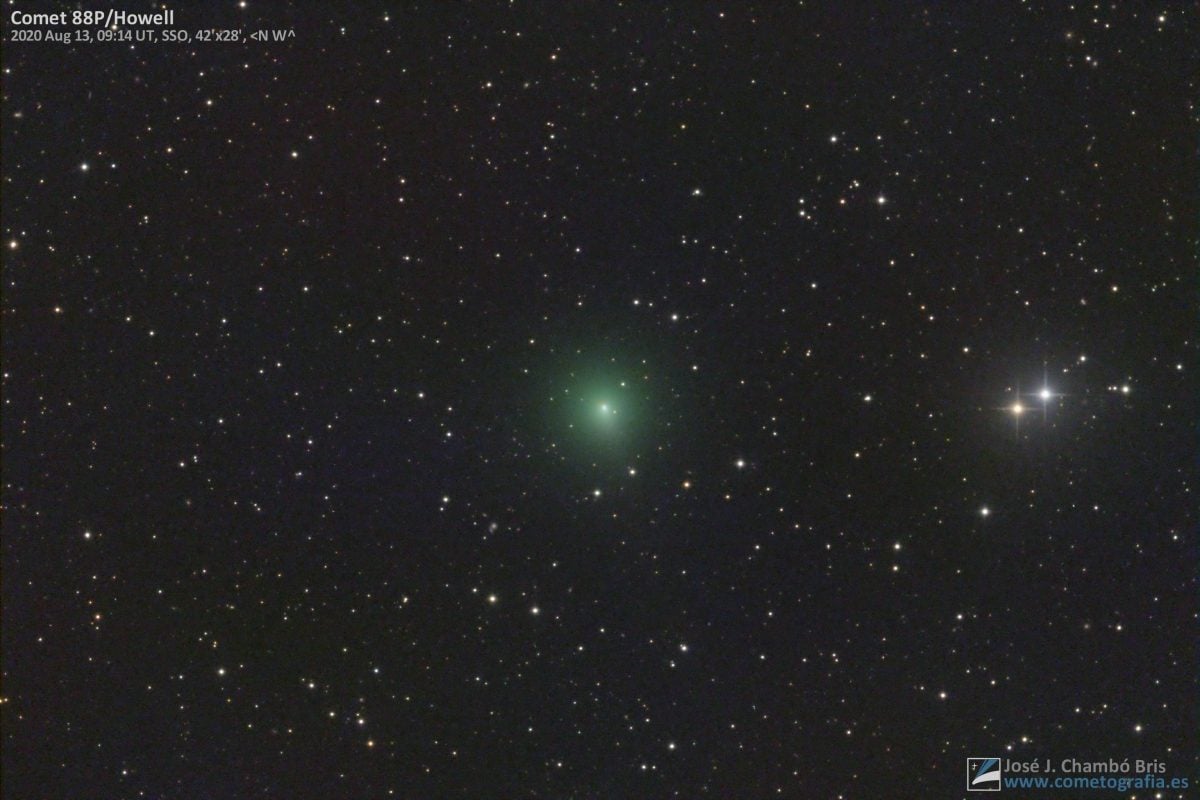
The March 18, 2026 the short-period comet 88P/Howell discovered in 1981 by Ellen Howell, it will reach perihelion, that is, the point of its orbit of maximum proximity to the Sun. At that moment, the comet will be about 1.36 astronomical units from the Sun and about 1.99 astronomical units from Earth (1 astronomical unit corresponds to approximately 150 million km), therefore in a region roughly between the orbits of Earth and Mars. The comet will be visible in the early hours of the morning, starting at 5 in the east/south-east direction. However, it will not be a sight visible to the naked eye because brightness estimates place it around magnitude 11, so you will need at least one small telescope to try to see it. There visibility window will be somewhat reduced from sunrise to 6.20am, so it will be necessary to go to places with a completely clear east/south-east horizon given the low height of the comet on the horizon.
Where, when and what time the comet can be observed
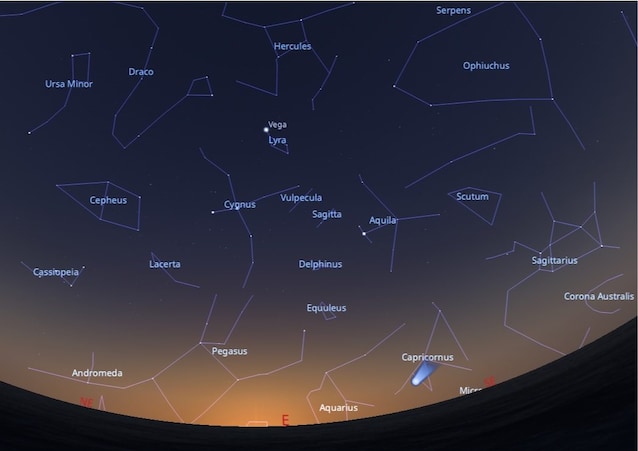
From Italy comet 88P/Howell will only be visible in the hours before sunriseVery low on the east/south-east horizon. The ephemeris places it in the constellation of Capricornwith raisedfrom the coordinates of Rome, around at 5 in the morning and a still modest height before dawn. The Sun in Rome on March 18th will rise shortly after 6:20therefore the useful window for observing the comet will be short and penalized by the growing light of the sky. To be able to observe it, it will therefore be better to go to a place with a perfectly clear east/south-east horizonvery little light pollution and a small telescope, as the comet will shine with magnitude equal to 11therefore not visible to the naked eye. The main difficulty will not only be its weak brightness, but also its small solar elongationthat is, the apparent distance from the Sun in the sky, of approx 38° in the days of perihelion. This means that the comet will remain immersed in the morning twilight and will never rise high enough to be comfortable to observe from the Northern Hemisphere.
The characteristics of 88P/Howell
Comet 88P/Howell belongs to the Comet family short-period comets. Discovery the August 29, 1981 by the astronomer Ellen Howell with the 46 cm Schmidt telescope from Palomar Observatory, the comet completes one orbit around the Sun in approximately 5.5 years and its nucleus has an estimated average size of approx 4.4 kilometers. A relatively close encounter with Jupiter in 1978 it changed its orbit, making it the one we observe today. Its relatively short orbital period means that the comet returns to our area at different orbital configurations of Earth and Mars. For example, in 2031 the comet will pass alone 11 million km from Marswhile in 2042 alone 114 million km from Earth.
Due to its orbital characteristics, 88P/Howell falls into the type of periodic comets that astronomers associate with the population of small icy bodies coming from Kuiper Beltthe vast ring of icy objects beyond Neptune that powers many of the Solar System’s short-period comets. When we observe it, therefore, we are actually looking at an icy remnant of the formation of the Solar System, born in the outer regions and then progressively pushed inward by the gravitational perturbations of the giant planets.
