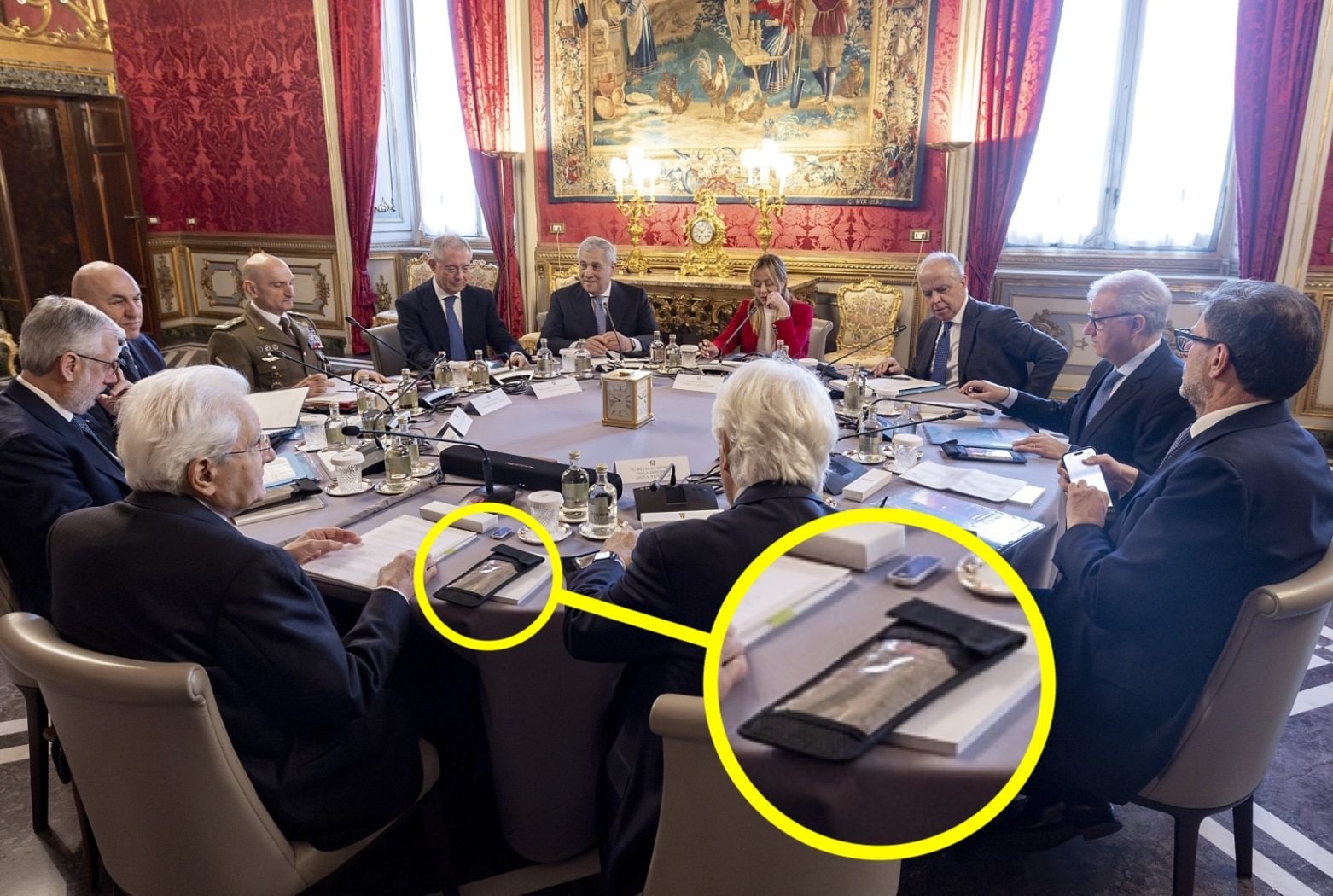
Looking at some photographs released after a meeting of Italian Supreme Defense Council (like the one at the beginning) an interesting detail catches the eye: next to the work documents and official dossiers, the participants place their smartphones inside small dark cases. Those are actually not simple cases, but real safety devices, called Faraday bag. These containers use a mesh of fine metal wires with microscopic mesh that blocks radio and electromagnetic signals. They are devices that serve to completely isolate telephones from any radio communication. Once inserted inside the shielding bag, the smartphone loses all connections with the outside world: it can no longer connect to the cellular network, it does not detect Wi-Fi, it does not establish Bluetooth connections and it does not receive signals from satellite tracking systems, such as GPS. When inside the case the device enters a condition of electromagnetic isolation.
The practice of using similar tools is now common in institutional and military meetings and where, more generally, national security is involved, where the confidentiality of conversations is fundamental. Modern smartphones are in effect small, highly connected portable computers: they integrate radio antennas, microphones, cameras and various sensors which, if compromised by a cyber attack, could theoretically collect information and send data externally. Placing the device in a Faraday bag is therefore a simple but effective solution to physically interrupt all wireless communication. Behind this measure there is a very precise physical principle, developed already in the nineteenth century, which today continues to find applications in communications security.
The functioning of Faraday bags derives from the so-called “Faraday cage”, a concept in physics named after the British scientist Michael Faraday. This term indicates a casing made with conductive materials – for example copper, nickel or silver textures – capable of block electromagnetic fields. An electromagnetic field is a region of space in which electric and magnetic forces act; the radio waves used by cell phones, Wi-Fi or Bluetooth are just one form of electromagnetic radiation. When an electronic device is enclosed in a closed conductive structure, the electrical charges are distributed on the external surface of the casing and prevent electromagnetic fields from penetrating inside. The result is that the device can no longer send or receive radio signals. Even if the phone remains turned on, from a communications perspective it becomes invisible to networks.
This feature is especially important when we consider how modern smartphones work. In addition to the cellular network, these devices integrate various communication systems: Wi-Fi, to connect to the Internet through local networks; Bluetooth, to communicate with accessories and other devices and satellite positioning systems, which allow geolocation. Added to these elements are microphones, cameras and a large amount of stored data. In a context where sensitive information is discussed, a smartphone can represent a possible security flaw. Turning off the phone is not always considered sufficient, because modern devices are complex systems composed of various hardware subsystems that can remain partially powered even when the screen is turned off. In advanced security scenarios, for example in government or military environments, it is therefore preferable to physically interrupt any possibility of radio communication.
The principle became known to the general public in 2013after the revelations of the former consultant of NSA (National Security Agency), Edward Snowden. On several occasions the famous whistleblower he said that, to avoid eavesdropping via potentially compromised smartphones, the phones were physically isolated during some sensitive conversations. Among the solutions cited even appeared the use of domestic metal containers, such as refrigerators and microwaves, which can function as “improvised” Faraday cages.
The Faraday bags used today are made with multiple layers of conductive materials and technical fabrics designed to shield a broad spectrum of wireless frequencies, from mobile phone bands up to the higher frequencies used by recent technologies. The quality of the materials and the precision of the stitching are crucial factors, because even small openings can allow radio waves to pass through. If a crack is comparable in size to the signal wavelength, isolation may be compromised. For this reason, the cases used in institutional or investigative contexts are designed to guarantee uniform shielding and tested to verify the effective attenuation of the signal.
In addition to government environments, these cases also find application in other contexts. Law enforcement, for example, uses them in the sector forensic when they seize electronic devices to conduct investigations. Placing a smartphone in a Faraday bag prevents the device from being modified or wiped remotely, preserving the integrity of data that could become evidence in an investigation. Another application concerns the protection of electronic car keys equipped with keyless opening systems. These keys communicate with the vehicle via radio frequencies, and in some cases, cybercriminals can try to copy the signal to open the car. Storing the key in a small shielding bag prevents the signal from traveling outside.
