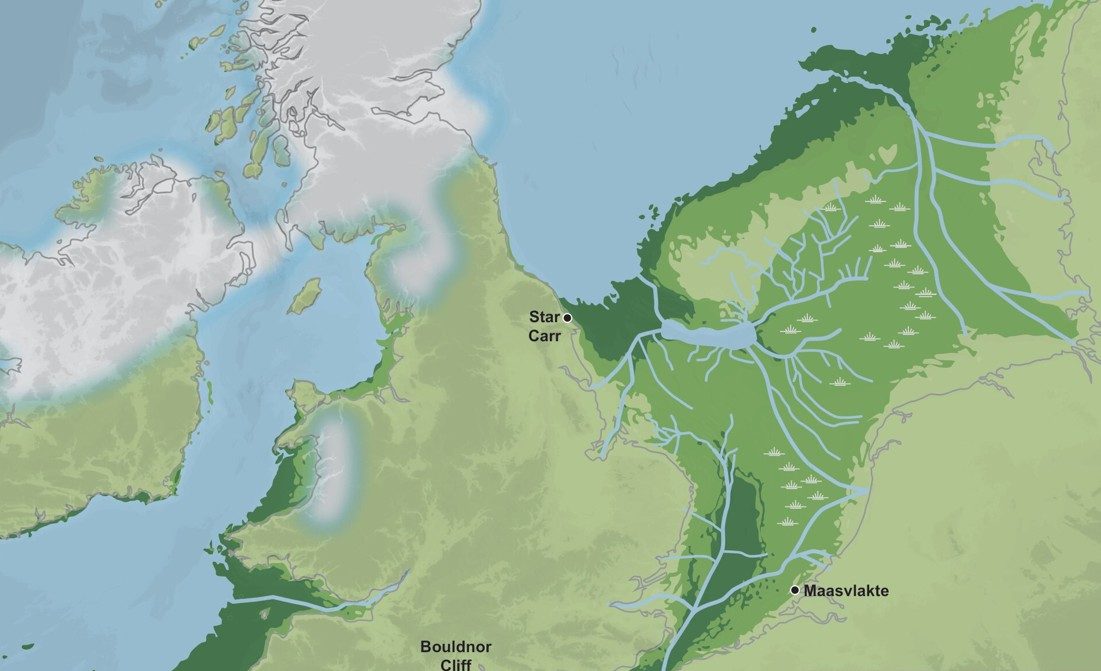
The land bridge known as Doggerlandwhich linked England to Germany and Denmark during thelast ice ageit was covered by forests when much of the northern hemisphere was instead occupied by ice. A new study from the University of Warwick, published in the journal Proceedings of the National Academy of Sciencesreveals what these forests were already present 16,000 years agoa few thousand years before the last ice age ended, while until now it was believed they appeared much later. Doggerland constituted an important refuge for many organisms plants and animals, including man, and some of its territories survived up to 7000 years ago, before being submerged by the North Sea.
The new study on the Doggerland land bridge in the North Sea
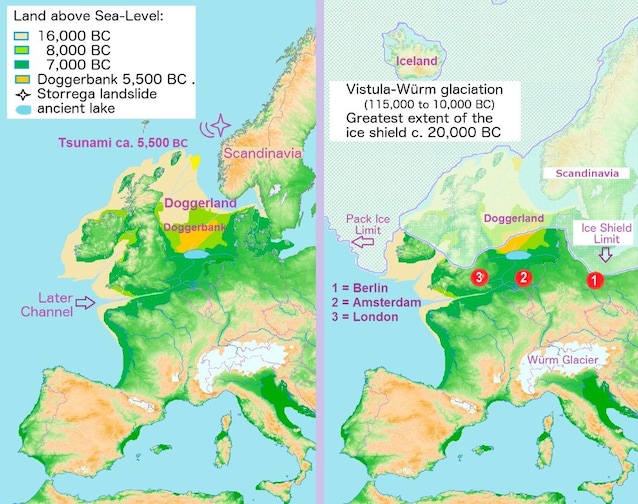
During the last ice age, which began 110,000 years ago and ended 12,000 years ago, an ice sheet approximately 3 km thick covered much of the Northern Hemisphere. The ice also occupied Iceland, Scandinavia, Ireland and Great Britain, up to the border between Scotland and England. Since these trapped huge amounts of water, the sea level was much lower than today, by as much as 120 m. As a result, some now submerged territories had emerged. Where the North Sea is now, in particular, there was a strip of emerged land known as Doggerland (named after a medieval Dutch fishing boat called a “dogger”).
Researchers have long known that this territory was covered by forests, but they didn’t know the exact age of their appearance. Now we know they existed already 16,000 years agowhile until now it was believed that at that time Doggerland still contained tundra, an arid and treeless plain. The discovery was possible by analyzing the so-called Sedimentary DNAthat is, that preserved in the sediments, of ben 252 samples extracted from 41 cores taken from the bottom of the North Sea off the coast of England. The samples reveal the presence in Doggerland of aenormous biodiversity. Traces of plants typical of a temperate climatesuch as oaks, elms, hazel and lime trees, in addition to Pterocaryaa walnut tree believed to have disappeared from the region 400,000 years ago.
Among the animals that inhabited these forests were wild boars, deer and bears. In short, Doggerland was a real refuge from the ice for many plant and animal organisms. The results of the analyzes also show that some territories of Doggerland survived large floods, such as that caused by the Storegga submarine landslide which generated a tsunami around 8000 years ago, remaining emerged up to about 7000 years ago.
Because the discovery on this submerged land is important
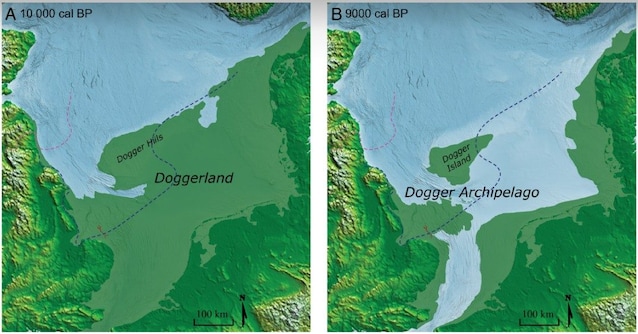
The discovery solves the so-called “Reid’s paradox“, that is, why European forests expanded so rapidly in Great Britain and the rest of northern Europe with the end of the last ice age and the retreat of the ice that accompanied it. The study also shows that Doggerland was not suddenly submerged by water, but disappeared gradually, becoming a archipelago of islands. Furthermore, the presence of forested habitats populated by many animals in Doggerland indicates that this territory could offer important resources for humans. It is therefore believed that here they are refugee prehistoric communities who then settled in the rest of northern Europe, of which numerous tools have also been found in the area.
