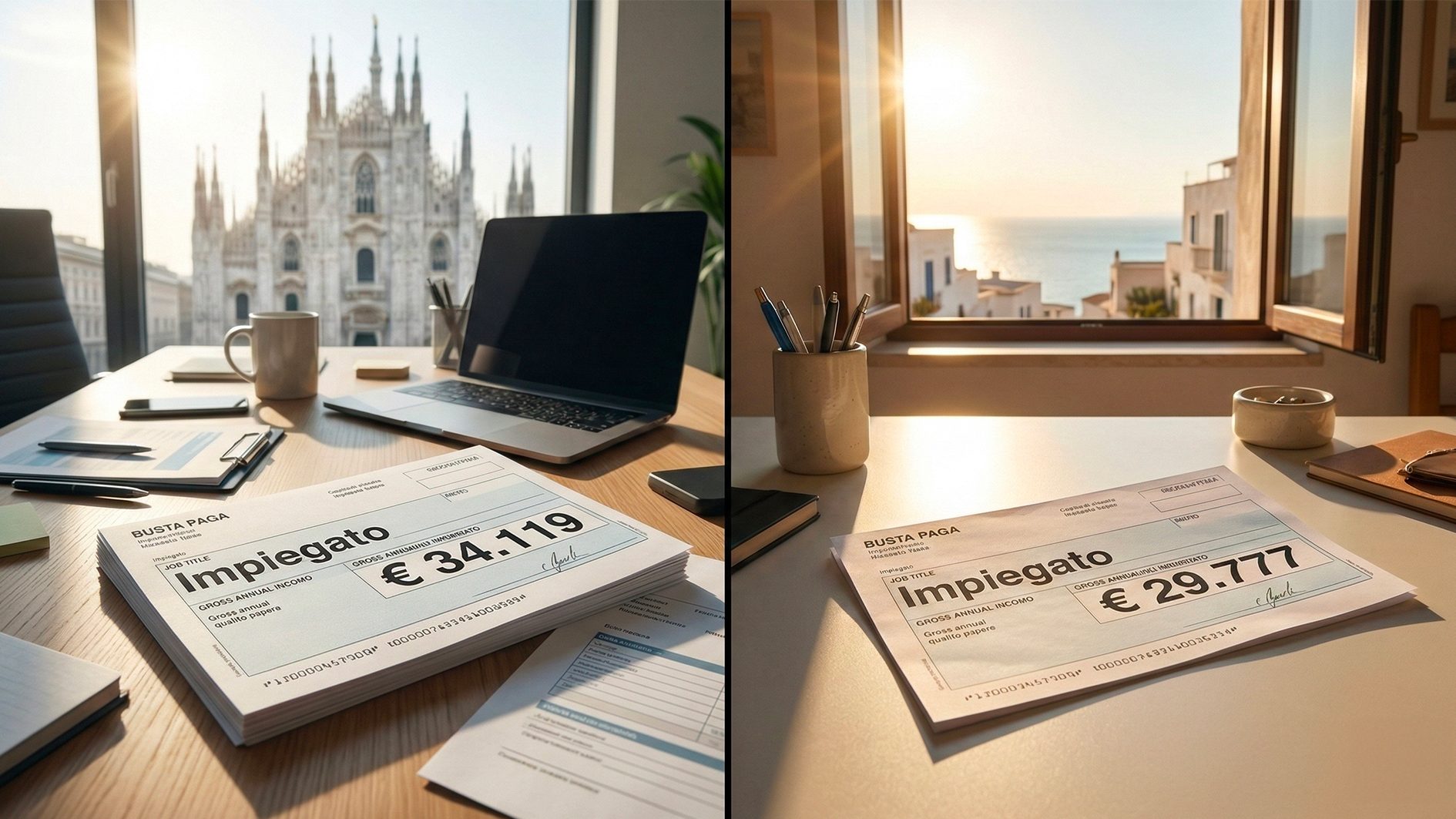
Who works at Milan and who works at Reggio Calabria is part of the same labor market, pays the same taxes and is covered by the same national collective agreement. Yet their paychecks, on average, are nothing alike. According to the JP Salary Outlook 2026 of the JobPricing Observatory – the main analysis of Italian wages, updated every six months on a representative sample of private sector employees – the average wage in the Northern regions exceeds that of the South and the Islands by almost 4,400 euros gross per yearwith a gap of about 15%. A number that has been dragging on for decades, which policies have never really eliminated, and which hides even more marked differences if you look at the top roles.
What is the average salary in Italy
In 2025, the National average gross annual salary is 32,991 eurosup 3.6% compared to the previous year. A positive sign, especially if we consider that inflation in the same period stood at 1.5%: for most categories it is therefore a real recovery of purchasing power. But the average figure alone says little. Photography changes radically depending on of the contractual framework: a manager earns on average 106,556 euros gross per year, a worker 27,909. The difference is almost four times.
What makes the picture even clearer is the distribution of wages. The 75% of Italian employees receives one gross annual salary of less than 35,000 euros; only one in ten exceeds 40,000. Essentially, the national average is pulled up by one limited share of high-paid workerswhile the vast majority are well below. It is in this context that the territorial gap acquires all its weight: when the medium-low ranges are already compressed, even a few hundred euros less make the difference.
Where you earn the most and the least in Italy: the map
The average salary increases as you go up the peninsula. Al North stands at a RAL of 34,119 euros annual average; al Center 32,746; al South and in the Islands 29,777. The Center is positioned closer to the North than to the South, but it is the distance between the two extremes of the peninsula that reveals the deepest fracture.
Going down to the regional level, Lombardy, Lazio And Liguria permanently occupy the top positions. Lombardy leads the ranking with an average RAL of 35,137 euros; Lazio is getting closer thanks to the weight of the capital’s salaries. At the other end of the list are Basilicata (27,340 euros), Calabria and Molise. None of the regions at the bottom of the ranking are located in the Centre-North.
However, the gap is not distributed uniformly between the different categories of workers. Among them workers the North-South difference is 4.7%, relatively limited. Between the paintings rises to 10.1%. And it is among the managers that the most interesting distinction emerges: the gap on the fixed part (RAL) stops at 5.8%, but if variable remuneration (RGA) is included the gap grows significantly, because the bonuses and incentives of managers in the North are structurally higher.
Why the gap between North and South remains so deep
There are four factors that Salary Outlook identifies at the root of the divide, and none of them are new.
- The first is the entrepreneurial fabric: in the North it is easier to access credit, invest in sectors with a high technological content and structure larger companies. Larger and more solid companies pay higher wages on average.
- The second factor is the participation in the labor market: in the southern regions unemployment is structurally higher, which reduces the bargaining power of workers, who may be more willing to accept lower wages in order to avoid periods of inactivity. This is also affected by female participation in the labor market, which is historically lower in the South.
- The third element is that of contractual violations: in the South there is a greater spread of wages below the minimum scales envisaged by national collective agreements, together with forms of irregular bargaining and a lower presence of trade union representation. It is not a marginal phenomenon: it directly affects the average RAL recorded.
- The fourth factor is the cost of livingwhich is generally higher in the North – just think of the real estate market in Milan – which pushes companies to pay nominally higher wages to maintain workers’ purchasing power.
Looking at the trends, one element emerges: in the long term, between 2015 and 2025, it is the Southern regions that have recorded the most significant salary growth (+17.3% compared to +14% in the North). It is the so-called catching-up effect: those who start from less tend to grow faster in percentage terms. But in the last year the dynamic has reversed: the North led the recovery with an increase of 3.7%, against +1.4% in the South and the Islands. In short, the convergence phenomenon seems to have partially reduced. The absolute gap – almost 4,400 euros in annual RAL – remains and that gap has never really closed.
