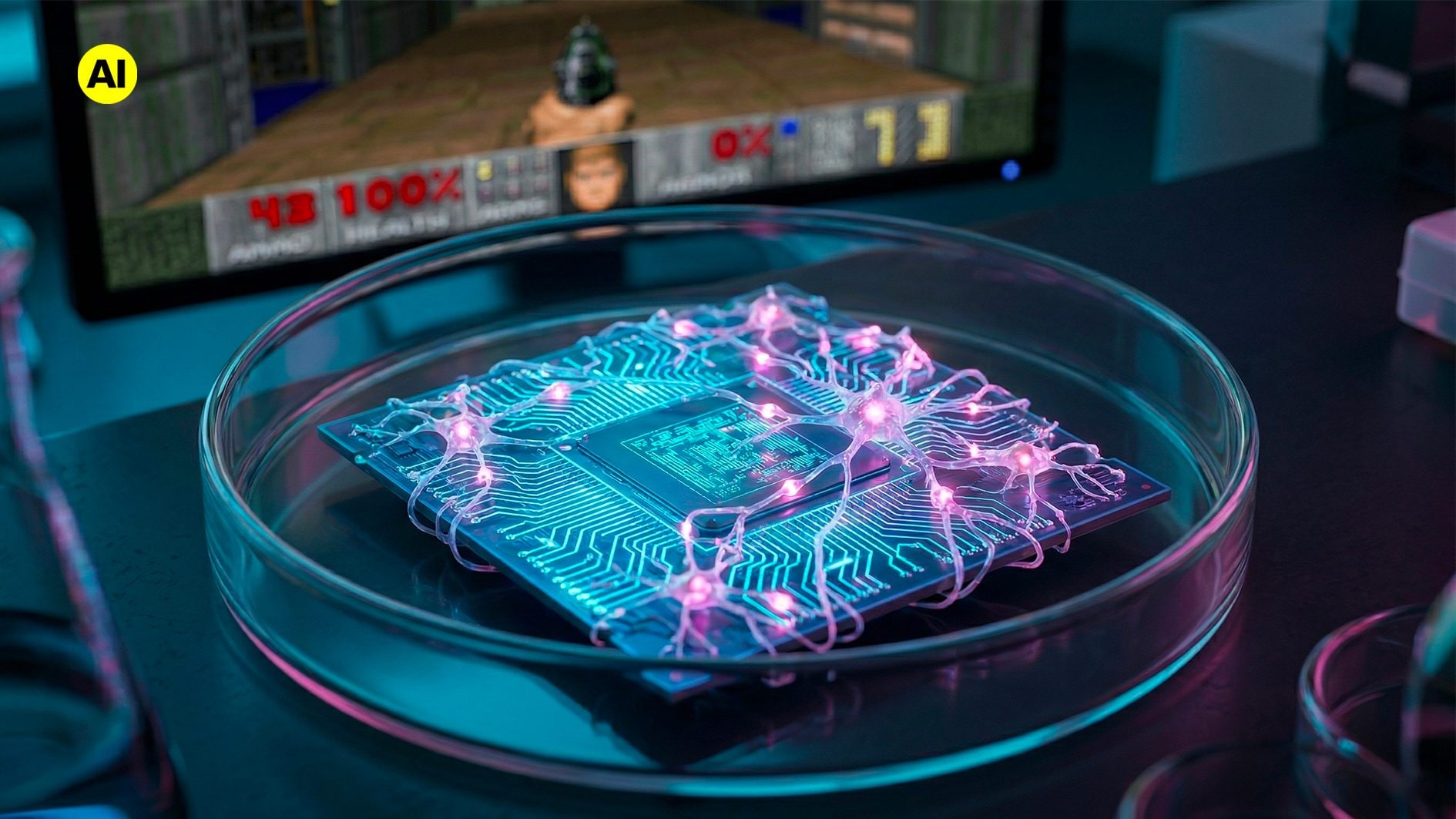
In Australia there is a laboratory that is being built computer controlled by networks of neurons in a test tubeor rather on a microchip. In short, the opposite of what we have become accustomed to seeing in recent years, in which electronics and information technology allow us to integrate and enhance the human body with robotic limbs increasingly sophisticated prosthetics and microchip capable of supporting vital functions (such as pacemakers and neurostimulators),
Already in 2022, with a study published in NeuronAustralian researchers from Cortical Labs they had attracted attention by “teaching” a network of neurons on a sophisticated microchip to interact with a virtual environment e play Pong (a simple simulation of ping pong). In March 2026the group is back in the news by publishing a video in which it shows CL1a “biological computer”driven by approximately 200,000 neurons, as it interacts with the most complex environment of Dooma first-person shooter video game. The results and experimental details they have not yet been published or peer-reviewedso we should wait a little longer to understand how this second experiment took place, which seems to come straight from a science fiction film.
The first Dishbrain “gamer neurons” in 2022
In 2022 a small laboratory in Melbourne (Australia), called Cortical Labsintrigued the world with a video on Youtube. For many, the video images will not seem like anything special. On the other hand, it is a trivial matter Pong gamethe well-known table tennis simulator from the seventies. Yet, the one shown is not a match like all the others. Or rather, to play he is not just any playerbut it is a DishBrain: a sophisticate microchip “colonized” by a network of approximately 800,000 neurons (human and mouse) in culture.
But how can neurons, outside the complexity of a brain intact, learn to play Pong? In the study, published by Australian researchers in the well-known journal Neuron, the Australian researchers taught the neurons of the DishBrain to “see”, despite not being equipped with eyes, converting into electrical signals (the “language” of neurons) the only two essential pieces of information for playing Pong: the position of the ball and the distance compared to the racket.
How is a neuron microchip made?
To understand well how it works a DishBrain, let’s look at the image below, taken from the Australian study.
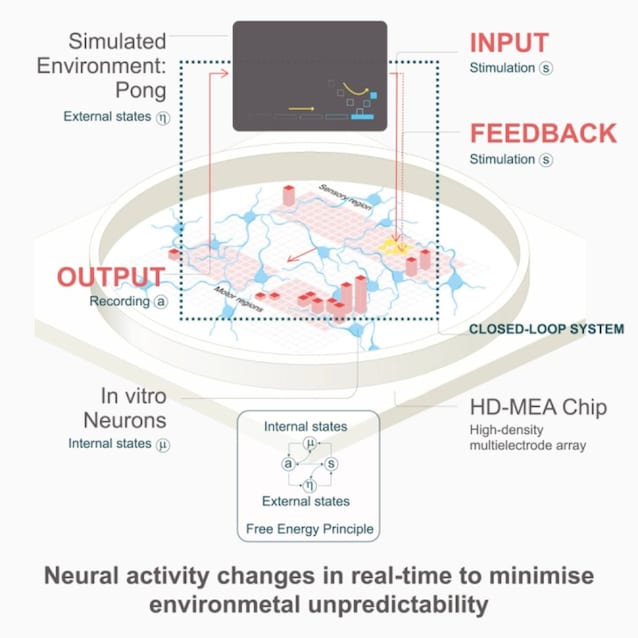
On the microchip Where neurons grow we can distinguish two areas:
- A sensor regionwhich sends electrical signals to neurons at points on the chip corresponding to the virtual tennis court. In practice, if the ball on the screen moves upwards, the neurons in the upper part of the microchip receive a shock, with a higher frequency as the ball approaches the racket. In this way, neurons can literally “see” the ball.
- A motor regionThat records the electrical signals released by neurons and converts them into racket movement. Simply put, if the neurons at the bottom of the microchip send an electric shock, the cursor moves downward.
Neurons must be “trained”
Yet, as science fiction as it is, this system alone is not enough. The neurons, in fact, move during the first games completely randomlya bit like a child learning to take his first steps. But giving them precise ones feedback signals when they hit or miss the ball (electrical impulses with specific characteristics), the neurons they learn to playmodifying the patterns of electrical activity in just a few minutes so as to make fewer and fewer errors, increasing theirs game after game personal “record”.
Be careful though: imagine that those neurons are thinking or acting according to a specific will would be a mistake. In fact, as they “learn to play”, the DishBrain’s “gamer neurons” do they self-organize in increasingly functional circuits. This is a mechanism similar to what happens when we learn something, but in this case not inside a brain, but on a microchip, giving a demonstration of the incredible plasticity of nerve cells: the ability to shape the structure of their connections in response to experiences.
Now gamer neurons play DOOM
See a computer controlled by neurons playing Pong is undoubtedly a great bio-technological achievement. Yet, the web audience is hardly surprised and is known for its extravagant requests. Thus, the video published by Australian researchers on “gamer neurons” was quickly flooded with a myriad of comments, almost all with the same question: “can you play Doom?”.
For those who aren’t into retrogaming, Doom is a famous first-person shooter in which the gamer takes on the role of a space marine on a mission to Mars to stop an invasion of demons and zombies. The game exploded in the 1990s, when gamers gathered in arcades around the world to explore its three-dimensional worldmade up of traps and enemies to shoot at every corner. In short, a game dynamic and definitely interaction more complex compared to simple Pong.
Cortical Labs’ response to the web challenge was immediate: challenge accepted. So, in March 2026, the Australian company published a new video showing CL1: the first biological computerled by a network of approx 200,000 neuronscapable of explore the world of DOOM and shoot enemies. Of course, as admitted by the company itself, the CL1s are not yet professionals (as they would say in gaming jargon: they are not “pro players”), and they play a bit like novice children. But if you consider that the character is controlled by one network of neurons which receive and send electrical signals through a tiny microchip, the undertaking is undoubtedly fascinating. And above all, similar to a human being or an AI, the more they play, the more they improve. In short, they learn.
The experimental details have not yet been published anywhere peer-reviewed paperbut it is plausible that the system uses principles similar to those already used for Pong, integrated with more advanced algorithms and a better one interaction between computers and neurons.
A challenge for the future
The company’s stated objective is to develop machines driven by synthetic biological intelligences increasingly sophisticated, which could be used to study the response of neurons to drugs or diseases, investigate the biological mechanisms underlying intelligence and even create new forms of “intelligence” that are more efficient, flexible and sustainable than current AI. All by exploiting the most surprising and characteristic properties of nerve cells: the ability to “feel” the surrounding environment and reorganize adapting to it.
