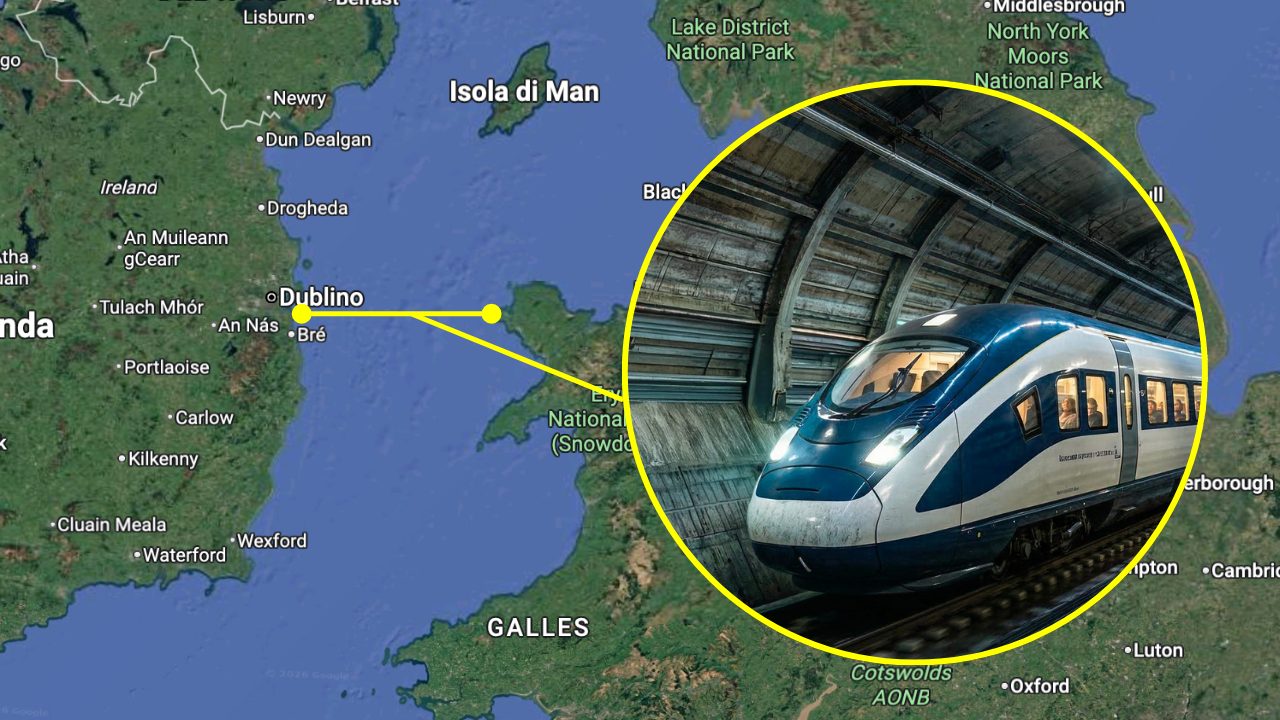
Imagine being able to pass by Great Britain toIreland in less than 30 minutesby car or train. This is an unprecedented environmental, engineering and political challenge: the one that connects the Dublin area to Wales (near Holyhead) is historically known as the Irish Mail Routefollowing the path followed for centuries by postal services. It is precisely there that, for years now, there has been a desire to build an underwater tunnel, although there is not yet a definitive project on the matter.
Description of the project and engineering challenges
To understand the scope of such a project we must analyze it first of all from a technical and engineering point of view. The submarine project on the Dublin-Holyhead route would stand out for impressive numbers, considering that it is a tunnel whose length could vary between 87 and 100 km, effectively doubling (or almost) the tunnel in the English Channel which barely measures 50km.
Another impressive figure is that relating to costs: well 251 billion euros. This sum would cover not only the construction of the tunnel strictly speaking, but also the construction of a high-speed railway line which will therefore be housed in the tunnel. The objective is to allow the stretch to be traveled and therefore to effectively connect Ireland and Great Britain less than 45 minutes travel, whether by car or train.
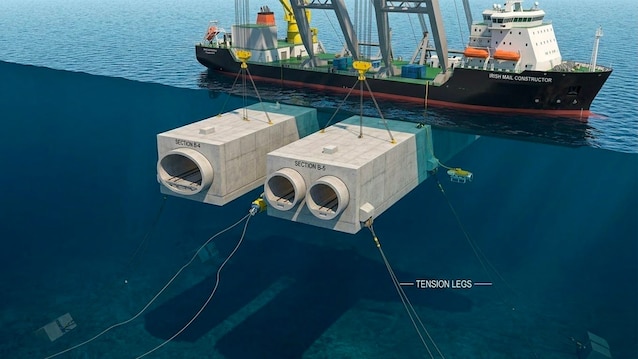
The project involves the construction of two main railway tunnels, and a smaller one located in the center for technical and maintenance needs. And here comes the first major engineering challenge that designers will have to solve. The Irish Sea has notable depressions, and certainly greater depths than the English Channel. It will therefore be necessary for designers to evaluate whether to proceed with the use of TBM therefore digging the rock and earth on the seabed or where it is deemed necessary or using the technology of pre-assembled and then subsequently immersed modules. This last choice certainly appears to be the most complex, considering the great depths of the sea in the area and the strong maritime currents that exist there. The use of TBMs also presents a great application difficulty, as the area is characterized by a varied set of rock formations, which often make the use of this technology not exactly simple.
However, it must be said that, given the great difficulty from the point of view of the engineering challenges, as well as the exorbitant costs and timescales (there is even talk of 30 years), the construction of the tunnel currently remains an idea that future Irish and British governments might be able to realise.
The economic and political impact
Such an important work, and certainly enormous from a strictly engineering point of view, cannot fail to have an impact also from a political and economic point of view. In particular, the union of the British and Irish markets with an infrastructure connection of this type would allow companies in both states to begin to act as a single large production district.
Currently, in fact, Ireland suffers from what, rightly, can be defined as a true post-Brexit geographical isolation. A direct tunnel would allow a constant flow of goods, eliminating weather and sea uncertainties and drastically reducing inventory costs for pharmaceutical and tech companies (pillars of the Irish economy in 2026).
It should also be considered that the construction of a tunnel of this level would also allow the creation of approximately 35,000 jobs, including engineers, logistics workers and workers on construction sites.
Environmental benefits
Furthermore, a whole series of great advantages that would also be achieved at an environmental level should be considered. The construction of the tunnel, in fact, would reduce the need to connect the two islands with flights which, in the area, are one of the main causes of CO2. Transit would be replaced by a rail network with dramatically lower emissions.
Furthermore, the tunnel could also be built with a view to making it become a “Green Hub”, an infrastructure capable, on its own, of hosting further infrastructures and elements for generating clean energy.
