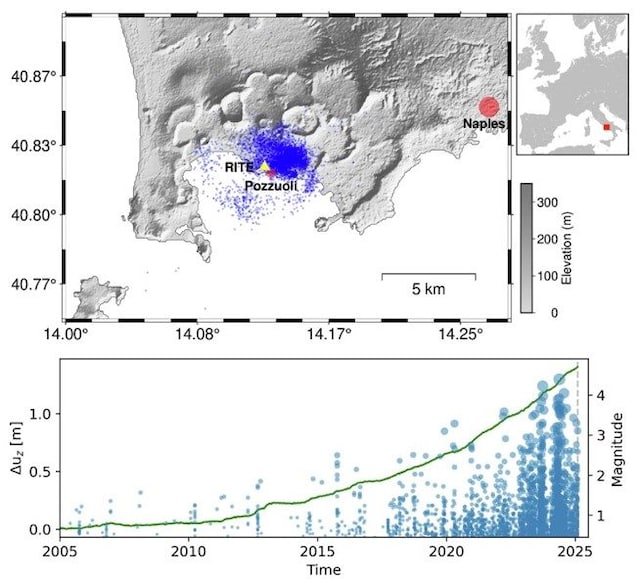
The researchers managed to develop a model that reproduces theseismicity trend at the Caldera of the Campi Flegrei in the pastregarding both earthquakes with a magnitude greater than 3 that have occurred from 1960 to today and the weaker ones that have occurred since 2005. The model is also able to provide probabilistic forecasts on the frequency of earthquakes and the maximum expected magnitude on a time scale ranging from weeks to months. The new study, published in the journal Communications Earth and Environmentis the work of researchers from the Helmholtz Center for Geosciences of the GFZ in Potsdam, Germany, and the National Institute of Geophysics and Volcanology (INGV).
The combination of two models to interpret the seismicity of the Campi Flegrei
The researchers managed to explain the non-linear relationship between earthquakes and uplift, which can be justified by the friction behavior and rock fracturing that emerges from laboratory experiments. This behavior is described by RS model (Rate-and-State model), which concerns the trend of long-term seismicityrelated to uplift and explainable by the accumulation of stress in rocks. The seismic swarms observed in a short period of time they are instead linked to the interaction between individual earthquakes and episodic intrusions of fluids into the subsoil. The ETAS model (Epidemic Type Aftershock Sequence), for the statistical description of how earthquakes interact to generate other earthquakes. The new study has the merit of combining the two models in a single model capable of reproducing both the trend of earthquakes with magnitude greater than 3 since 1960 and the weaker ones with magnitude less than 0.5 which have occurred since 2005. Tests based on historical data have then demonstrated that this hybrid model allows us to develop probabilistic forecasts of seismicity rates and maximum expected magnitude on a time scale ranging from weeks to months.
“This hybrid modeling approach therefore represents a promising tool to improve seismic risk assessment in Campi Flegrei and, potentially, also in other volcanic systems,”
says study author Sebastian Hainzl.
The characteristics of seismicity at Campi Flegrei
Since 2005, the Campi Flegrei caldera has undergone a lifting more than one and a half metresaccompanied by a strong increase in shallow earthquakes. The uplift and associated seismicity are attributed not to the upwelling of magma, but toincrease in gas pressure about 3-4 km deep. Seismicity in the area also manifests itself in the form of swarms of earthquakesa concentration of shocks of similar and moderate intensity typical of many volcanic regions, rather than seismic sequences characterized by a main shock with less strong aftershocks. Analyzing seismic catalogs and altimetric measurements relating to the deformation of the ground at the Campi Flegrei since 1905, researchers have also identified another characteristic of these earthquakes: their frequency did not simply increase proportionally with respect to the speed with which the ground rose. There is instead a non-linear relationship, characterized by an increasing ratio between the seismic rate and the uplift rate, with theever-accelerating seismic activity.