
Eye contact is often considered a universal behaviorassociated with sincerity, Attention And participation. However, social sciences show how gaze be one culturally regulated practicea, whose meaning varies depending on the historical, social and symbolic contexts.
In fact, in some cultures, keeping your gaze can indicate openness and reliability, in others, it can be perceived as invasive, aggressive or respectful.
Eye contact as a cultural construction
There sociology of interaction demonstrated how gaze be part of a complex system of non-verbal signals that organize social life. In particular, the sociologist Erving Goffman highlighted how the daily interactions are regulated by implicit rules which define what is appropriate to display in public and what needs to be controlled.
In this sense, eye contact is one of the major ones practices of “presentation and exposure of the self”through which individuals manage their social image and regulate the degree of involvement in interaction.
Cross-cultural psychology studies demonstrate, even more so, that the duration and intensity of the gaze vary significantly between different populations and are learned from childhood.
What is interpreted in some societies as a sign of attention may be perceived elsewhere as a excessively direct or intrusive behavior.
Regulation of the gaze in power relations
A recurring element in the scientific literature concerns the relationship between eye contact and power structures.
In contexts characterized by high hierarchical distanceas highlighted by the studies of Geert Hofstedenonverbal behavior tends to reflect the respect for authority and social order.
In various companiesEast Asiafor example, lo direct gaze towards a superior can be perceived as a signal of opposition or lack of deference.
Similarly, in some communities in theSub-Saharan Africachildren are taught to do not look adults directly in the eyesas such behavior could be interpreted as a form of challenge.
Differences between individualistic and collectivist cultures
There cultural psychology highlighted a possible division between the so-called companies “individualistic” and those “collectivists”which differ due to the different attribution of meanings to the individual.
Researchers like Hazel Markus And Shinobu Kitayama have shown that, in individualistic cultures, personal identity is often conceived as autonomous and distinct from the group. In such contexts, direct gaze can be interpreted as sign of authenticity, safety And transparency.
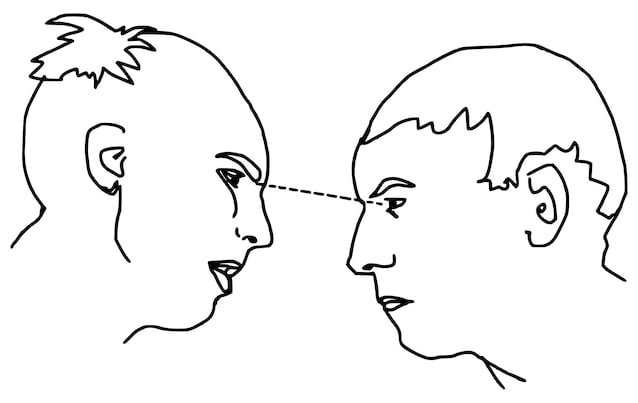
In collectivist cultureshowever, the identity is more defined in relation to the social context and the expectations of the group. In these cases, prolonged eye contact can be perceived as a overly assertive behaviorso long as emphasizes individuality to the detriment of relational harmony.
Among the societies generally considered individualistic are United States, Canada, United Kingdom, Netherlands, Australia and Germanywhere personal autonomy and the direct expression of opinions are strongly valued.
Among the societies often described as collectivist are instead Japan, China, South Korea, Vietnam, Indonesia and many countriesSub-Saharan Africa and of theLatin Americain which group harmony, respect for social roles and indirect communication tend to be priorities.
Implications for intercultural communication
There cultural variability of eye contact, between individualistic or more collectivist societies, has implications significant in areas such as education, international cooperation, diplomacy and multicultural working contexts.
Misunderstandings related to gaze can influence the perception of reliability, competence or interest, contributing to formation of stereotypes or implicit biases.
Studies of intercultural pragmatics highlight how professionals who operate in international contexts must, for these reasons, develop observation and adaptation skills For interpret correctly and reproduce in turn the non-verbal signals.
There awareness of cultural differences it allows us to avoid automatic interpretations and to recognize that apparently similar behaviors can have different meanings. Understanding the cultural dimension of the gaze therefore contributes to promote more effective, respectful and inclusive interactions in an increasingly interconnected society.
Sources
Argyle M. & Cook M. (1976). “Gaze and Mutual Gaze”
Markus H. R. & Kitayama S. (1991). “Culture and the self: Implications for cognition, emotion, and motivation”
Goffman E. (1959). “The Presentation of Self in Everyday Life”
