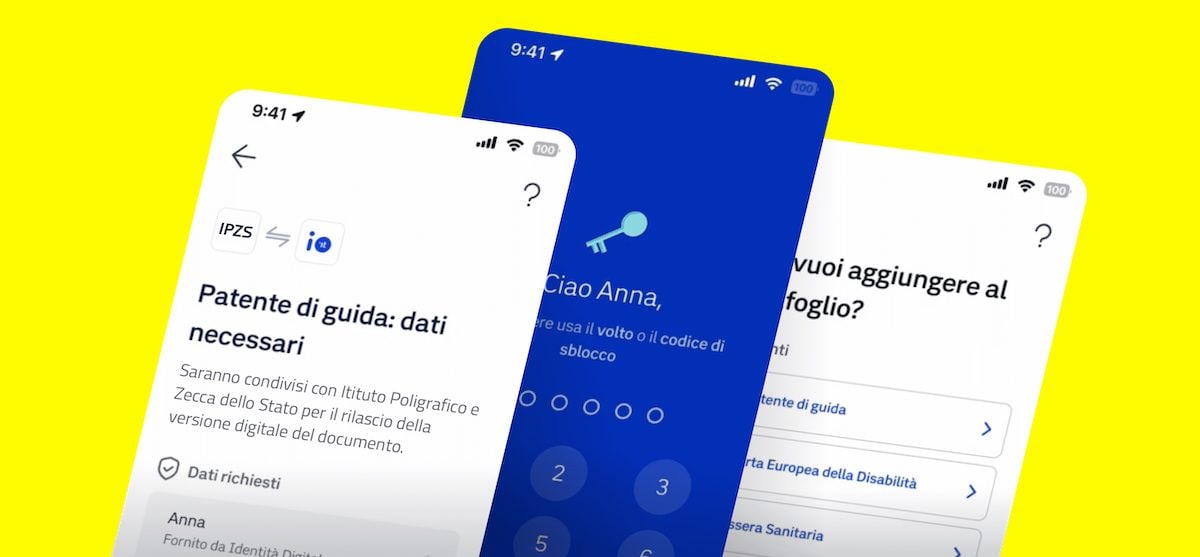
The driving license, health card and European disability card will not be the only documents that Italians will be able to access digitally in the IO app. The digital wallet IT-Walletin fact, is destined to become increasingly central in the lives of citizens who will prefer it to physical documents and will be enriched over time by becoming accommodate up to 200 different documents.
The documents coming to the smartphone and the role of IPZS in the development
According to the Department for Digital TransformationThe February 17 last IT-Wallet reached high altitude 10 million activations on the IO app and beyond 17 million documents already loaded between digital driving licence, health card and European disability card. This means that many citizens are starting to actually use the digital wallet, which is fully entering our daily lives. The digital driving licence, for example, can be shown during a check, while the digital health card allows access to services and benefits without the need for physical support.
You understand well, therefore, that a system already so widespread and called upon to manage the personal data of millions of citizens requires a fully efficient and functioning, as well as secure, infrastructure. A central role in the management of the various electronic documents of Italians is played byIPZS (State Mint Printing Institute). The Institute has three data centers – two in Rome and one in Foggia – with an infrastructure that counts for something like 10,000 systems between servers, databases, storage and backup systems, network devices, security devices, etc. and it matters 3 petabytes of storage (i.e. millions of gigabytes of data), 81 terabytes of RAM and well 6,000 CPUs.
Among the new documents that can be collected by IT-Wallet will include:
- residence certifications
- qualifications
- ISEE certifications
- badge for public employees
- special licenses
- documents with which to certify your age (without providing personal data).
The differences with the SPID
The IT wallet should not be confused with the SPIDor the Public Digital Identity Systemwhich is mainly used to authenticate online and access Public Administration services. This is because while the SPID can be spent online, the IT-Wallet can be used both online and in the physical world, with a use that we could define as «hybrid», to quote the words of Antonio GentileIPZS product engineering manager, who at the economic newspaper Il Sole 24 Oreexplained:
The strength of the IT-Wallet compared to digital identity tools is precisely this: it can be used hybridly, i.e. also in the physical world. In the field of document production, this has led to the transition from a factory dimension to that of a digital ecosystem. In Italy, Poligrafico has been tasked with creating the core of this ecosystem, which will have to safely receive and make usable data from over 200 authentic sources.
At the basis of this evolution is the European eIDAS regulation 2which defines a regulatory framework for digital identity at community level. The goal is to allow citizens to conserve and use interoperable digital credentialsi.e. recognized and usable in different countries and systems.
To upload documents into IT-Wallet, here is our guide.
