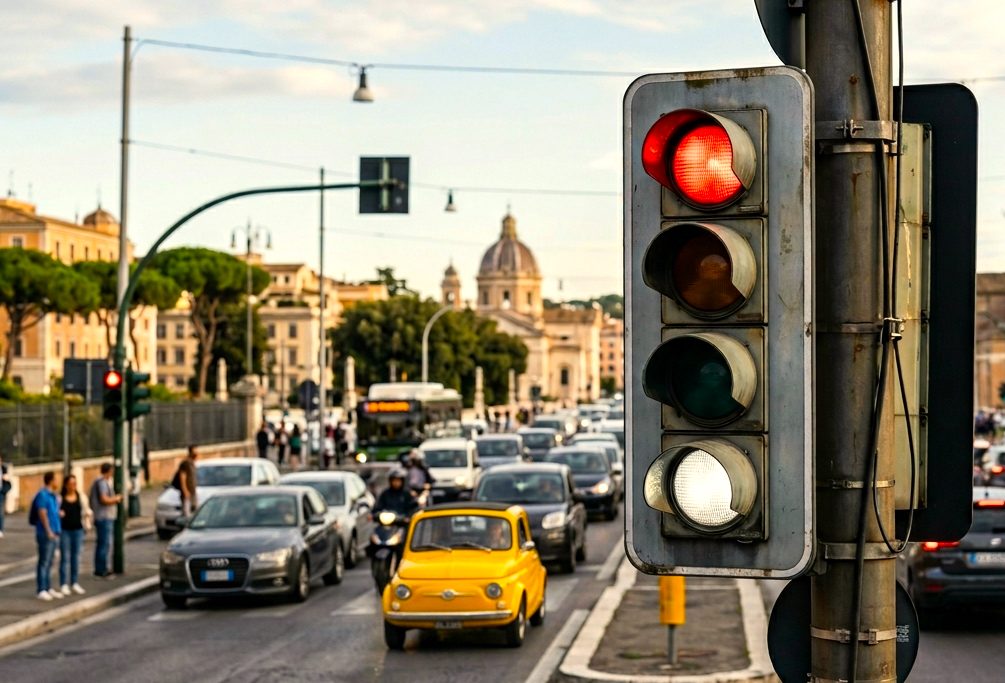
TO Rome we could soon be faced with an interesting evolution of the traffic light language. In addition to the three “traditional” colors – red, yellow and green – theintroduction of a fourth colorthat whitedesigned to integrate with connected vehicles and autonomous driving systems. The novelty would not be aesthetic, at all. This would be a purely functional solution. The idea was born in the context of so-called smart roads, i.e. road infrastructures equipped with sensors, communication systems and the ability to process data in real time. The white light would indicate that traffic coordination no longer depends exclusively on the traffic light, but on a digital network that connects vehicles and the road infrastructure itself.
To use the words of Luigi Di Matteoresponsible for the Technical Area of ACI, «when the white light appears, the connected vehicles communicate with each other and with the infrastructure, automatically optimizing the passage at the intersection». In this way we could achieve the objective of «reduce waiting times, improve traffic flow and exploit the computing and communication capabilities of autonomous vehicles», which is not bad in a complex city like Rome.
How white light could change traffic
The idea of white light ties directly into the connected mobilitythat is, a system in which vehicles communicate with each other and with the road. When we talk about vehicle-infrastructure communication, often referred to by the acronym V2I (Vehicle-to-Infrastructure), we mean a continuous exchange of data that allows movements to be coordinated more efficiently than static signals. In the presence of white light, this digital network would ideally become the “director” of the intersection.
The smart roads they represent the enabling infrastructure of this model. Although, clearly, they do not eliminate traffic in an absolute sense, they improve its management. Thanks to sensors, cameras and real-time analysis algorithms, the road is able to adapt to current conditions. This means traffic lights that change the duration of the green light based on actual flows, lanes that change function dynamically and information systems that suggest alternative routes. This is how the so-called happens dynamic traffic managementthat is, an approach that replaces fixed rules and replaces them with decisions based on data transmitted and read by systems in real time. Studies indicate that with a significant diffusion of connected vehicles, infrastructure capacity could be increased without building new roads.
The goal: to increase road safety
On the level of safetythe integration between smart roads and autonomous driving is seen above all as aopportunity. Today most road accidents are linked to the human factor: distraction (such as that due to the improper use of smartphones while driving), errors in judgment or excessive speed. Driver assistance systems and fully autonomous systems reduce this margin of error.
And speaking of safety, the head of the ACI Technical Area Luigi Di Matteo (already mentioned before), explained:
Assisted and autonomous driving technologies can reduce this human factor. Smart roads add an additional level of safety: digital signs, communication between vehicles and infrastructure, advance warning of accidents or obstacles, monitoring of road conditions. All elements that allow you to prevent risk situations. Of course, issues remain to be addressed, such as system reliability, cybersecurity and the coexistence of traditional and autonomous vehicles. But overall the direction is towards a safer mobility system.
