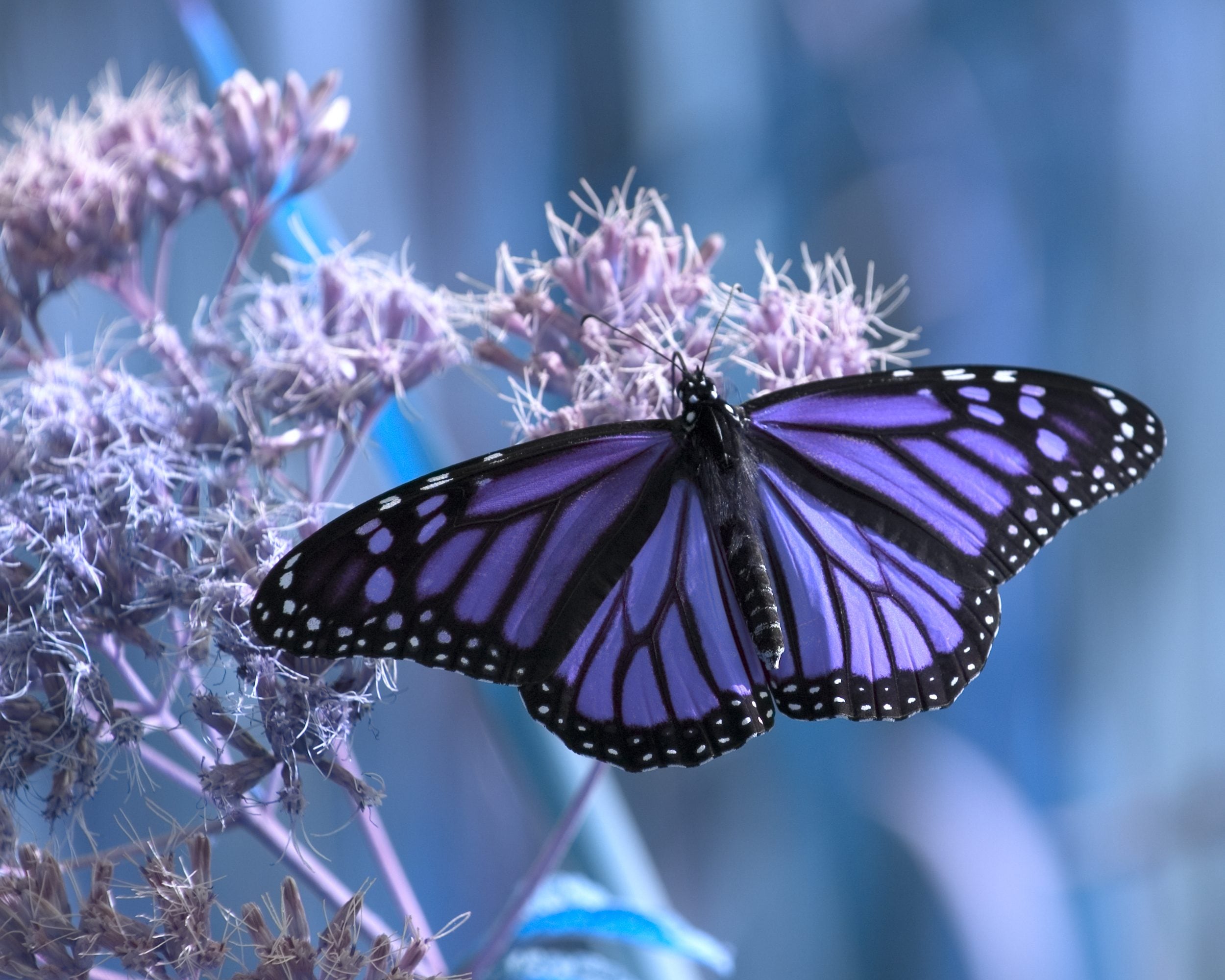
The butterfly wings attract for bright colors and the agile movement that characterizes them. Yet, the aspect that should surprise you the most is not so much the aesthetic one, but rather that functional given that, thanks to their shape and structure, they are perfect tools not only for flying, but also for thermoregulationthe communication of signals of defense or attraction of the partner and even for the resistance to pathogens. Scholars believe that various factors such as habitat, predators and intraspecific relationships were the selective causes that acted on the evolution of the shape and colors of the wings of these insects. All Lepidoptera, both butterflies and moths, have two pairs of wings composed of a double membranous layer, reinforced by a branching of ribs: a bit like a kite. The membranes are covered by thousands of microscales so much so that the very name of Lepidoptera derives from the Greek lepís ‘scale’ and pterón ‘wing’, therefore, animals with wings covered in scales. These micro-structures covering the wing give it properties anti-reflectiveheat absorption capacity, hydrophobicity and much more. That impalpable “powder” that remains on our fingers if we try to grab a butterfly is precisely the coating of scales. But, be careful! Precisely for this reason, the wings should never be touched because it takes very little to destroy them, condemning the animal to death.
How the colors of butterfly wings are formed: the scales
The different colors derive fromcolor and microstructure together of the individual flakes. Some pigments contained in the scales selectively absorb certain wavelengths of light and, at the same time, the series of nanostructures that characterize each individual scale (ridges, lamellae, micro-roughness) act as diffraction gratings that is, as a sort of prism capable of separating light into its colors.
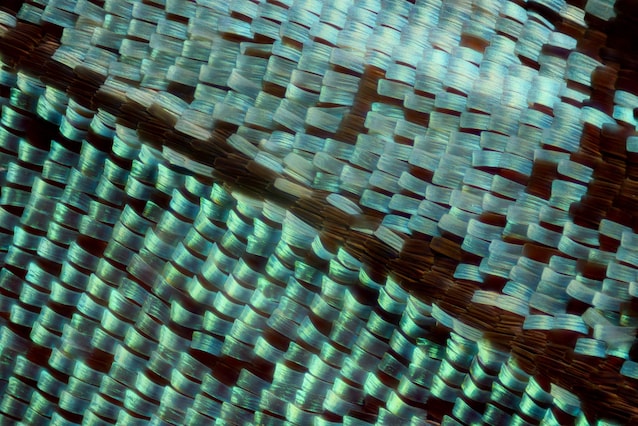
Indeed, a 2024 study highlighted dynamic optical properties of scales: certain reflexes depend on the inclination of the wing and consequently of all its scales. In some species the colors result less brilliant when the wing is in a vertical position versus when it is in a horizontal position.
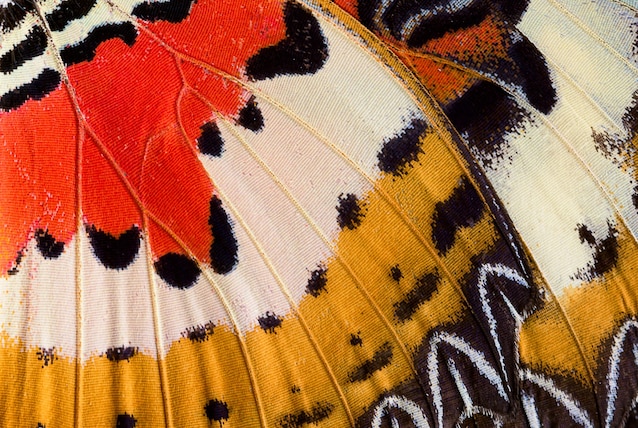
In this way, when we see wings with yellow, orange and red, it means that both the covering and base scales present on the wing contain absorbing pigments selective for the specific wavelength. The blue color comes from conformation of the scales and by the overlapping of scales with different shapes. The white instead it derives from the fact that both the covering scales of the wing and those that form the base layer are bluebut since they are superimposed on each otherthe optical result is a faint whitish color.
The functions of the designs and various colors
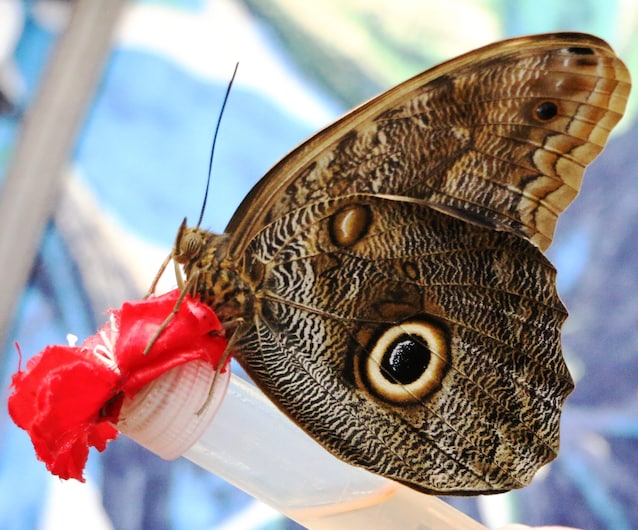
Each group of butterflies has a coloration and one wing design schemeso much so that it is considered among the distinctive characters precisely for the classification of the species. Color has several species-specific functional meanings. For example, the combination of red, yellow or black often correspond to signals toxicity or indigestible for any predators: this is what they are called aposematic colorsa name which also in this case derives from the Greek (“apo”, far and “sema”, signal). Great shaped designs eye on the wings of some species tend to scare the predator. Some colors allow the animal to camouflage perfectly with the surrounding environment; still others to recognize the partner of the same species.
A perfect system for thermoregulation
The wings also contribute effectively to the mechanism of thermoregulation of the butterfly thanks to a combined effect of the color and position they assume. They get the maximum of exposure to solar radiation when the wings are fully open and horizontal a bit like solar panels and the minimum when they are closed and in a vertical position. It has been observed in some experiments that closing the wings results in a dispersion of up to 20% of chest temperature in case of excess heat.
Butterflies like that Pieris instead they use a particular position of the wings to favor exposure to the sun by reflection, in order to convey radiation towards the body, as confirmed by studies from the 1980s. Even the coloring of the entire wing surface influences the mechanisms of heat accumulation or dispersion. For example, always from the study of gender Pieris it emerged that the black (melanic) coloration in the outermost regions of the wing, towards the edges, concentrates the absorption of radiation in the peripheral part and lowers body temperaturewhile black portions placed in other areas of the wings they help warm the body.
How the structure and shape of wings determine flight
The size, shape and again the micro-scales of the wings give the butterfly a perfect functionality in flight. The scales are arranged according to an aerodynamic pattern that favors flight liftthat is, the aerodynamic force that pushes upwards and allows one to rise and support oneself in flight.
The wings are connected to the thorax via a mechanism lever. The wing surface of the butterfly is very large compared to the body: think that the females of the Queen Alexandra butterfly (Ornithoptera alexandrae) that lives in Papua New Guinea reach a wingspan of approximately 25–28cm, guaranteeing it the record of largest butterfly in the world. Despite this discrepancy between body size and wing size, butterflies are equipped with abilities that allow them to control every single flap of the wing with a much more efficient system even than that of a dragonfly. This sophisticated system allows butterflies to maintain stable flight even in the presence of gusts of wind.
The wing microstructures with water-repellent and antibacterial function
The scales that cover the wings observed under the Scanning Electron Microscope (SEM) have a “staircase” ultrastructure that promotes a water-repellent and antibacterial action. Basically the drops of water they are unable to adhere and they slide rapidly on the surface of the wing, taking with them microparticles of dirt or bacteria. The surfaces are composed of materials such as chitin which also have properties hydrophobic, that is, they repel water and the combined effect between composition and structure gives it a marked effect repellent and self-cleaning properties. According to recent research, in fact, the ladder structure, combined with water repellency, would make it difficult for bacteria to adhere to the surface of the wings and reproduce.
