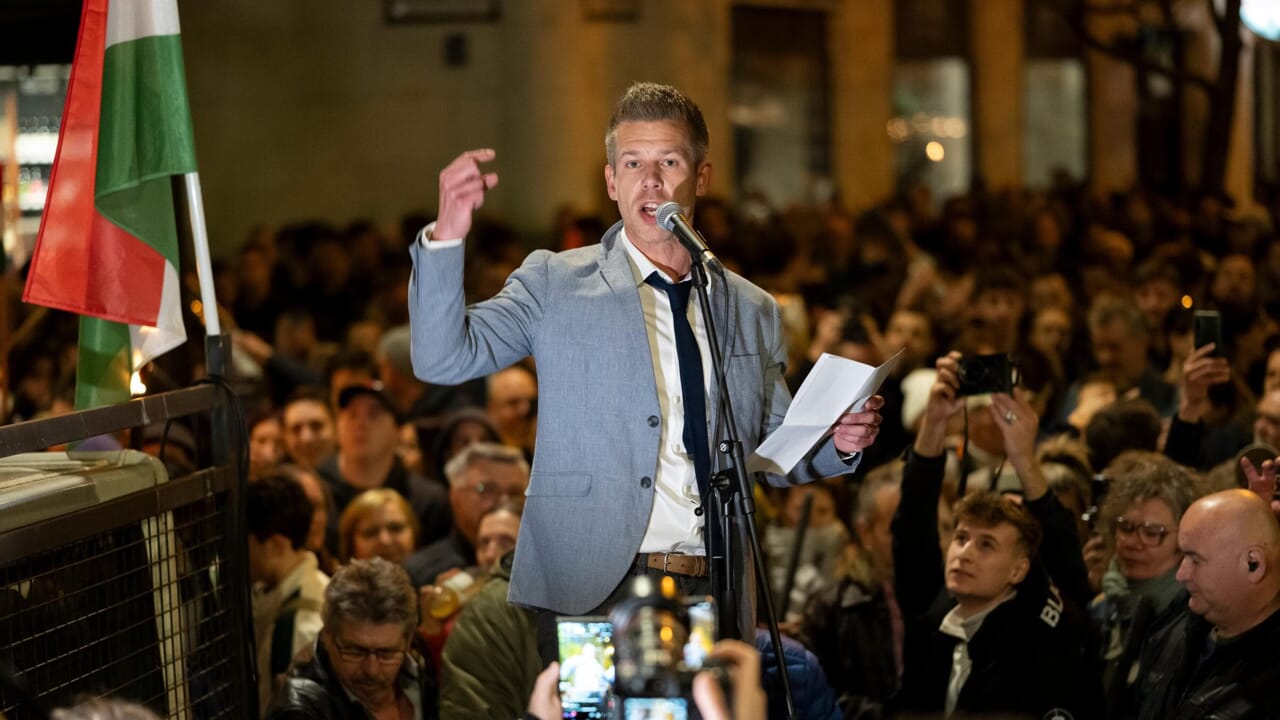
There are just a few hours left until a historic vote that could call into question the political system built over more than fifteen years by Viktor Orbán. On Sunday 12 April, millions of citizens in Hungary will go to the polls for the parliamentary elections. The challenge is between two duelists. On the one hand there is Orbán, 62 years old, in power since 2010 and now the longest-serving European leader, the man who transformed Hungary into a laboratory of sovereign nationalism. On the other there is Péter Magyar, 45 years old, a former insider of the Fidesz system, now leader of Tisza and the first truly competitive opponent against the Hungarian prime minister for many years. A political clash seen with great interest by European chancelleries and which could reshape the balance in the Old Continent.
Who is Orbán’s rival?
Péter Magyar was born in 1981 into a family of lawyers, studied law and worked for the Foreign Ministry. He then went to the prime minister’s office in Brussels, later moving to a state bank and running a student loan agency. In 2006 he married Judit Varga, who would become Orbán’s justice minister. The two, later divorced in 2023, have three children. His political explosion came in 2024, after the case of the pardon granted to a man involved in a case of sexual abuse of minors, a scandal that overwhelmed Varga and opened a breach in the ethical narrative of Fidesz. A few months later, almost out of nowhere, Magyar led his new party, Tisza, to 30 percent in the European elections.
The relationship between Magyar and Orbán is the heart of the electoral duel that will take place in the next few hours. According to some reconstructions, as a child the Tisza leader kept a photo of the Hungarian prime minister hanging in his bedroom, fascinated by the energy of the regime change and the image of the young anti-communist leader. The parliamentary elections are also an internal showdown in the long Orban era: Magyar does not come from the historical opposition, but from the political and human universe that grew up around Fidesz.
The breakup
Magyar’s split arose when he said he felt disillusioned by the corruption and propaganda seen from the inside. From then on the relationship turned into open hostility. Orbán has treated Magyar as the political face of the external front that wants to overthrow him, associating him with Brussels and Kiev and presenting the vote as a choice between “war and peace”, insisting that “for peace, Fidesz is the safe choice”.
Orbán’s last dance?
For his part, Magyar defined the vote as a “referendum” on Hungary’s place in the world and accused the Hungarian prime minister of having dragged the country towards an increasingly pro-Russian and increasingly conflictual balance with the European Union. The harshness of the conflict was also measured in the methods. In recent months Magyar has denounced that people linked to the government are preparing the release of a video to discredit him, speaking of a “Russian-style” campaign. On the other hand, the opposing camp continued to use the old argument of betrayal against him: not simply an adversary, but a turncoat who has lived inside the system and now fights it. The leader of Tisza, however, represents a threat to Orban’s power given that he knows well the language on which the Hungarian prime minister has built his fortunes. The outcome of these parliamentary elections therefore appears very uncertain.
