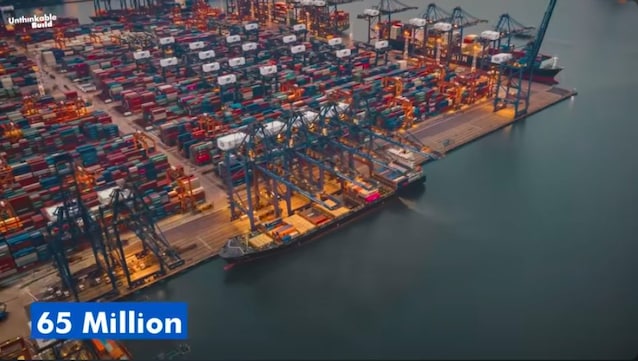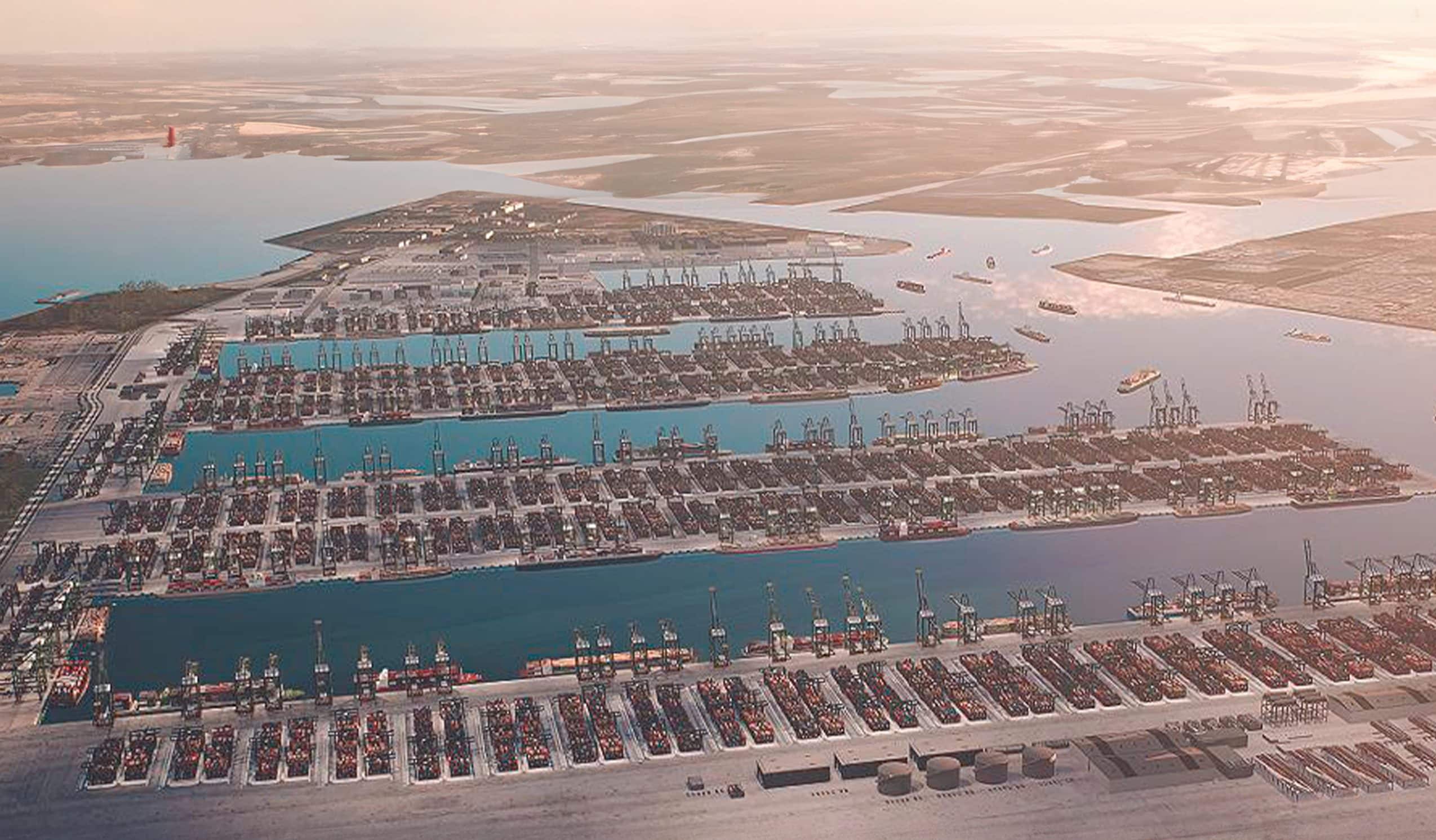
Located at the western end of Singaporethis mega-project from beyond 20 billion dollars represents the engineering response to the challenges of supply chain of the 21st century. The widespread use of artificial intelligence and integrated automation systems aims to make the port of Tuas the largest automated container terminal in the world, consolidating Singapore’s role as a key hub between East and West. Once fully operational, it will be able to process well 65 million containers per year.
Project description
From an engineering point of view, the realization of the port quay it is certainly the most iconic and significant element of the entire project. The technique used was that of massive prefabrication of the structural elements. THE caissons that compose it, in fact, are made on the ground using sliding formwork, thus allowing a continuous pouring of concrete. Once ready, with the use of powerful tugboats, they come lower yourself in sea and are placed on the bottom. This is possible thanks to a system ballasts filled and emptied with water as needed, so as to allow the prefabricated element to descend at a controlled speed, preventing any damage. These huge boxes are well tall 28 m and heavy 1,500 tons.
The filling of the boxes that make up the port quay comes from debris and waste deriving from other construction activities around the country, with a view to the circular economy.
One of the main engineering challenges facing the designers of the Tuas Port is the rise of sea levels. To address this risk, the designers chose to build the work 5 m above the average sea level – also considering the level variations due to the tides and seasons in the data.
The operational heart of the project
For anyone who enters the port, the feeling is that of finding themselves in front of a semi-abandoned place. This, of course, is no coincidence, given that within the port infrastructure it is already possible to see hundreds of AGVs (Automated Guided Vehicles)driverless electric vehicles that speed by carrying containers coordinated by a private 5G network and artificial intelligence algorithms.
How is all this coordinated? Isn’t human intervention necessary anyway? To answer the question we need to introduce the concept of the so-called digital twin, or digital twin. Every dock, every crane and every vehicle has a digital twin capable of receiving data in real time. This allows you to perform actions predictive maintenance which eliminates downtime: the system, based on algorithms, is able to understand when a component is about to fail before it even happens, guaranteeing operational continuity not even remotely imaginable for traditional ports.
Advantages and economic consequences
The creation of a port infrastructure of this scale certainly brings with it a whole series of enormous advantages, especially from an economic and commercial point of view. Singapore’s port trade activities are currently fragmented into several hubs (Tanjong Pagar, Keppel, Brani and Pasir Panjang). One of the first advantages of the creation of a fully automated port infrastructure, with the support of artificial intelligence, is certainly the elimination of the Inter-terminal Haulage. Moving containers between distant docks generates traffic, fuel costs and pollution. By consolidating everything in Tuas, it is planned to eliminate 80% of road transport between terminalssaving approx 170,000 tons of CO2 per year. All with another great advantage, consisting in a general optimization of human resources and of carbon dioxide emissions into the environment.
Finally, it is estimated that Tuas Port, once fully operational, will be able to raise the Singapore GDP by 0.5%, and to generate well 5,000 highly specialized jobs.