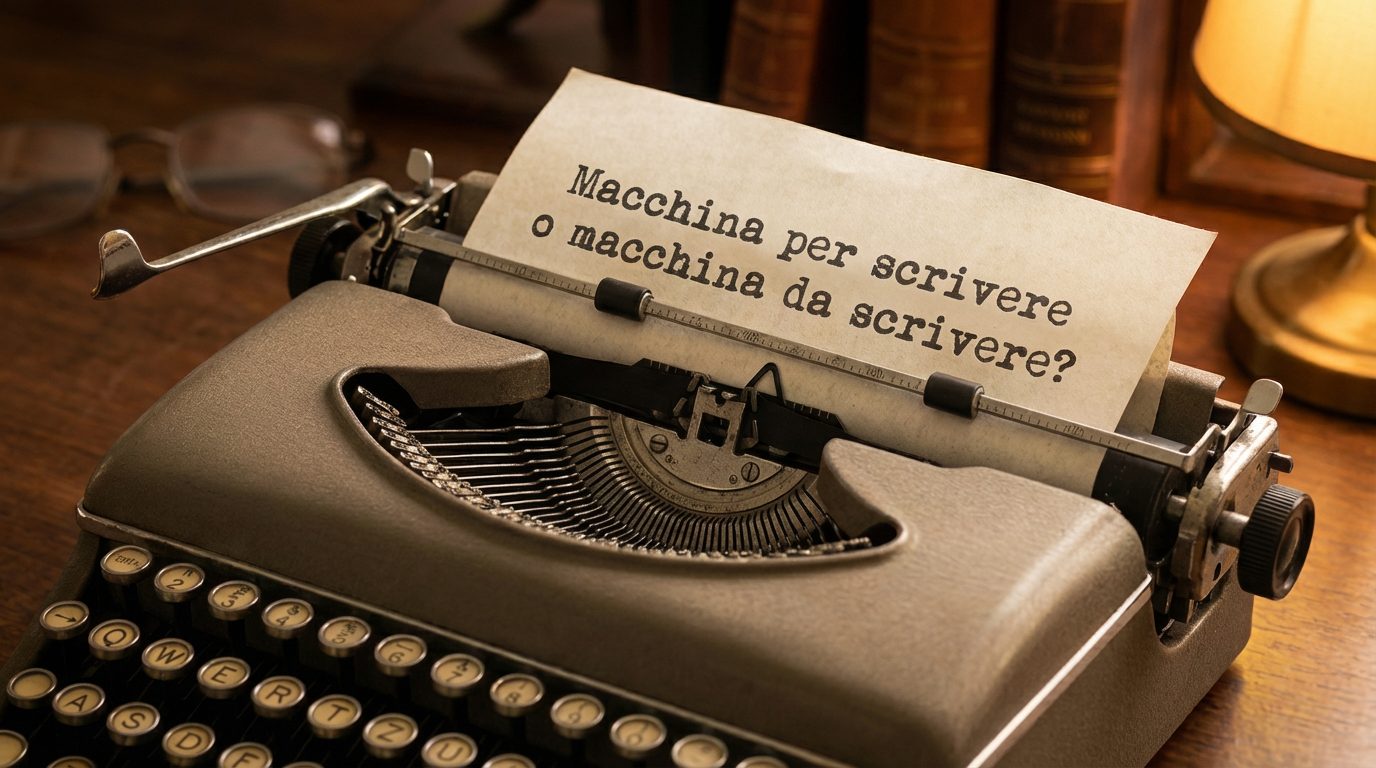
Perhaps not everyone has come across an object now considered “vintage”: born at the end of the nineteenth century, the typewriter she is in her own way the ancestor of the computer, an engineering masterpiece that revolutionized society, making fast and precise writing possible and also making history in Italy, thanks to Camillo Olivetti and then to her son Adriano.
In any case, even if you haven’t had one in your hands, you will all have heard of it… almost certainly how “typewriter”. However, there is another grammatical form, “typewriter”, which on paper should be more correct, even if few people use it in common language. In this article we explain whether to use the preposition for or the preposition from and how widespread the two forms are.
The Olivetti case: a historic change of direction
Returning to Olivetti and drawing on its history, the company was established in 1908 as the “first national typewriter factory”. However, according to theCrusca Academythe greatest reference for the Italian language, which has reconstructed the use of these forms throughout history, both are legitimate as they have both been employed by authors, journalists and writers.
Within the history of literature, the Accademia della Crusca reports how Umberto Eco prefers “typewriter” within The cemetery in Prague (2010), as well as Alberto Moravia in One thing is one thing (1967), while Luigi Pirandello and Italo Svevo prefer the “typewriter” form.
“Typewriter” is reported in many dictionaries as an accepted variant, but also as the main or only one. The dictionary Treccani contains the form “machine for (or, more commonly, to be) typed”. In general, Italian dictionaries accept both forms: the Zingarelli “machine for or to type”, the GRADIT “machine for, to write”, the Sabatini-Coletti, “machine for (or to) write” while the Devoto-Oli chooses the option from, without alternatives.
Where does the dilemma between “from” and “for” come from?
In Italian, the correct preposition to use when you want to indicate what purpose does an object serve? through an infinitive verb is usually For, with the structure “object + for + infinitive”. According to this rule, therefore, we should use the “typewriter” forms. The same goes for “eraser” – which many call in current language “to erase” -, for “sewing needle” and so on. The preposition For here it indicates purpose or destination: that machine exists for the purpose of writing, that eraser serves the purpose of erasing.
When our intention is to use the passive formwe can use the preposition from. For example, “coffee to be ground”, i.e. “which must or can be ground”. Following this rule, therefore, saying “typewriter” would correspond to the “machine that must or can be written”. Actually the preposition from it is multifunctional and like all prepositions it serves to express different meanings: among these, when it is followed by an infinitive verb, not exclusively the passive one, but also that of end or purpose, the destination of the object being talked about and the use to which it is put, as in the case of “typewriter”, “eraser”, etc. Of course, it is more common, in use, to happen when we have from + nounas in the case of “running shoes”, “ballroom”, “soccer ball” and so on.
So, which form is the most correct? The conclusion of the Accademia della Crusca is that “forms such as typewriters or sewing machines are, today, crystallized residues of a construct that was certainly much more productive in the past, but this does not take away their right to be and remain in the Italian vocabulary”. Therefore, a sewing machine would be more correct, but use, as often happens, has legitimized its alternative.
