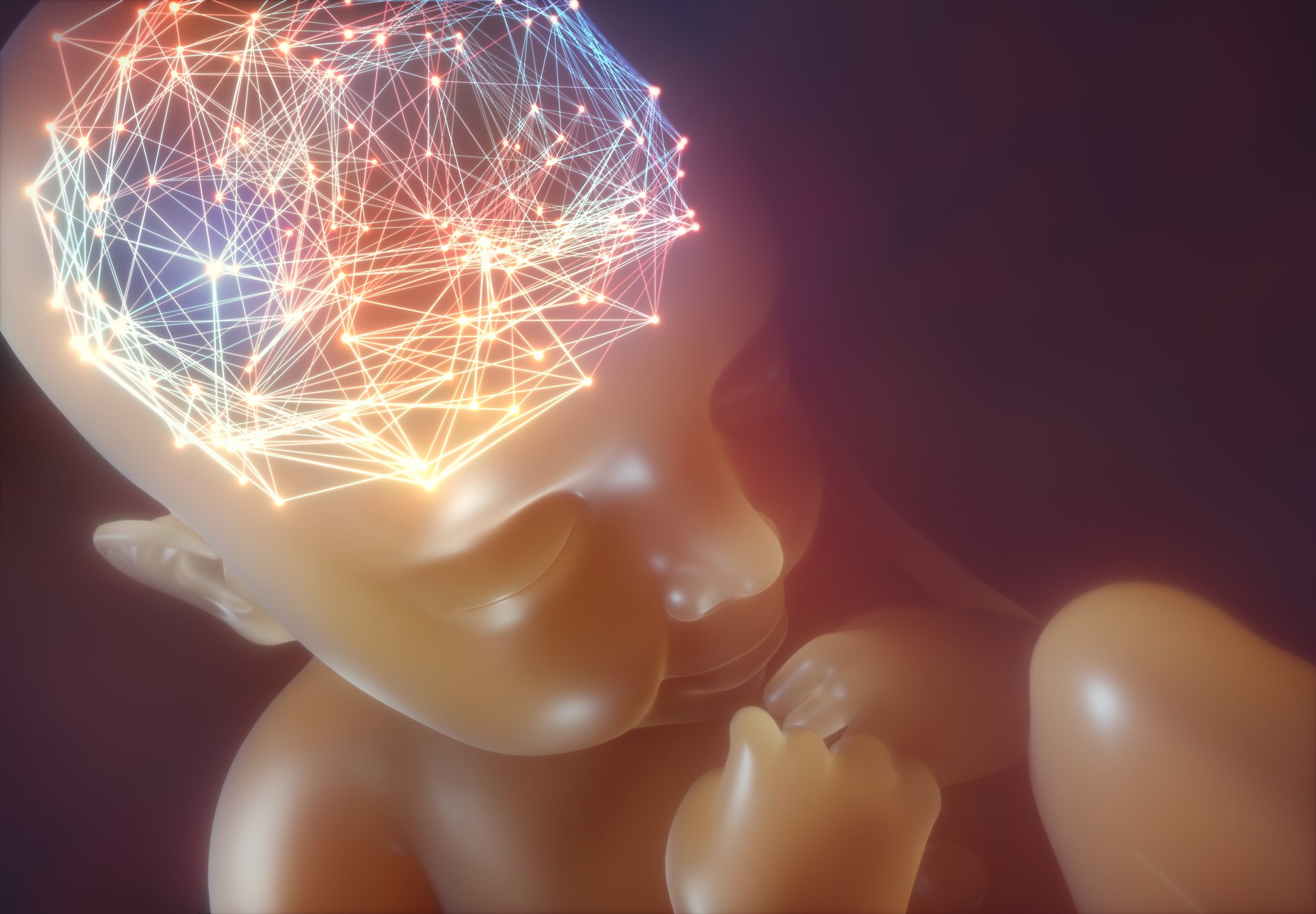
Looking at a newbornwe often ask ourselves: is his mind like a computer with an empty hard disk, or does he already have a “operating system“? For centuries it was believed that the infant brain was a blank canvas or, as the philosopher argued John Lockeone “clean slate“. Today knowledge on the subject has progressed greatly and, despite the complexity of the matter, we know that we are not born empty at all. Our brain has already pre-programmed networks and active, but ready to be shaped by experience: if we already have a basic structure for sensory networks, such as sight, hearing and movement, the environmental conditions of pregnancy, childbirth and the first months of life can shape our neural connections.
An operating system already installed before birth
Already in the womb, the brain of the fetus first and then the child begins to generate billions of neurons and also to connect them to each other in functional networks. When we come into the world we possess a basic brain architecture that is largely a copy of that of adults: this happens because development follows a genetic project that development follows, with rules that have stratified during our evolutionary history. As the article published on explains Biological Psychiatryresearchers used advanced MRI techniques in fetuses and newborns and discovered that the primary brain networksthat is, those responsible for vital senses such as viewhearing and bodily movement, are already structured and equipped at the time of childbirthalbeit sometimes immature as in the case of sight. Imagine these nervous networks as highways already paved and protected by special sheaths, ready for the traffic of sensory information to quickly flow. Even the complex systems intended for semantic memoryour future “mental encyclopedia” to store knowledge of the world, present specific and operational subdivisions already in the very first days of life. Furthermore, specific regions of the visual cortex, predisposed to visually recognize human faces or landscapes, are exactly in their “adult” position at just four or six months of age. In short, we are born with the fundamental infrastructures already installed.
A “software” designed to learn slowly
If the basic infrastructure is already ready, for what reason newborns take years to learn to speak, reason abstractly and make complex decisions? The phenomenon can be explained through an evolutionary adaptation typical of human beings called “neoteny“, which consists in an extreme extension of brain development times compared to other primates. Biologically, it happens that while the sensory and motor networks mature quickly, the “higher” or associative brain networks remain fragmented and immature for a long time. This apparent delay is actually our biggest evolutionary resource.
The genetic program human he was selected in this way because the neural plasticity (and therefore our extraordinary ability to learn) has proven to be adeadly weapon for survival. Let’s think of the child’s brain as a software released in a “beta” version: the essential modules for survival work, but to unlock the advanced functions you need to download updates via the input from the outside world. For example, the formidable ability to isolate and hyper-selectively recognize a human face by distinguishing it from any other object is not perfect from day one, but requires continuous and assiduous exposure visual to be able to refine. In response to lived experience, the brain acts physically eliminating superfluous synapses in a real “pruning” process, which serves to definitively optimize the neural networks.

The environment as the final programmer
Finally, we must understand that the basic genetic program is not a rigid and immutable script, but a dynamic mechanism. Several studies confirm that the environmental conditions to which we are exposed since the womb can alter and reprogram physically the nascent architecture of our brain. This flexibility is governed byepigeneticsa process in which environmental factors act as chemical signals that, although not modifying the DNA sequence itself, influence itsexpressionturning on or off certain genes: some genes are there and are activated, others are there but are not activated.
Because of this, we find that adverse prenatal eventssuch as maternal psychological stress, variations in nutrition or oxygen deficiency during childbirth, they deviate the connection trajectories of the brain. As highlighted in a 2016 research, children born prematurely, for example, despite retaining a correct global brain structure, often show weaker connection networks between the various districts of the brain; it is a sort of anomalous “rewiring” triggered by early exposure to an extrauterine world for which the nervous system was not yet fully ready. On the contrary, highly positive environmental stimulisuch as maternal warmth and support or an interactive growth environment, actively increase development and the volume of essential areas such as the hippocampus, which is our center for learning and emotions. The “tabula” with which we are born therefore has an innate and highly refined plot pre-programmed by genetics, but awaits the encounter with the nuances of the environment to complete its cognitive masterpiece.
Sources
Zhu et al., 2024, Innate network mechanisms of temporal pole for semantic cognition in neonatal and adult twin studies Deen et al., 2017, Organization of high-level visual cortex in human infants Nielsen et al., 2024, Maturation of large-scale brain systems over the first month of life Miguel et al., 2019, Early environmental influences on the development of children’s brain structure and function Eyre et al., 2020, The Developing Human Connectome Project: typical and disrupted perinatal functional connectivity Cao et al., 2017, Early Development of Functional Network Segregation Revealed by Connectomic Analysis of the Preterm Human Brain Zhou et al., 2024, Genetics of human brain development Keunen et al., 2017, The emergence of functional architecture during early brain development Thomason, 2020, Development of Brain Networks In Utero: Relevance for Common Neural Disorders
