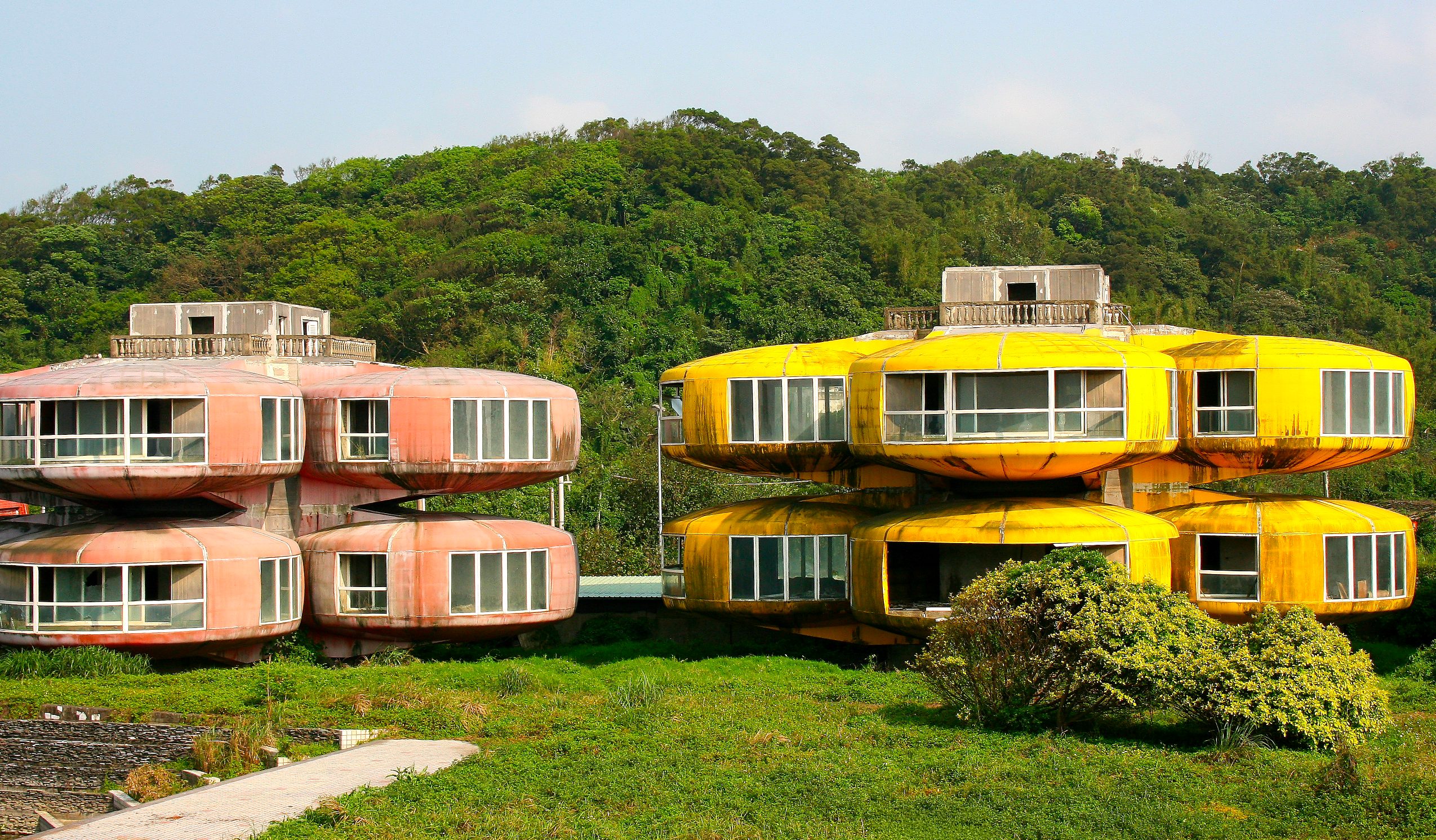
The Sanzhi UFO Houses they represent one of the most fascinating and controversial case studies of modern architecture Taiwan. Originally located in the Sanzhi district and demolished in 2010, these saucer-shaped structures have long been one of the country’s leading examples of architectural failure. But for what reason?
The Sanzhi “UFO houses” project
The project, which began in the 1970s, was initially envisioned as a luxury resort for tourists and American military officers in Asia. Of this interesting project, the architectural part is the aspect that stands out most to the eye. The lines were in fact inspired by the concept of Future House by Finnish architect Matti Suuronen. The units were prefabricated, more than 70% constructed using glass fiber reinforced plastic (FRP) and reinforced concrete, materials chosen because they are able to resist salt corrosion well, given their proximity to the coast. From a structural point of view, each “disk” rested on a central concrete core, with a steel load-bearing structure supporting the composite shell.

From a design point of view, the architects thought of a modular internal environment capable of exploiting the circular space to maximize liveability, with large windows offering panoramic views of the ocean. Unfortunately, the work was practically abandoned almost immediately after construction began. The causes are to be found in multiple elements and factors, such as careless management of costs, but also a series of partial assessments of the geological risks of the area, with a terrain characterized by reduced stability and resistance to vertical loads, which led to the need to intervene, on several occasions, to stabilize the structures built. All with a consequent increase in costs.
The socio-economic impact: a failure announced
From a socio-economic point of view, the UFO Houses represented a real failure announced from the initial stages of the project. In fact, the construction suffered a very hard blow due to the energy crisis of the 70s, and a series of serious accidents on the construction site. On this last point, local folklore also added, which attributed the accidents, sometimes even fatal ones, to the destruction of a dragon statue during the works. The real estate complex therefore remained unfinished, transforming into what is, today, a real city–ghostbecoming an attraction for photographers, urban explorers and tourists over the decades.
Although the original intent was to create a tourism hub for the Sanzhi area, the economic impact was essentially zero for the local community for almost thirty years. Only after the definitive demolition, which took place in 2008 – despite the protests of those who asked for its conservation as a monument to utopian design – was the area redeveloped, allowing the district to turn the page and focus on a more conventional and sustainable seaside and hospitality development.
The environmental impact of the ghost village
In addition to everything we have seen, there is still another aspect to consider: the environmental impact of the work.
The parts made in fiberglassdespite being very durable, have shown chemical degradation over the years due to constant exposure to atmospheric agents and salt, with the release of fragments of synthetic polymers into the surrounding ecosystem.
In addition, the abandonment of the construction site created a vast area of anthropized and degraded soil, with large quantities of dispersed construction debris which hindered the natural reforestation of the area. There final demolitioninitially designed for 2008 but completed only in 2010, although necessary for the reclamation of the site, was a complex operation that required the disposal of large quantities of plastic materials and corroded metals.
