
The activity ai Phlegraean Fields remains modest: the latest weekly bulletin of the Vesuvian Observatory (INGV) records 21 earthquake shocks with a maximum magnitude of 1.9 in the period between 20 and 26 April 2026, compared to 14 in the previous week. The other parameters monitored also do not indicate significant changes: the bradyseism remains in line with recent weeks with a ground lift rate of 10 mm/month and geochemical parameters, including the Solfatara temperature (approx 173°C), remained substantially stable compared to previous weeks.
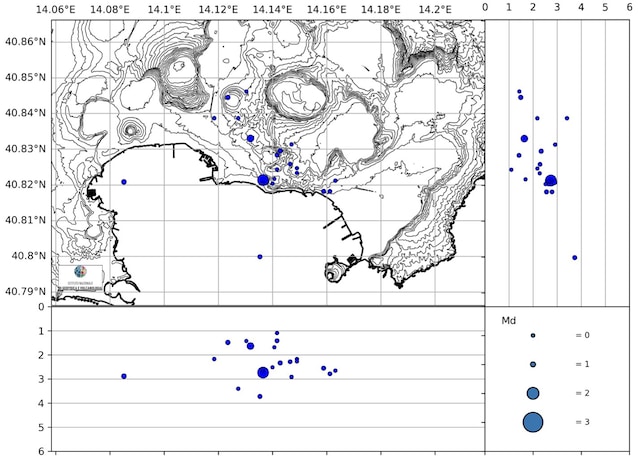
21 earthquakes with maximum magnitude 1.9: earthquake data
In the week from 20 to 26 April 2026, the seismographs of the Phlegraean area recorded 21 seismic eventswith the most intense shock (magnitude 1.9) which occurred on April 25th. The earthquakes are confirmed to be very superficial, as typically happens in the phases of bradyseismic uplift: the maximum depth detected was 2.89km. Overall, the seismic picture appears contained and in line with what was observed in the previous week.
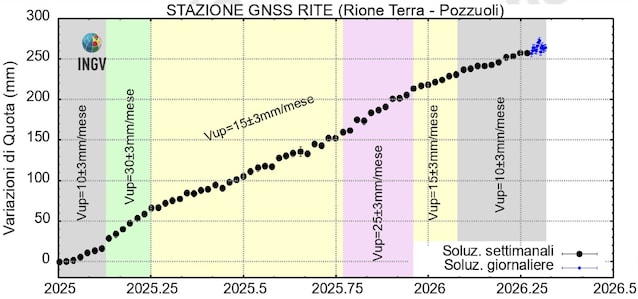
Soil heave remains stable at 10 mm/month
The bradyseismic ground uplift rate at Campi Flegrei remains stable at 10 mm/month from February 2026, a slowdown compared to the values recorded in the previous year. Since the beginning of 2025, the ground in the area of the Rione Terra GNSS station has accumulated an overall upheaval of approximately 26.5 cm.
THE geochemical parameters are in continuity with what was observed in previous weeks, confirming the already known increase trends, both in terms of the flows of gas emitted and the temperatures of the fumaroles. In the period considered, the Pisciarelli fumarole recorded an average temperature of approximately 95°Cwhile for the main fumarole (BG) located in the Solfatara crater an average value of approximately 173°C.
