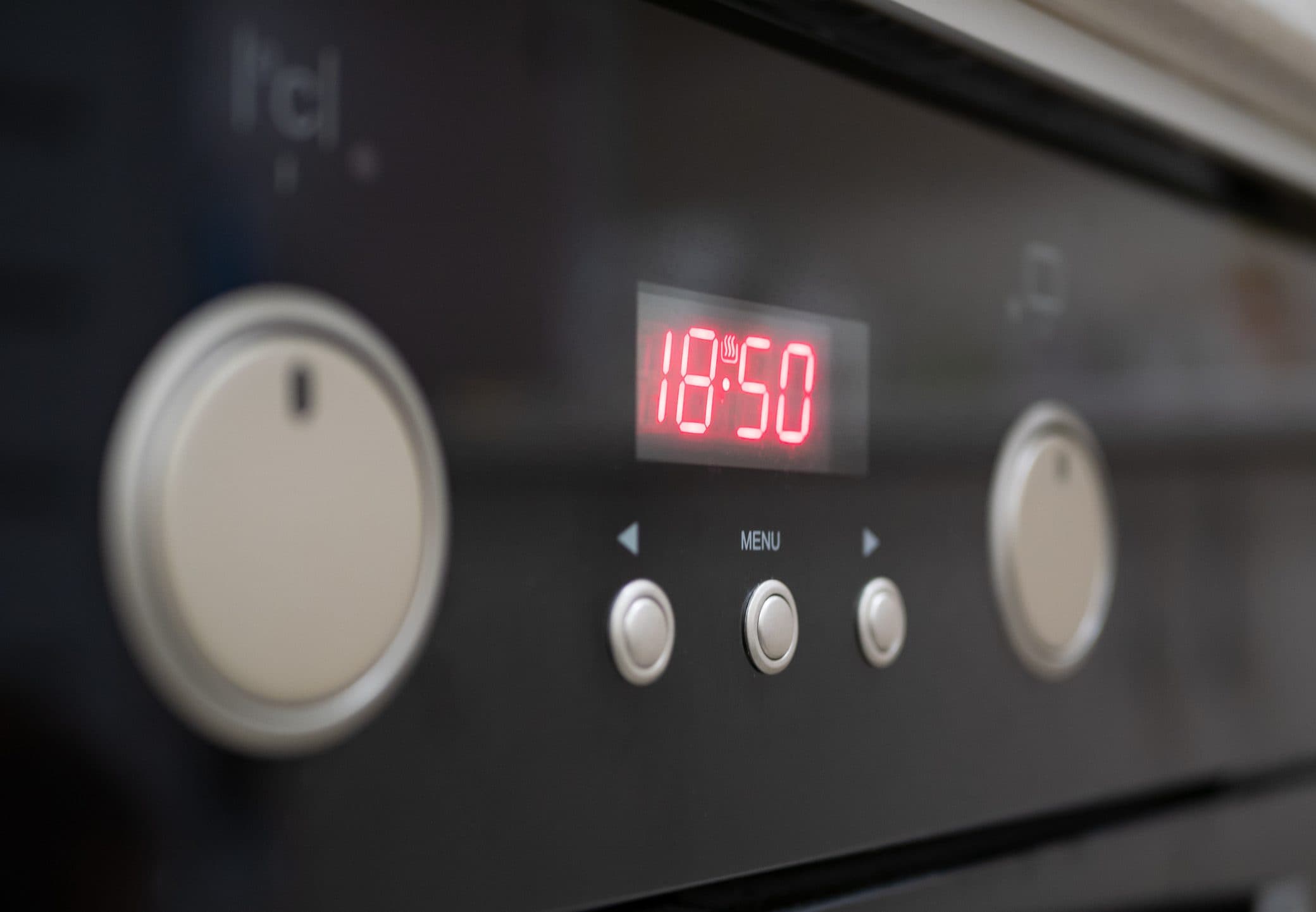
The oven clock shows a certain time, the smartphone clock shows another. Why this difference? Many household appliances like ovens and microwaves do not use advanced synchronization systemsbut they rely on a surprisingly simple principle: counting the oscillations of the alternating current coming from the house socket.
In Europe, alternating current oscillates nominally at 50Hzthat is, accomplishes 50 cycles per second. Some devices (such as the oven or the microwave) exploit this feature: through a circuit that detects the zero crossings of the sinusoid, they “count” the cycles of the current to estimate the passage of time. Under ideal conditions, one second corresponds to 50 network cyclesand minutes and hours are then obtained from there.
The point is that the electrical grid is not a perfect metronome. The frequency fluctuates continuously depending on the balance between energy production and consumption: when demand exceeds supply it tends to drop slightly below 50 Hz, while the opposite happens when there is excess production. These variations are generally very small (on the order of a few hundredths of a Hertztypically within ±0.1 Hz), but sufficient to introduce errors if they persist over time.
However, an important distinction must be made: in the interconnected European electricity system, managed by organizations such as ENTSO-E (European Network of Transmission System Operators for Electricity), the frequency is not allowed to “derive” freely. Operators, at least in normal conditions, intervene to correct the average frequency over the course of the following hours or day, precisely to prevent the clocks synchronized with the network from accumulating significant errors. In other words, even if in the short term the frequency fluctuates, in the long term it tends to be brought back to the nominal value.
When this compensation mechanism fails, the effects become evident. That’s what happened in 2018when a prolonged imbalance in the grid due to geopolitical tensions in the Balkans (between Serbia and Kosovo to be precise) caused a slight but persistent reduction in the standard frequency of alternating current in Europe. Within a few weeks, millions of domestic watches have accumulated a delay of approximately six minutesdemonstrating how sensitive these systems are even to minimal but prolonged variations.
The “out of order” of the oven clock, therefore, is not attributable to a defect in the individual appliance, but is a direct consequence of the method used by the clock in question to measure time. As long as the average frequency of the network remains stable, the clock remains accurate; However, when prolonged deviations occur, even a small deviation can turn into minutes of waste in the space of a few weeks.
Added to all this is a further practical limit: theabsence of backup systems. Most ovens and microwaves do not have backup batteries, so even a brief power outage will completely reset the clock. When power returns, the device starts from scratch (typically 00:00), further contributing to the perception of imprecision.
The end result is a watch that may seem unreliable, but which actually faithfully reflects the small imperfections of the electrical grid on which it depends.
