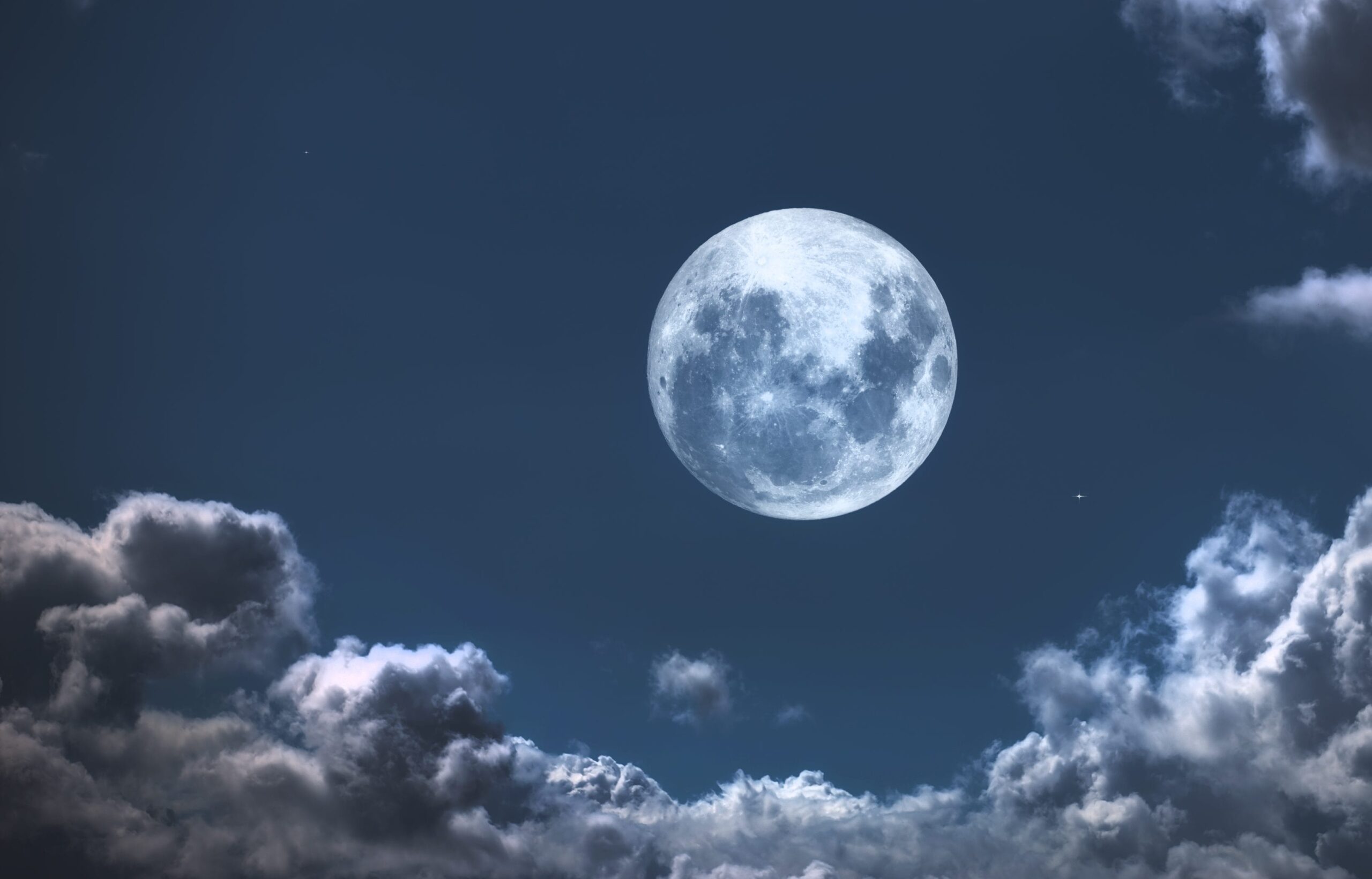
2026 holds a small astronomical gift for us: in May we will have two full moons in the same monththe first the May 1st and the second the May 31stwhich will also be a so-called “micromoon”, that is, it will appear slightly smaller and less bright than usual in the sky. In general, the full moon in a month has an informal name: blue moonor blue moon. It is a phenomenon that happens every 2 or 3 years (the last time was in the summer of 2023), when the full moon falls on the first day of the month thus giving time to the lunar cycle (which lasts 29.5 days) to close before the month ends.
Because it’s called a “blue moon” and it happens every how many years
As anticipated, when two full moons occur in a calendar month, the second is traditionally called blue moon or in English blue moon. Let’s immediately specify the origin of the name It has nothing to do with color of the moon: in short, there is nothing that can color our natural satellite blue.
Indeed, the blue moon is called that own because a moon of this color is impossible. In English it is said «once in a blue moon» (which we could translate as “every time the moon is blue”, an expression similar to our “every death of the Pope”) to indicate an extremely rare event. From there the expression came to indicate this astronomical event, because it is quite rare. But we can rest assured: May 31st, like any other blue moonthe Moon will have its usual color.
The blue moon is not an exceptional event, but it doesn’t happen that often either. The return period can go from 2 years and 6 months to 2 years and 11 months. The last time was inAugust 2023when moreover both full moons were also supermoons (i.e. they appeared larger and brighter than usual because the Moon was close to the perigeethe point of its orbit closest to Earth)
The second full moon in May will be a “micromoon”
It may seem quite surprising that there are two full moons in one month, because from an early age we are taught that every month has its full moon. In reality this is almost always true, but not always, and the reason is the period of the lunar cycle, that is, the time it takes the Moon to complete all its phases in the sky. This period may have small variations, but on average it is 29 days, 12 hours and 44 minutes.
The months of the calendar, however, last 30 or 31 days (with the exception of February). This means that if the first full moon of the month falls on day 1 of a month that is not February, there is enough time to have a second full moon before the month ends. That’s exactly what happens in May 2026, with a full moon on May 1st and one 29 days later on the 31st.
Unlike August 2023, the full moon on May 31st will be one micromooni.e. the opposite of a supermoon, which occurs when the Moon shows its full phase nearapogeei.e. the point of its orbit plus distant from Earth. This will make May’s second full moon slightly smaller and dimmer than an “average” full moon. It must be said that the difference is quite imperceptible to the naked eye: the apparent diameter of the Moon can vary by approximately 14% between a supermoon situation and a micromoon situation.
There are also months without any full moon
If February it’s the only month where it’s guaranteed there can’t be a blue moon, it’s also the only month that may not have any full moon. This phenomenon is sometimes nicknamed black moon or black moon, and has the same cause as the blue moon: the 29.5-day duration of the lunar cycle. This means that if we have a “non-leap” February and a full moon right near the end of January (the 31st or at most the 30th), the next full moon will only arrive at the beginning of March, when February will be over. This is a decidedly rarer event than blue moon: the last time it happened in 2018 and the next one will be in 2037. On the other hand, when this happens it is practically guaranteed that both January and March will have a blue moon!
