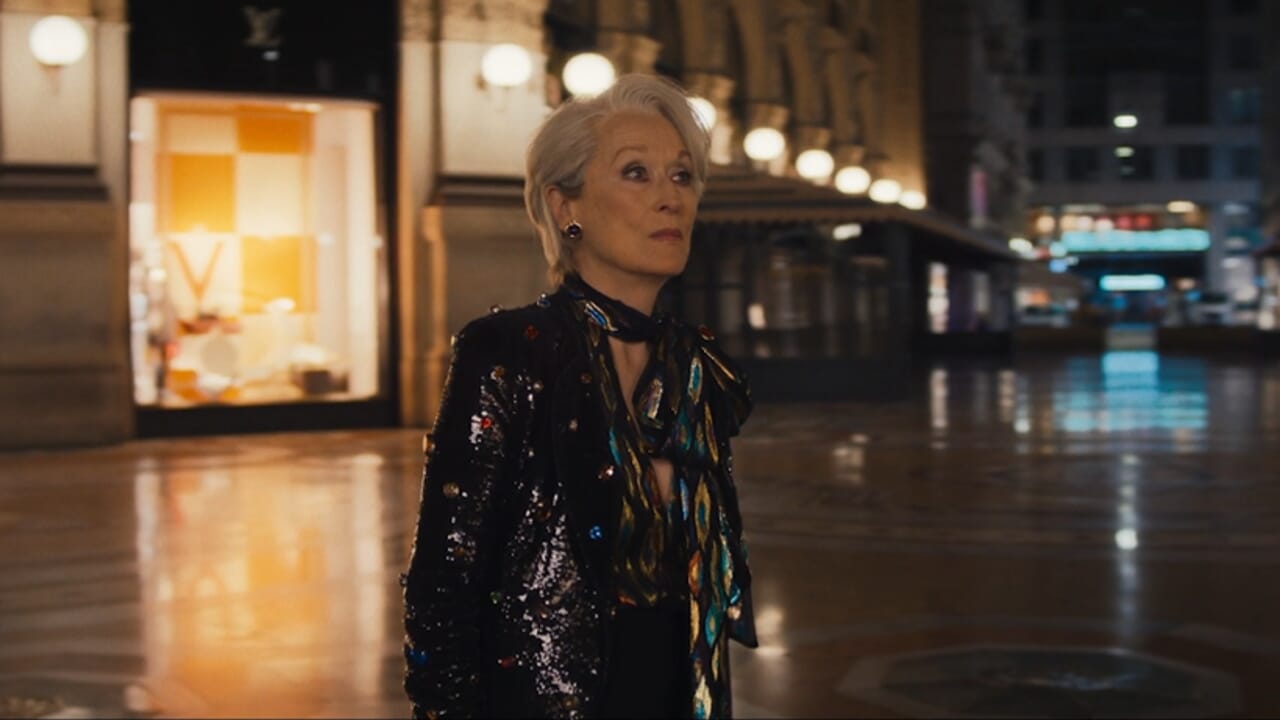
“The Devil Wears Prada 2” is a more necessary film than the first. Yet it risks being less understood
“The Devil Wears Prada 2” is a more necessary film than the first. Yet it risks being less understood. In fact, it was easy to become passionate about “The Devil Wears Prada 1”, when the glossy world of fashion magazines was in hype: at the time, for the public, observing Miranda Priestley’s life was like spying through a peephole on something extremely attractive because it was luxurious, inaccessible and unattainable. However, it is much more difficult to be fascinated by the story today that Miranda has collapsed, inside and outside of fiction, along with her entire publishing empire. Yet it is precisely now that its history can teach us something, or at least more than the era.
First of all, a premise. “The Devil Wears Prada 2” is a successful sequel. Not only for its credible screenplay, but also because it has maintained its primary characteristic: ruthless sincerity. As many will remember, in fact, the first chapter represented a comedy, but above all a real denunciation of the despotic Anne Wintour, director of “Vogue”, and of certain toxic dynamics of the fashion system (the attention to the body, a certain snobbery: elements which, we assure you, were even more evident in the book than in the film). Well, twenty years later, we can say that the devil has maintained his vocation: adherence to the raw truth of the facts. He did so by reporting on the crisis of journalism, now replaced and harassed by social media, without therefore lying to himself. And so, thanks to the use of figures like Andy and Miranda, he has made mainstream a topic that until now was confined to professionals, but which in reality concerns us all. (“Oh, of course I get it: you think this has nothing to do with you,” Miranda would say. And yet it has a lot to do with you.)
The inexorable crisis that journalism is facing is photographed mercilessly right away, at the beginning of the film: Andy and his colleagues are in fact fired on the spot with a simple message on their cell phone, despite (moreover) having just received an award for their investigation. Nothing could be more real: just since the beginning of the year, in America, a third of the Washington Post’s editorial staff has been decommissioned. “We stopped being a magazine a long time ago. Today we work digitally, that is, we produce content that people can scroll through while they are in the bathroom”, says Nigel, Miranda’s long-time assistant, underlining the decrease in quality of information in recent years. And up to this point, perhaps, he is not telling us anything new: by now we should know that, by relegating information to rapid and distracted consumption for years, we have knowingly renounced quality. From victims and executioners.
“I’ve spent my career understanding what people need to know, now I need to understand what they want to click on”
However, there is one phrase from Andy that, more than the others, speaks to the future. And he pronounces it when, faced with yet another published investigation, he realizes that no one has read it. “I’ve spent my career understanding what people need to know, now I have to understand what they want to click on,” he exclaims, in a sudden realization. And, in this sentence, it’s all there. Or rather, there is the toxicity of the way in which, in recent years, we have begun to inform ourselves: not what we “have” to know, but what we “want” to click on. We no longer read a newspaper from beginning to end, from the most important news to the lightest one, but we let the algorithm – on Google or Facebook – rain down on our heads the news that most affects us emotionally: the one that most resembles us. And so, instead of letting the newspapers open our minds, we remain trapped in a feed that only confirms our interests, our beliefs, our prejudices.
I mean, do you really think that a thirty-second reel is there to explain the war in Ukraine to you? No: it’s there to make you quickly take a stand. The one you already tend towards.
Is “The Devil Wears Prada 2” a film worthy of its predecessor? Yes, if we know how to grasp its meanings
Tech billionaires in charge of information: the satire on Jeff Bezos and Elon Musk
Then there is another theme that “Prada 2” addresses. And that concerns everyone a bit. It is the hands in which the information ended up: tech billionaires, or very rich heirs, who find themselves managing enormous publishing empires without ethics. The figure described is no longer that of the “old-fashioned” publisher passionate about print media, but that of the Silicon Valley technocrat who buys newspapers – and social media themselves – as a tool of political or economic influence, or as an image trophy.
In this sense, at a certain point “Runway” risks being purchased by a questionable character: the tech magnate Benji Barnes, intending to intervene heavily in the magazine, regardless of its cultural authority. He is a figure in which many have seen some references to Jeff Bezos and Elon Musk – in the obsession with the physicist, for example, or in the expansionist aims on Mars – and which serves to talk about a very hot topic in America: that of the interference of technocrats on information. Of course, in the film there is no direct mention of the events, nor any nod to politics, but it is worth underlining that both characters mentioned above ended up at the center of controversies of this kind: in 2024 Bezos, current owner of the “Washington Post”, was widely criticized for having blocked the editorial staff’s endorsement of Kamala Harris (thus distorting the newspaper’s nature and leading to a collapse in subscriptions); as for Musk, however, it is redundant to remember how, after purchasing the X platform (formerly Twitter), he put it at the service of Trump’s politics. SPOILERS FROM HERE ON
Returning to “Runway”, in the end the magazine is saved by a woman, the ex-wife of a powerful entrepreneur, who decides to leave full independence to the journalists. And who knows if it is a coincidence that, in “real life”, Lauren Powell Jobs, widow of Steve Jobs, is highly appreciated: after purchasing “The Atlantic”, she guaranteed journalists all the autonomy necessary to produce a quality newspaper.
“The future will come like a lava flow”
But “Runway,” to use Miranda’s words, was lucky. “It’s the last piece of wood floating near the Titanic,” he says. And the comedy has, as per its nature, a happy ending. Off-script, however, journalism remains grappling with its ethical, economic and identity problems. And, above all, with the nightmare of the Ai, “a future that will arrive like a lava flow”, to use Barnes’ words. Problems which, however, from today, are finally in everyone’s consciousness.
