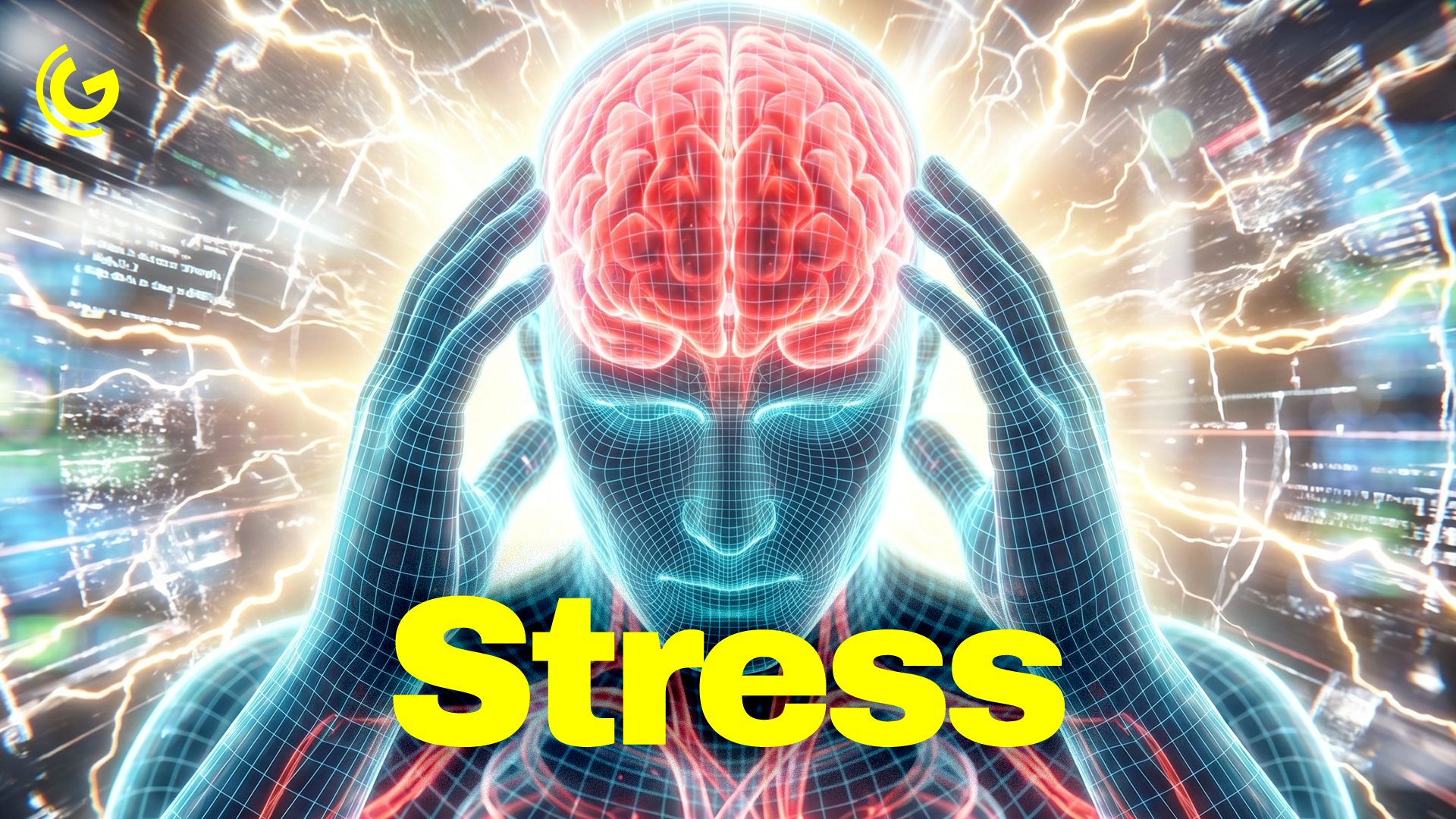
Tense shoulders, mind that won’t stop, struggling to sleep even when you’re exhausted. That feeling of always having something to manage, to predict, to keep under control. We usually say, “I’m stressed.” But in the body stress is not just a sensation, it is a precise biological response, the way in which the brain and organism reorganize themselves when they understand that there is something important to deal with. If we look at it from this angle, it’s almost a superpower. The problem is that we often use it incorrectly.
What is stress from a neurophysiological point of view?
Simply put, stress is a warning mechanism that the body activates when it senses something important, urgent or dangerous. It is a reorganization of resources: the body decides to focus all its energy on an immediate problem, putting non-essential processes (such as digestion, tissue repair or hair growth) on “pause”.
Everything starts from an evaluation. Three areas of the brain work together to decide whether we should act:
- The Amygdala: our “smoke detector”. It is very fast and raises the alarm immediately.
- The Hippocampus: the memory archive. He asks himself: “Have we already experienced a similar situation? How did it go?”. Helps calibrate the reaction.
- The Prefrontal Cortex: the rational part. Consider whether the challenge is within our reach or whether it risks crushing us.
If the answer is “we have to get active”, the brain speaks to the body at two different speeds:
- Immediate route (Adrenaline and Noradrenaline): within milliseconds the heart accelerates, the bronchi dilate to take in more oxygen and the liver releases sugar (glucose) to give instant energy to the muscles. We become hypervigilant.
- Slow way (Cortisol): if the situation is not resolved immediately, cortisol, the stress hormone, comes into play. It helps keep the system active longer. The problem? If cortisol remains high for too long, it starts to cause damage: insomnia, accumulation of abdominal fat and decline in immune defenses.
“Good” stress and “bad” stress: the performance curve
There is a fine line between being productive and being exhausted. Scientists explain this with a bell curve:
- Eustress (Good Stress): It is the phase in which pressure stimulates us. We are focused and ready for the challenge. It is stress that makes us shine during an exam or a sports competition.
- Distress (Bad Stress): Beyond a certain limit, the system becomes overloaded. The prefrontal cortex (the one used to reason) begins to function worse. Anxiety, mental fog and mistakes arrive.
When we are in full “distress” and can’t think, doing small repetitive tasks (such as tidying up the desk or cleaning the house) can help to “unload” the system and lower the alert level.
Why do we get sick from stress?
The reason lies in what biologists call evolutionary mismatch. Our neuroendocrine architecture has refined itself over millions of years to respond to acute, physical threats. Let’s imagine the animal model of a zebra in a savannah that sees a lion: the encounter with a predator triggers an immediate response of the Sympathetic Nervous System . In a few seconds, the secretion of adrenaline and norepinephrine shifts the organism from a state of internal balance to a state of emergency aimed at survival. Once the danger has passed, the system turns off and the physiological parameters return to baseline ranges.
The problem is that we use this exact same “machine” to manage natural stimuli psychosocial and chronic.
Our limbic system, and in particular the amygdala, does not have a real biological filter capable of distinguishing between a life threat and an imminent work deadline. For the brain, an aggressive email from the boss or the constant thought of bills activate the same biochemical cascade. However, while the zebra lion disappears after a few minutes, the stressors of modernity are persistent.
This turns an adaptive response into a allostatic load: the organism is no longer able to return to the original equilibrium point, but is forced to “set” itself on constant activation levels that become pathological. In technical terms, we go from beneficial acute stress to one chronic hyperactivation. The result? Prolonged exposure to glucocorticoids (such as cortisol) which, if in the short term are anti-inflammatory, in the long term become toxic for the tissues, for the neurons of the hippocampus and for the cardiovascular system.
Chronic stress: like elephants on a swing
Neuroscientist Robert Sapolsky uses a beautiful image: keeping your body in balance is normally like balancing a swing with two children. Under chronic stress is how to do it with two elephants. Maybe the balance holds, but the structure creaks and wears out.
Here’s what happens over time: the brain enters a state of difficulty in making decisions, irritability and insomnia, constantly high blood pressure increases the risk of heart attacks and strokes, the body could accumulate fat on the belly as an energy reserve for an emergency that never ends, the system gets “high”, making us more susceptible to infections or autoimmune diseases, in addition to the fact that constant muscle tension very often leads to headaches and neck pain.
The question is not how to eliminate stress, but how to learn to “turn it off”. If you feel your mind not stopping and physical symptoms of stress, your body is telling you that it has been in “alert” mode for too long.
