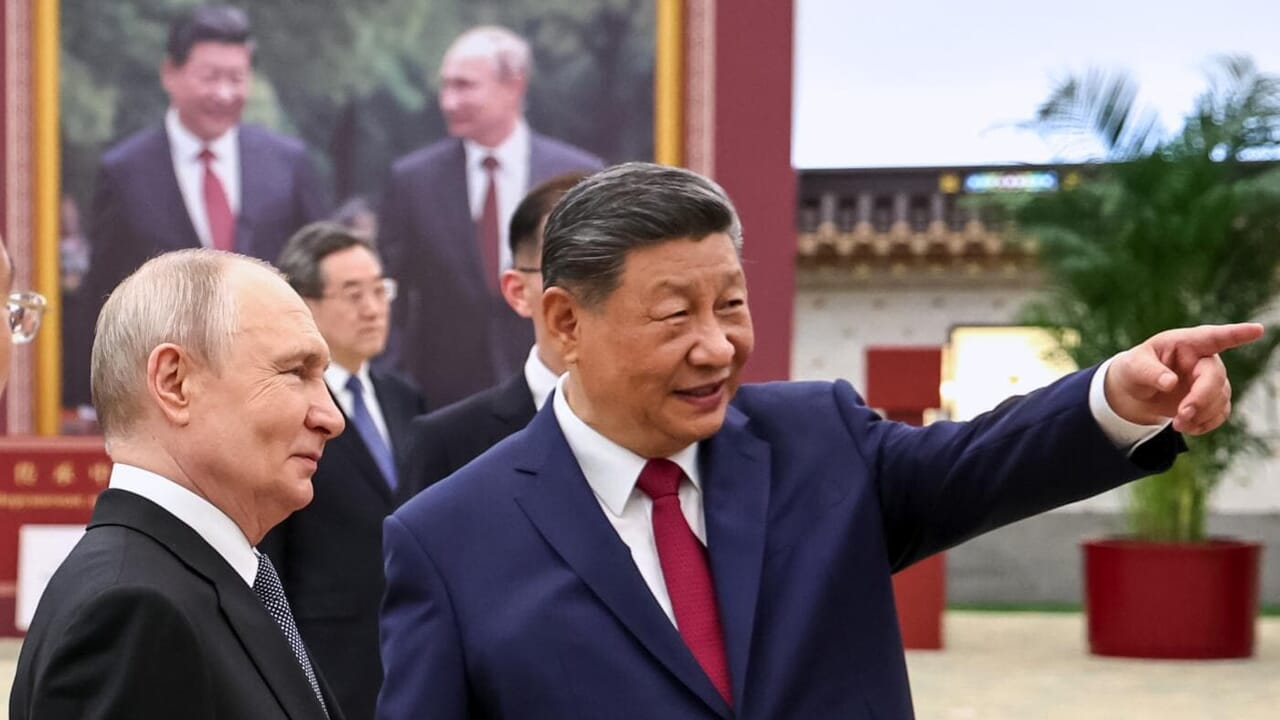
It is China that dictates the pace
We had already written about how, according to the new “US Strategy for National Security” document published by the White House last December, the only global adversary of the US superpower is China and how much effort Trump’s America must make in order to gain ever more influence and power in the Indo-Pacific region and hold the hegemony of the Western hemisphere. It is a pity, however, that Donald Trump went to the meeting with the President of the People’s Republic of China Xi Jinping in an extremely difficult position, due to the Iranian conflict, after having committed a serious crime: having brought disorder and economic uncertainty – if not a real energy catastrophe – following the closure of the Strait of Hormuz.
Roses, smiles and no signatures: the US-China summit leaves Trump empty-handed
The summit itself did not lead to any agreement. Donald Trump was welcomed with all the honors due to the head of state of the world’s largest superpower. He was able to enjoy the view of the magnificent garden of Xi’s residence, the Zhongnanhai – it seems that the Chinese leader will have some magnificent roses that impressed Trump delivered to the White House – and was able to bring with him all the major exponents of the US business world, mostly the big tech bosses, hungry for new and advantageous trade and economic agreements. But, in the end, he didn’t make any real deal.
The meeting produced a series of agreements which, although without resolving the structural tensions between the two powers, indicate a mutual desire to stabilize the confrontation. In short, a sort of study phase, but no signature or concrete commitment. On an economic level, the most significant result concerns a partial trade détente. Washington has agreed to ease some restrictions on non-sensitive technology goods, while Beijing has promised increased imports of US agricultural products and greater openness for foreign businesses in selected sectors. On a geopolitical level, Trump and Xi Jinping have reiterated their commitment to maintaining open communication channels on sensitive dossiers such as Taiwan and the South China Sea, with the declared aim of preventing military incidents. But the elephant in the room – or should we say “the dragon” – is the Iranian conflict, because it is precisely this that puts Trump in an extremely weak position.
Xi at the center of the global triangle: between Putin and Trump, China dictates the pace
Even more so since China is now the prominent summit of a triangle that sees it juggling between Vladimir Putin’s Russia and Donald Trump’s USA. And the two state visits, one after the other within a few days of substance, show the world in the most plastic way possible the central role that Xi Jinping now plays on the negotiating table. The meeting between Xi Jinping and Vladimir Putin, after the one with Trump, takes place against the backdrop of a delicate balance in which the figure of the American Tycoon, now the third protagonist, also weighs heavily. Beijing sends a double signal: it does not abandon Moscow, but presents itself as a central interlocutor for both powers. Xi thus strengthens his image as a global leader, aiming to overtake the USA in the future, while maintaining a pragmatic profile. China benefits from the difficulties of others: the war in Ukraine weakens Putin, while tensions in the Middle East distract Washington, which appears in the eyes of the world as the main architect of the economic, financial and energy earthquake that is putting the global economy on edge. Meanwhile, Beijing supports Moscow in a concrete way, without breaking with other international players, and responds firmly to American commercial pressure. If Trump suffers and is shown to be condescending towards Xi, Putin, for his part, arrives weakened both militarily and diplomatically. Despite this, the agreement with China remains vital. Xi welcomes him and reassures him, keeping alive an alliance which, although complex, continues to be based on mutual interests.
The Gulf crisis upsets the balance
The Third Gulf War, with the crisis taking place in the Strait of Hormuz, has given China the strategic leverage to turn the table and keep the upper hand in negotiations with Trump’s US. The crisis with Iran has reached a point where American military strength is no longer enough to guarantee a decisive outcome. Tehran is not obliged to win: it just needs to hold out long enough for it to transform the Strait of Hormuz into its main instrument of pressure against Washington, to the detriment of the entire world economy. Energy, inflation, maritime traffic and Asian growth pass through there. The paradox for the USA is that the more the pressure on Tehran increases, the more the strategic weight of Hormuz grows and, consequently, the negotiating weight of its most dangerous enemy: China. For this reason the military solution appears less and less practicable and diplomacy becomes central again. China is Iran’s main energy customer and one of the few leaders capable of truly influencing Tehran. Beijing does not want Iranian collapse, useful as a partner and anti-American leverage, but neither does it want an out-of-control escalation that would damage global trade and, therefore, its interests.
In this scenario, China assumes the role of main negotiator between the parties, gaining further prestige against its US contenders. Presenting Beijing, in the eyes of world public opinion, as the bearer of dialogue and moderation, while Washington as a loose cannon, whose sole aim is to bring chaos and upheaval around the world. For these reasons, the crisis in the Middle East offers China only advantages: it wears down the United States and its image as a world leader, distracts Washington from the Indo-Pacific – entangled as it is in the Middle East – and strengthens Beijing’s global weight. From this perspective, then, there is an element very dear to Xi Jinping: Hormuz and Taiwan are starting to intertwine, signaling that the Middle East and Asia are no longer two separate dossiers but parts of the same geopolitical confrontation. And so here we are again at the demolition of one of the pillars of the “US Strategy for National Security”. The US can no longer treat the Middle Eastern region separately from the Indo-Pacific region. A dogma falls and with it a large portion of America’s strategic advantage. If we want, this difficult international situation is the greatest and most harmful legacy that this administration will leave to those who come after.
