There washing machine it is an appliance that is now essential in our daily lives as it significantly optimizes the maintenance of clothing, automating a process that, otherwise, would be time-consuming, and guaranteeing practicality, energy efficiency and quality results superior cleaning compared to traditional washing methods. The operation of the washing machine is generally intuitive; however, in emergency conditions or due to lack of experience with the device, they can errors occur which negatively influence the performance of the washing cycle. In order to mitigate these issues, it is recommended to acquire knowledge of the main functional components of the system, as well as the technical specifications and differential modes of the programs that can be selected.
The main components of the washing machine
The washing machine is an electromechanical device consisting of a integrated whole of mechanical and electrical components that interact synergistically during the washing cycle. The central control element is represented by timer or selector programswhich acts as a coordinated management unit of the various functional modules. This component is composed of a knob external connected to an electronic board equipped with a microprocessor, which processes the program stored in a non-volatile memory, regulating the operating sequence based on the data received from the sensors distributed within the system. Installed near the door there is theelectric locka component with a dual function. The first is to act like door closing sensorallowing you to monitor the position of the door; this control is crucial to ensure safety, since the management system prevents starting the wash cycle if the door is not closed correctly. The second function concerns the mechanical door lockwhich is activated by the control unit at the beginning of the cycle, preventing opening the door while the washing machine is operating.
The quantity of water introduced into the tank is regulated by asolenoid valve: an electromechanical device similar to a faucetelectrically controlled by the central unit and positioned at theattack of the loading hose. Although the terms “basket” And “basin” are sometimes used interchangeably, they identify two distinct elements. The basket represents the perforated drum which houses the items to be washed, visible when the door is opened; the tub, on the other hand, is the container outside the basket, designed to contain the volume of water necessary for the washing operation which, reaching the desired level, penetrates the basket through the holes in the drum. A connection duct branches off from the solenoid valve and conveys the water directly to the drawer dispenser of the detergentscomposed of several separate compartments, usually identified by markings to indicate the specific function:
- The compartment marked with the number “1” or with one single vertical line is intended for the administration of detergent for the prewashincluding bleaching agents, active oxygen powders or bleach;
- The compartment identified with the number “2” or with two vertical lines is reserved for laundry detergent main washwhich can be in liquid or powder form;
- The compartment generally indicated by the symbol of a “flower” is designed for the insertion of thesoftener
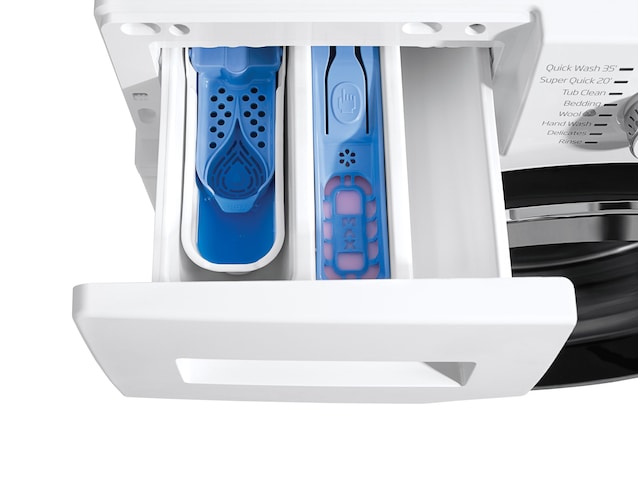
Depending on the selected wash program, the dissolution of the detergents occurs exclusively during the first passage of the water flow through the appropriate compartment. Next, the water is directed into the tub and, once the preset level is reached, the control unit sends a closing signal to the solenoid valve, interrupting the supply through the loading pipe. The rotation of the basket is driven by an electric motor, whose motion is transmitted by a belt to a pulley located in the rear part of the machine. Considering that the effectiveness of the detergent is directly related to the temperature of the water, the washing machine is equipped with one electrical resistance which is activated exclusively during the washing phase for the heating of the water flow.
At the end of the wash cycle, water evacuation occurs through one pump which conveys the fluid towards the exhaust duct. This operation is managed temporally by the control unit which powers the pump for a pre-established interval, ensuring the complete emptying of the basket. On the back of the pump there is generally a filterdesigned to retain fluff deriving from clothes or foreign bodies present in the tub; this filter is protected by a cork accessible from the outside and a removable plastic cover, which allows inspection and maintenance.
How a wash cycle is structured
A wash cycle consists of a sequence of five operational phases which follow one another automatically based on the settings selected on the appliance: prewash, wash, rinse and spin. Each of them has a specific function in the cleaning and treatment process of the garments.
Prewash
There prewash phasewhich can be optional or included in high intensity wash programs, consists of a preliminary treatment during which the clothes are kept in “soaking” in heated water inside the drum, which performs partial rotations to ensure uniform immersion of the garments. In this passage, a flow of water, channeled through a jet, dissolves the detergent, allowing uniform distribution in the drum.
Washing
During the washing phasethe basket initially performs alternating movements aimed at ensuring adequate mixing of water and detergent, as well as promoting deep penetration of the detergent solution into the textile fibres. The subsequent rotations, the duration of which varies depending on the program selected, have the purpose of moving the items to optimize the chemical action of the soap.
Rinsing
Once the washing phase is completed, the cycle begins rinsingduring which the tub is filled with water at room temperature (or cold) and the basket is rotated, in order to ensure the total elimination of detergent residues from the clothes.
Centrifuge
All wash cycles, with the exception of those dedicated to highly delicate garments, include a centrifuge phase in which the basket rotates for a predetermined time interval with a variable speed between 300 and 1000 rpm (rotations per minute).
https://www.istockphoto.com/en/photo/adjusting-the-settings-on-an-automatic-washing-machine-in-a-modern-laundry-gm2194276818-612452289?searchscope=image%2Cfilm
Difference between the various programs
There program selection washing is carried out through the control knob which allows the choice between different cycles, distinguished on the basis of specific parameters such as the duration of the washing phase, the water temperature, the recommended capacity and the rotation speed of the basket.
Eco program
Among the most common programs is the eco cyclewhich, depending on the washing machine model, operates at temperatures between 40°C And 60°C. This cycle is set to maximize energy and water efficiency, reducing resource consumption, resulting minimization of the environmental impact.
Program for mixed or synthetic items
The program dedicated to mixed items or synthetic fabricssuch as nylon or polyester, runs a wash cycle at a nominal temperature of 30°C with centrifuge included. However, it is possible to increase the operating temperature to a range between 50°C And 60°C without incurring adverse effects, given thehigh mechanical resistance and the low tendency to shrink of such materials.
Program for delicate fabrics
The specific program for delicate fabrics is calibrated for the treatment of particularly sensitive fibers such as silk, satin or protection payment. In order to preserve the structural integrity and surface quality, it is recommended to operate on low temperatures and of limit the centrifugation speed at the functional minimum.
Quick wash program
The rapid cycledesigned for reduced loads, provides for a maximum duration of between 30 And 40 minutes and generally does not include the prewash phase. This program is mainly indicated for garments in cotton or mixed and operates at temperatures of approximately 30-40°C. One is recommended reduced dose of detergent to optimize washing efficiency and minimize chemical residue.
Regular maintenance
To ensure optimal maintenance of the washing machine, it is recommended, should they be found unpleasant odors or training of moldto proceed both to cleaning the filter and the internal sanitization of the appliance through the use of the specific cycle sanitization of the basket.
