
The 2026 World Cup is the largest tournament in history: 48 teams, 104 matches, 3 countries. But there’s one thing that really makes it different from all those that came before it besides the number of teams. They are the technologies hidden on the pitch, on the referees and inside the ball. Among race directors who wear microphones And micro-cameras stabilized by advanced algorithmssmart balls that need to be charged before kick-off and assistants guided by instant notifications in their earphones, the entire tournament turned into the most impressive technological laboratory never seen in sport. This great event “spread” between Canada, Mexico and the United States has officially begun and will accompany us until July 19th: the inaugural match at Azteca Stadiumwon 2-0 by the Mexican hosts against South Africa, got the ball rolling, showing the first fruits of this system on the pitch. But how do these innovations work from an engineering and IT point of view? And how is Big Data changing the rules of the game?
5 tech news from the 2026 World Cup
Referees with AI cameras: how “Referee View” technology works
During the first matches of the 2026 World Cup it was easy to notice a small device mounted on the referee’s head. Is called Referee Viewand it is a camera that broadcasts the match director’s first-person point of view live, visible both on TV and on the giant screens in the stadiums. It is added to the microphone used to explain to the entire public the decisions made after VAR reviews, a practice also introduced in the last Italian Serie A season.
The problem with this technology, which has existed in experimental form for a few years, had always been the same: when the referee runs or sprints, the images shake so much as to be almost unusable. The broadcasters had made this clear to FIFA. Thus, in view of 2026, Lenovo — FIFA’s official technology partner — has developed AI-based stabilization software that analyzes camera micro-vibrations in real time and “dampens” them before the frame even reaches the director. The certified result is a reduction of motion blur (motion blur) up to 50%with the computing servers physically installed in the International Broadcast Center in Dallas, Texas.
The Referee View was first tested at FIFA Club World Cup 2025with results that the President of the FIFA Referees Commission himself, Pierluigi Collinahe defined it as having gone “beyond all expectations”
At the 2026 World Cup it is officially part of the regulations: the IFAB — the body that decides the rules of football — has updated the Law 5 (the one governing the role of the referee) during its February 2026 AGM in Swansea, Wales, to explicitly include body-worn cameras as a “competition option”
The 2026 World Cup ball needs to be recharged: the technology behind “Trionda”
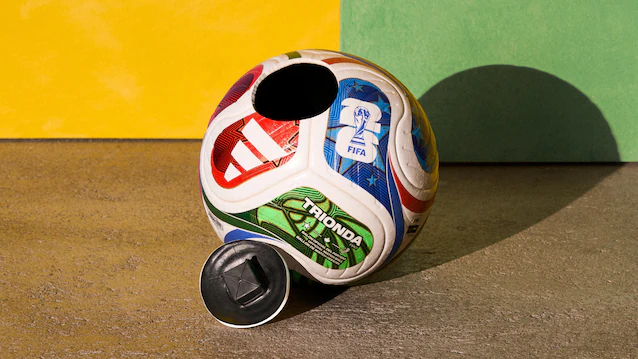
The official match ball of the 2026 World Cup is called Triondafrom the union of the Spanish tri (three) andonda (wave), in homage to the three host countries. It is produced by Adidas in collaboration with the German tech company KINEXON. On the outside it looks like a normal football. Inside one of its four panels there is a small 14 gram revolution.
That component is called IMU (Inertial Measurement Unit, or inertial measurement unit): a sensor chip that records acceleration, rotation, spin and every single contact in three dimensions for 500 times per second. All this data is transmitted wirelessly in real time to the VAR room, where it is cross-referenced with data from the optical tracking cameras installed in each stadium
The most curious practical consequence? To run this whole system, the Trionda has an internal battery. And so the ball goes physically rechargedand before every game.
Offsides in real time: the AI algorithm in linesmen’s headsets
The referee assistant’s headset (the linesman) is not just a communication system with the central colleague. At the 2026 World Cup, a automatic alert generated by artificial intelligence which informs him in real time when an attacker is in an offside position.
This changes everything compared to before. At the 2022 World Cup in Qatar, when the system detected a potential offside, the information was first passed to VAR, which validated it and then communicated it to the central referee. Now, for purely positional offsides (i.e. when the attacker is physically beyond the last defensive line, regardless of his possible interference in the game), the alert arrives directly into the assistant’s headsetskipping the VAR step.
The sensitivity threshold has also been refined: the system already signals offside 10 centimetres of advantage. The assistant can always choose not to raise the flag if he believes there is an error (the final decision remains human).
3D scanner and player avatars: SAOT technology in offsides
Before every match of the 2026 World Cup, when you see the replay of an offside on the stadium screen and the players look like characters from an ultra-realistic video game, you are not looking at generic graphics. You are looking at a 3D reconstruction based on the real body of that player.
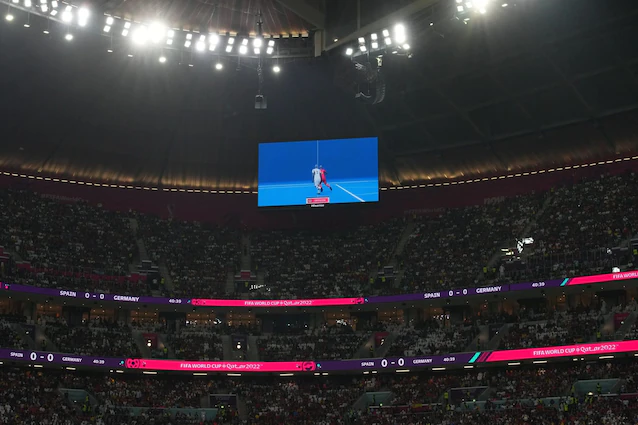
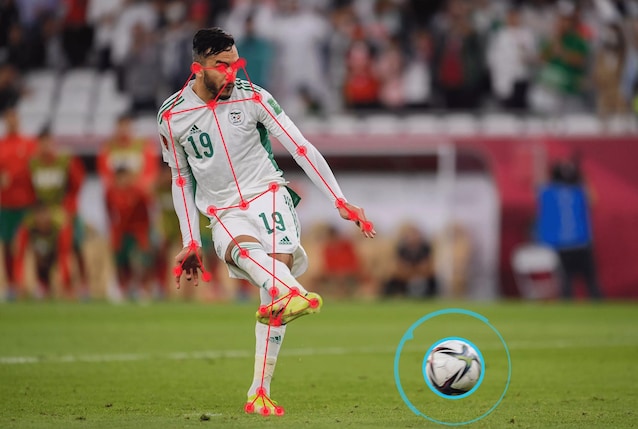
All the 1,248 players of the 48 participating national teams underwent a three-dimensional body scan. The resulting digital model (the3D avatars) is integrated into the system semi-automated offside technologythe SAOT, which uses it to calculate with millimetric precision the position of each limb at the moment of passage
The tracking system that powers all this monitors 29 specific points on the body of each player (all joints and extremities relevant to the offside) for 50 times per secondusing 12 dedicated cameras mounted under the roof of each of the 16 stadiums. When VAR needs to explain a decision to the public, the 3D reconstruction does not use a generic humanoid model, but the personalized avatar of Mbappé, Vinicius or whoever was involved in the action.
Big Data in football: why a match generates 150 million data
Putting together all the technologies described so far, the 2026 World Cup is probably the largest sports data collection experiment in history. They are installed in every single stadium 16 optical cameras that produce beyond 150 million tracking data points per match. This data is used to feed the tactical analysis system Football AI Pro made available to all 48 participating teams, and to broadcasters, who can generate 3D highlights and reconstructions for audiences at home.
To give an idea of the logistical complexity: Lenovo manages this mass of data through physically distributed infrastructures, with servers in the International Broadcast Center in Dallas simultaneously supporting real-time analysis, broadcast transmission and archiving. According to Lenovo technicians involved in the project, the World Cup final could be the single event with the highest data transmission volume in history.
