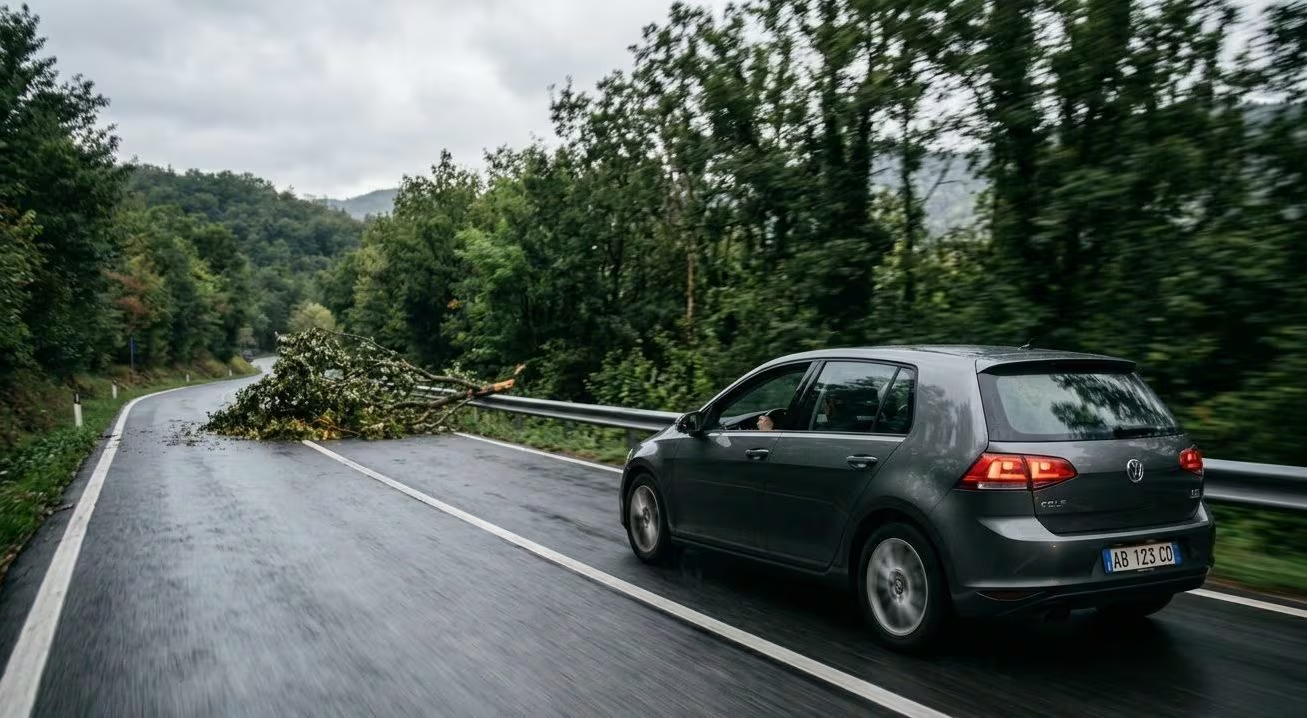
The reaction space it is the distance that a means of transport travels from the moment in which a danger arises to the moment in which the driver starts to brake and, together with the braking distancecomposes it stopping space necessary to stop the vehicle. The reaction space does not depend on the characteristics of the vehicle or the road, but mainly depends on the speed of the vehicle and the psychophysical conditions of the driver. Let’s see how to calculate it and what changes at different speeds, 30Km/h, 50Km/h, 90Km/h or 130Km/h.
Let’s imagine ourselves driving a car when suddenly a danger appears on the road. From the moment we perceive it, a series of things happen before braking begins (in the case of a motorbike this procedure can be slightly different and also involve the use of the hands):
- our brain processes the information and sends the command to brake to the foot
- The foot he lifts himself from the accelerator pedal and moves to the brake pedal
- the foot starts brake pressing on the brake pedal.
All these steps do not happen instantly and a certain amount of time passes before we start to brake, as said reaction timewhich can range from half a second to several seconds, depending on the psychophysical condition of the driver. On average the reaction time is just under a second, but by convention and ease of calculation it is generally considered 1 second if the driver is in optimal psychophysical conditions, for example if he is rested and not under the effects of alcohol.
As the reaction time passes, the vehicle continues to go at the speed it was traveling at before the obstacle appeared, without slowing down, covering a certain distance which depends on the speed and which can be easily calculated.
How to calculate braking distance
Let’s see how to calculate this distance starting from case of 50km/h which correspond to the standard speed limit in urban centres.
First of all, to be able to visualize the result well, let’s convert the 50 km/h into meters per second. To do this, multiply by 1000 to find how many meters you travel in one hour, i.e. 50 km/h = 50000 m/h, then divide by 3600 to find how many meters you travel in one second: 50 km/h = 50000 m/36000 s ≅ 13.89 m/s.
In practice, going at a speed of 50 km/h, if a obstacle, before you even start to brake you travel almost 14 metres, which is more or less the length of an urban bus (RIF), or just over 3 small cars one behind the other, or almost 5 floors of a building, a non-negligible distance. If the obstacle is a pedestrian crossing the road, and we realize it when we are less than 13 meters from the crossing, when we start braking we will have already hit him. In general, if we go at 50 km/h, any obstacle appears in front of us less than 13 mfor example at 10m, will be destined to be hit from our vehicle before we can even start to brake.
Things improve significantly if our speed is lower. In case we proceed to 30 km/haccording to the limits of some urban areas, multiplying by 1000 and dividing by 3600 we obtain that 30 km/h ≅ 8.3 m/s, therefore in 1s we travel approximately 8.3 m, a decidedly shorter distance and this time if the obstacle presents itself at 10 m from where we are we can start to brake a little before reaching it.
This type of calculation can also be done faster, in fact multiplying by 1000 and dividing by 3600 is the same thing divide by 3.6. We use this shortcut to calculate the reaction space relative to the velocity of 90 km/hthe standard limit of extra-urban roads, we obtain 90 km/h = 90 ÷ 3.6m/s = 25 m/s, that is, during the reaction time, we travel well 25 m which is equivalent to an 8-storey building. Things, as expected, get even worse if we consider the speed limit of Italian motorways, 130 km/hin this case we will have traveled well before starting to brake 36 mlike a 12-story building.
These reaction distances that we have calculated refer to the case of a driver in optimal psychophysical conditions, but in different conditions the reaction time can increase and so the reaction distance in a proportional manner, for example if the reaction time doubles then the reaction distance also doubles: if we go at 50 km/h we could travel over 25 m before even starting to brake, if we go at 130 km/h we could travel 62 m before starting to brake, like a 20-storey building.
