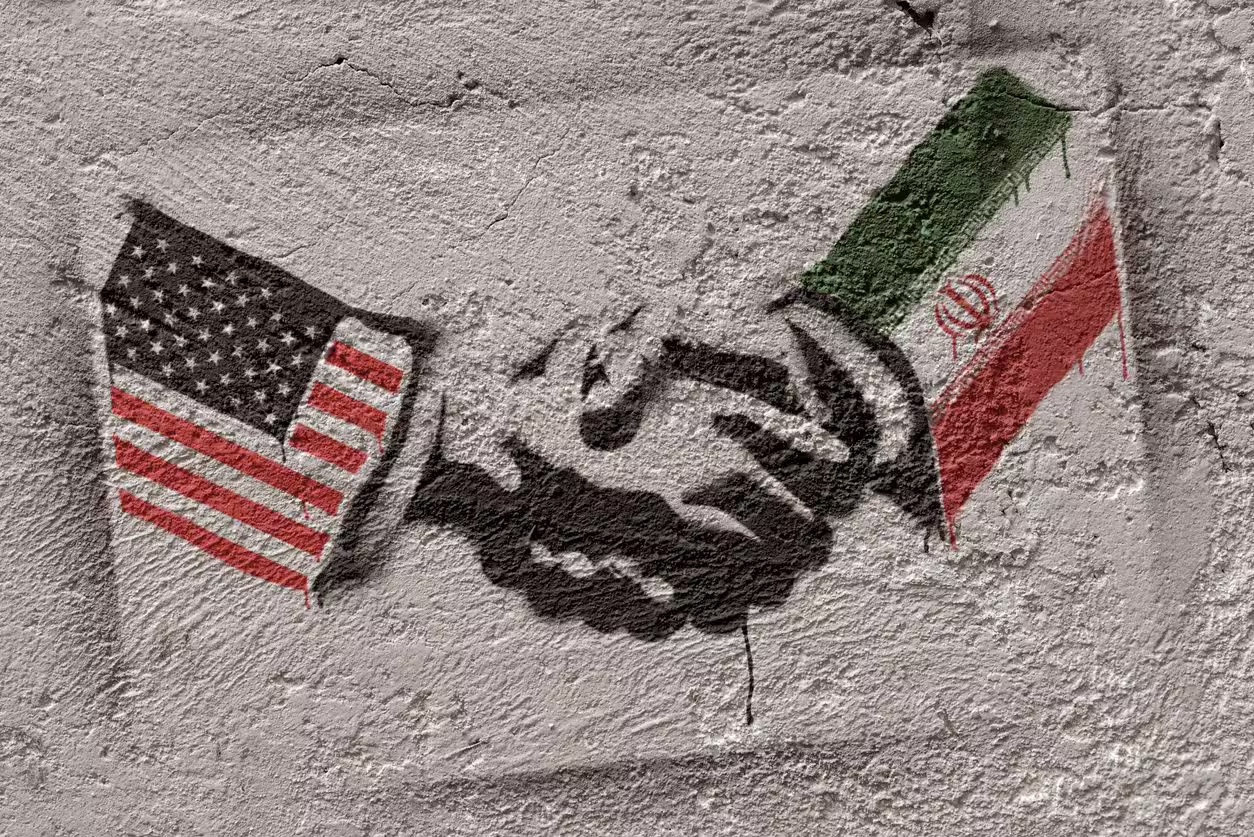
After over one hundred days of war, United States and Iran they announced that they had achieved a agreement which will lead to reopening of the Strait of Hormuzwith the end of the naval blockade American. The official signature is set for Friday 19 June in Geneva, in Switzerland: the most delicate dossier, the one dedicated to the Iranian nuclear program, will instead be postponed to a second phase of negotiations.
The announcement came on Sunday 14 June, with the Pakistani prime minister Shehbaz Sharif who confirmed, via a post on The markets reacted positively to the announcement, with the price of Brent oil (the benchmark in Europe) being at $83.59 per barrel: such a low value has not been seen since March.
The agreement, it must be said, is there anyway hanging by a thread and it could fail even before the official signing, especially after Israel has declared that it will continue its bombing in southern Lebanon regardless of the outcome of the agreement.
What we know (and what we don’t) about the US-Iran deal
The first thing to clarify is that, at the moment, the precise terms of the agreement are not public: as mentioned, the agreement would provide for the immediate and permanent end of military operations on all fronts, including Lebanon, but the exact details are not yet known. The versions of the agreement circulated in the last few hours are limited to outlining a general framework more than anything else.
According to some rumors reported by the New York Times, we would find ourselves faced with a memorandum of understanding, that is, a document that establishes principles and intentions, without delving into the binding obligations in detail. Specifically, the Atlantic Council describes it as a 14-point plan that formalizes the fragile ceasefires in Iran and Lebanon and outlines areas of future negotiations.
The most complete draft so far was released by the Iranian News Agency Mehraccording to which the text would concern, among other things:
- There permanent cessation and immediate hostility on all fronts, including Lebanon.
- There revocation complete with US naval blockade within 30 days.
- The United States’ commitment to withdraw their forces from areas around Iran.
- There reopening of the Strait of Hormuz.
The draft would also mention the suspension of sanctions on oil sales, reaching a final agreement on nuclear issues within 60 days of signing the agreement and unlocking $24 billion in frozen Iranian assets during the 2 month trading period.
In short, on a concrete level the most certain points would be three: the reopening of the Strait of Hormuzthe end of the naval blockade USA of Iranian ports and the extension of cease-firewhile discussions on Iran’s nuclear program are postponed for further talks for another 60 days.
It must be said, however, that these rumors have not yet been officially confirmed: in any case, from this draft it already appears clear how the memorandum does not resolve the underlying issuessuch as the functioning mechanisms of the Strait of Hormuz, Iranian nuclear concessions and the easing of sanctions towards Tehran, all topics that will be discussed in a second phase.
In terms of timing, the signing is scheduled for Friday 19 June in Geneva and may take place electronically by the US President, or in person by Vice President JD Vance. Trump has already declared the agreement concluded, authorizing the “toll-free” opening of the Strait and the removal of the American naval blockade, but caution is a must in these cases: analysts warn that there will probably be significant changes between the possible points written down in the memorandum and what will actually emerge from the final agreement.
The Strait of Hormuz will reopen, but it will take months to restore energy flows
The memorandum of understanding will therefore allow the (almost) immediate reopening of the Strait of Hormuz: the problem is that, on paper, reopening the Strait is not equivalent to restoring energy flows to the same pre-conflict levels.
The Atlantic Council itself invites you to Don’t take a quick return to normality for granted: the ceasefire, at the moment, is extremely fragile and risks delaying mine clearance operations, effectively slowing down the complete restoration of energy supply and keeping risk premiums high.
Moreover, over 3 and a half months of stoppage cannot be recovered in a few days, given that the war also caused it damage to refining infrastructure of oil and processing of liquefied natural gas (LNG)such as the Ras Laffan plants in Qatar. Facilities will therefore require extensive repairs and, even in the most optimistic scenario, returning to normality will take several months. Meanwhile, global oil supplies have been shrinking at a record pace (after being largely depleted to compensate for supply losses during the conflict) and it will take countries some time to restore them to initial levels.
Meanwhile, Western economies are already paying the bill, with the European Central Bank which last week she was forced to raise interest rates (for the first time in three years) to counteract the increase ininflationgoing from 2% to 2.25%.
Who won the conflict? The difference between US tactics and strategy
We therefore come to the question that many are asking: who emerges victorious from over a hundred days of conflict? As underlined by several analysts, the answer that emerges is rather inconvenient for Washington. The agreement is probably the best possible outcome, but perhaps it is not what the United States and Israel had foreseen when planning the attack against Iran on February 28th.
On the military levelit must be said, i results there are and are relevant. The Trump administration can claim to have decimated key elements of Iranian military power and eliminated top figures in the regime, including Supreme Leader Ali Khamenei himself.
But this is where it comes in difference between tactics and strategy: Despite these tactical successes in the military field, the war for the USA was a strategic failurebecause the desired regime change did not take place and the Pasdaran even emerged strengthened, after the retaliation carried out throughout the Gulf.
The biggest paradox concerns itself the declared objective of the conflictwhich was to stop Tehran’s nuclear program: the war may have convinced the Iranian leadership of the opposite, that is, that a nuclear deterrent is the best way to ensure survival.
Then there is the management of the Strait of Hormuz to consider, which weighs on the future. Iran has demonstrated that its historical threats to close Hormuz they were not a bluff and that, in fact, a possible block is capable of bring the global economy to its knees: the ability to close the Strait – which remains in the hands of Tehran – is a powerful weapon that the country will have threaten to use again in the future. That’s why this peace looks more like a truce than a solution. The most likely scenario is that of a temporary and fragile agreement, which at best will avoid a new war until the end of this administration.
The unknowns about the second phase of the negotiations, however, do not help. Washington has not shown the patience necessary to implement a complex nuclear deal with new verification measures, while Israel appears opposed to any agreement and will use its influence (and attacks in Lebanon) to hinder it. On the Iranian front the picture is equally tense: the new Supreme Leader Mojtaba Khamenei may not want anything more than a small transactional agreement.
In short, the United States they won almost all the battles, but they may not have won the war (or at least not as they expected to do). And the Strait of Hormuz, which was the initial issue, remains exactly where Iran left it, the same country that can arbitrarily decide to close it again.
