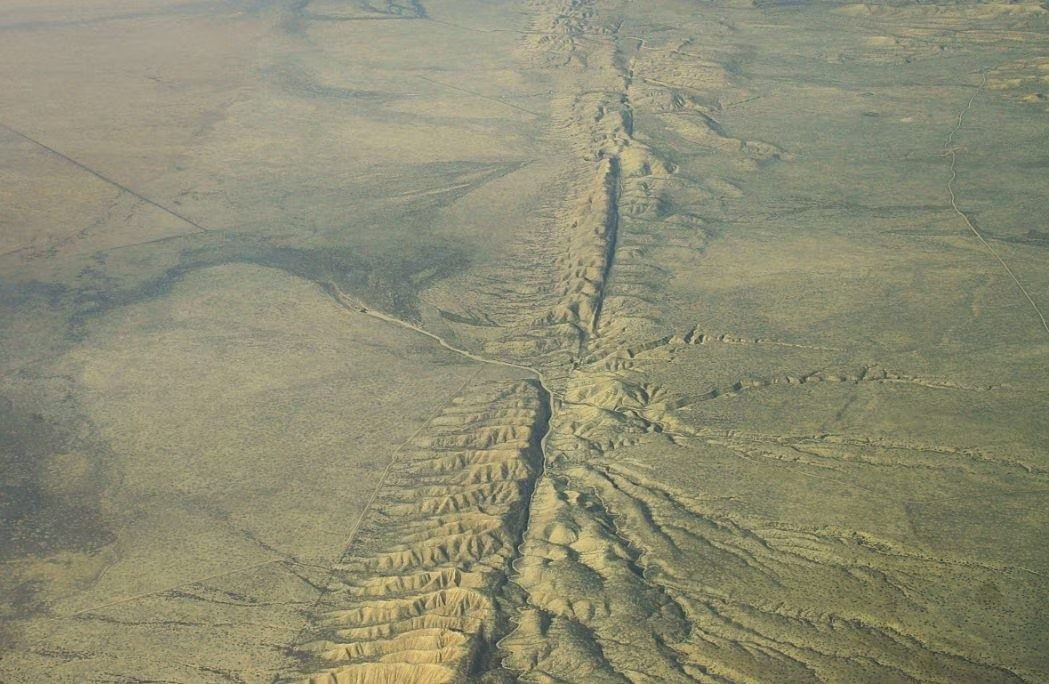
Along the systems of San Andreas and San Jacinto faults in the Southern California the rocks are currently subjected to a level of stress, due to the movements of the tectonic plates, which has reached i maximum values of the last 1000 years. This was demonstrated by a new study, led by the University of Hawaii with the collaboration of the University of Bern and the US Geological Survey and published in the journal Journal of Geophysical Research: Solid Earth. To reach this conclusion, the researchers analyzed a millennium of seismic history of the area and realized simulations with a physical model. The study shows that a violent earthquake capable of affecting both faults severely affecting densely populated areas, the famous “Big One” which has been talked about for decades. Predicting exactly when this will occur is not possible, but research is essential to improve seismic risk prevention.
The San Andreas Fault and the most at-risk sector “Big One”
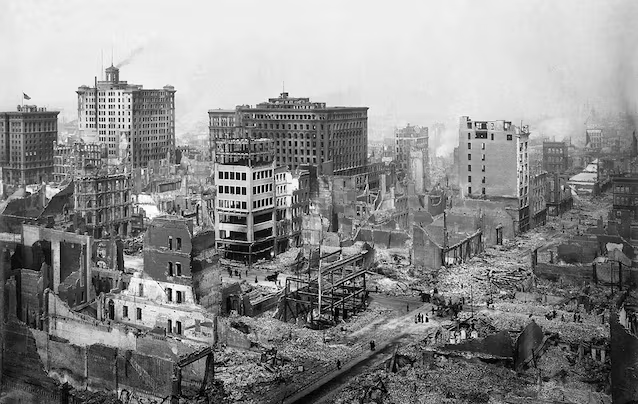
The San Andreas Fault is one strike-slip fault over 1000 km longwhere two tectonic plates slide horizontally past each other. Separate the Pacific platemoving north, from North American platemoving south. These movements cause a to accumulate in the rocks increasingly higher amounts of energydestined to be released suddenly when the efforts exceed the resistance of the rocks. The fault system of which the San Andreas is part generates thousands of earthquakes every year. In the past, very violent earthquakes have occurred here, the best known of which was that of 1906, with a magnitude of 7.9, which devastated San Francisco in Northern California. For decades, seismologists have been saying that here, sooner or later, the so-called “Big One”: journalistic term indicating an earthquake with a magnitude greater than the seventh degree on the Richter scale. Currently the the southern sector of the fault is most at riskwhere more energy is accumulating. The last strong earthquake that occurred in this area is Fort Tejon earthquake, of 1857with magnitude 7.9.
The study on the maximum stress in the southern sector of the fault
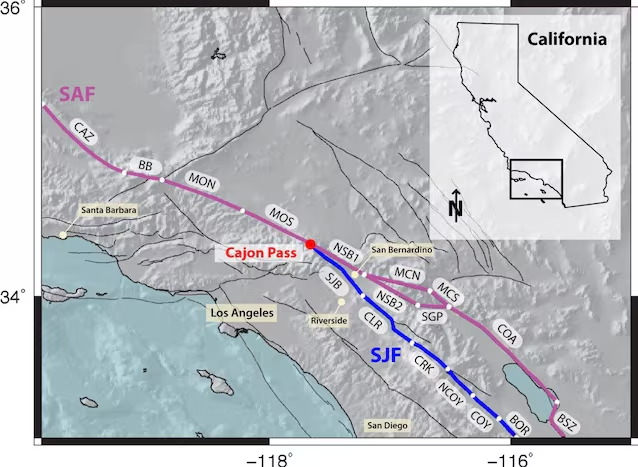
Since the southern sector of the fault is the most at risk, the researchers’ study focused on this portion. Thanks to geological data, historical documents, radiocarbon dating of sediments and analysis of tree growth rings, they were able reconstruct 1000 years of seismic history of the area. After that they built a physics-based computer model which simulates how stress is accumulated and released along the fault system. In particular, the following were taken into consideration: San Andreas and San Jacinto fault systems and the simulation showed that both present very high levels of effortequal to or higher than the highest ever recorded in the last millennium. The San Jacinto Fault branches off the San Andreas Fault from Cajon Passa mountain pass that constitutes a critical site because it acts as aseismic door”, in the sense that sometimes it blocks large ruptures that propagate along the faults, while other times it conveys them in both fault systemswho are thus simultaneously involved in a single seismic event. An event of this kind could be far more destructive than one relating to a single fault. They would come densely populated areas affected such as Los Angeles, San Bernardino, Riverside and the Coachella Valley.
The study is not a prediction of the “Big One,” but one physical evaluation of the current state of fault systems. Its importance is linked to the fact that it allows you to improve seismic risk assessment of the area and therefore also the planning of buildings and infrastructure and the preparation of contingency plans. Furthermore, the type of model used is also applicable to other multiple fault systems present on the planet.
