
Have you ever put the hot food directly in the refrigerator? Or the milk in the doorwhy does the space seem made on purpose? In this video we discover that behind every shelf, every drawer and every function of the fridge there is a precise logic and following it really makes the difference.
Let’s start with the basics: how the refrigerator produces cold? Inside it circulates a refrigerant fluid which, thanks to a continuous cycle of compression and expansionabsorbs heat from the inside and expels it outside. That buzzing noise you hear every now and then? It’s the compressor who gets to work.
And the hot food? Putting it in immediately doesn’t break the fridge, but it strains it: the heat spreads, the appliance consumes more energy and nearby foods risk spoiling. Better to wait for it to cool down a bit.
In the video we also talk about frost in the freezer, how it is formed, how it is removed (never with chisels or hair dryers!) and how the systems No Frost, Total No Frost and Dual Total No Frost they solve the problem automatically and definitively.
Then we come to the more practical part: where to put the food. In traditional fridges the coldest area is at the bottom, because the cold air is denser and sinks. The most perishable foods go there. The door, on the other hand, is the worst area: it undergoes continuous shocks every time it is opened. Milk, contrary to popular belief, is much better on the internal shelves.
A technology that we found interesting, and which makes the arrangement of food irrelevant, is the FreshLock. Thanks to a system of sensors and fans, the temperature is uniform in every point of the fridge. For this, you can put the food wherever you want, it makes no difference.
THE bottom drawers, then, they are not just a convenient container: they retain the natural humidity of fruit and vegetables, preventing them from drying out. And that device on the drawer that few people notice? It serves precisely to regulate humidity: open for fruit, closed for vegetables.
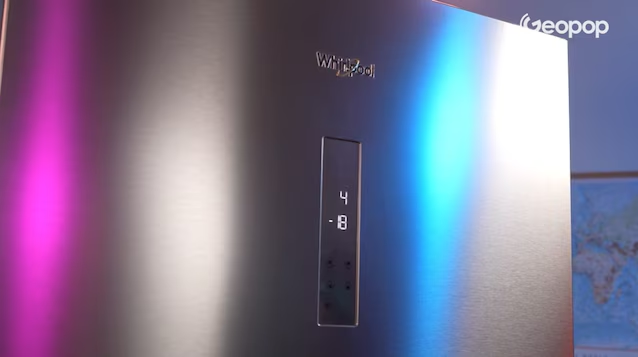
Finally, the right temperature: 4°C for the fridge, -18°C for the freezer. If we have one of those old models with the dial from 1 to 5: the higher the number, the lower the temperature, while in some newer models, it is written directly on the display.
Finally, two useful features worth knowing about, the rapid freezing and holiday mode.
Watch the video to understand how to best use one of the appliances you always have before your eyes.
