Among the eight questions raised in the second math test, addressed at Maturity 2026 from the students of the scientific high school, a famous fair game is hidden: Cover the spot, in Italian “the game of the red circle”.
The rules are very easy: there are a big red circle And five smaller discsthe player must place i 5 small circles so cover entirely that big. Behind the very simple appearance there is actually a solution it’s not that immediatebecause the dimensions of the circles are such that if we move even slightly from the only possible solution, the large circle results discovery.
The question of the second test of Maturity this year is a modified version of “Cover the Spot” in which you are required to place 3 circles in order to completely cover the surface of a square.
Cover the spot: the original game and the solution
The rules of Cover the Spot, one of the oldest and most profitable attractions at American and Canadian fairs, are elementary. A large circle, usually red, is painted on a table. The player receives five blue discssmaller, and must place them above the circle until they cover it completely.
The diameter of the five discs, compared to that of the large circle, is calculated at millimeter to leave zero margin for error. Indeed, it exists a single geometric configuration capable of covering the entire surface, every minimal movement of the first disk leaves a glimmer of red exposed on the other side, and is therefore lost.
The solution everyone tries (and why it’s not enough)
Faced with the problem, almost everyone tries the same strategy, the one that seems more “orderly”: a disk in the center of the large circle and the other four arranged symmetrically aroundone for each cardinal side, like the arms of a cross.
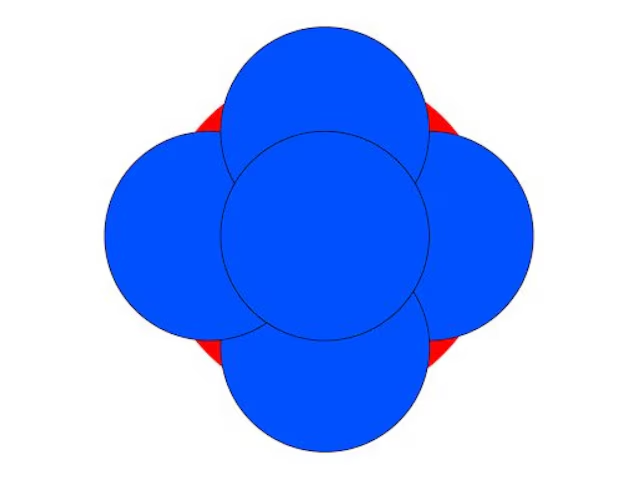
It’s a reasonable intuition, but it is wrong. This arrangement always leaves four “slices” of the red circle uncovered.
The real solution is part of the Five Disk Problem, a mathematical problem in which we ask ourselves what it should be the minimum radius of the 5 small circles so that they can cover the large circle by placing them in symmetrical manner on a regular pentagon. The solution for “Cover the spot” starts from this idea, but varies the arrangement slightly, so as to eitheroptimize spaces to the maximum even in an asymmetrical and irregular manner.
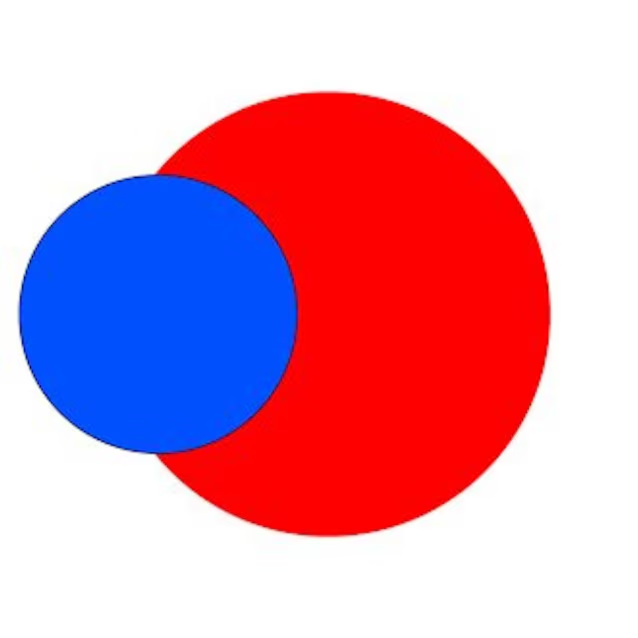
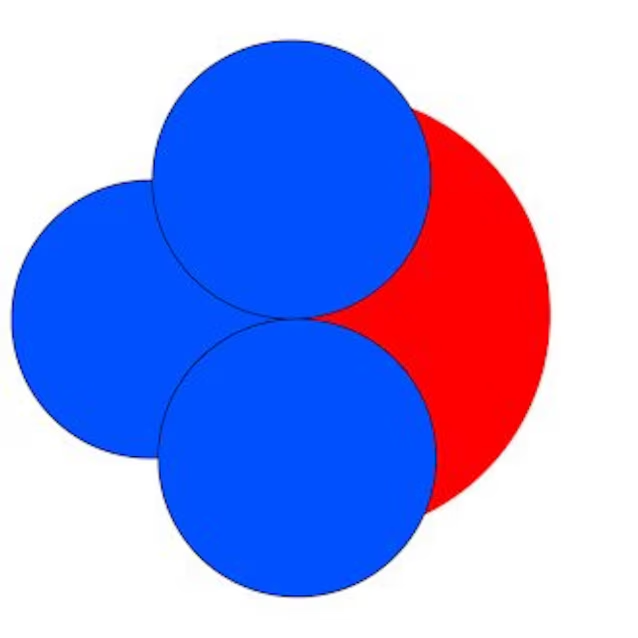
Below we show you how to arrange the circles one by one to solve the “Cover the spot” game.
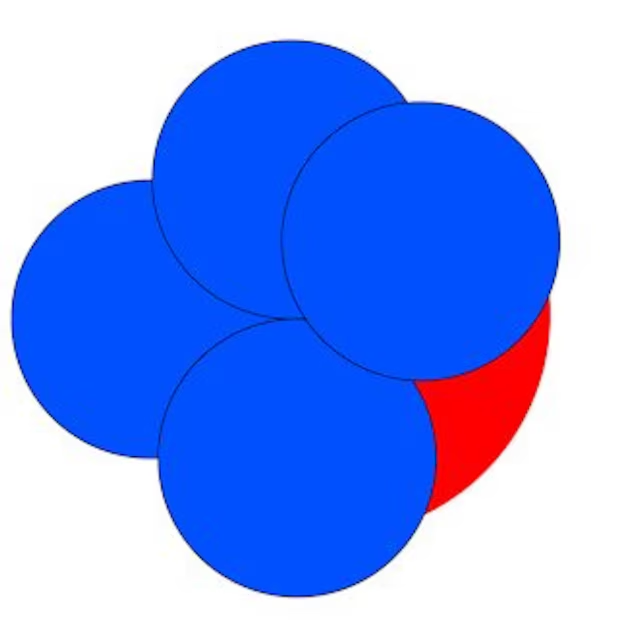
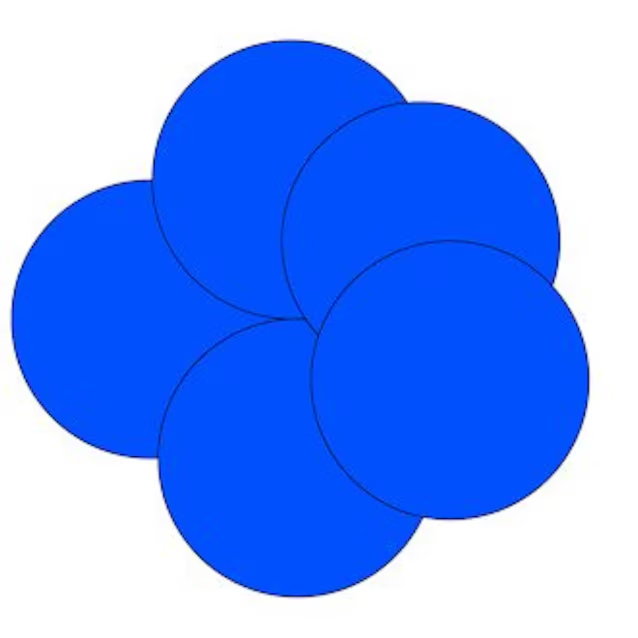
The question of the second Maturity test: a variant of Cover the spot
The question number 1 from the second test of the 2026 Maturity tells of a small challenge between two students, Cecilia and Nicolò, who play a game variant of Cover the spot: instead of a large circle to be covered with five disks, here there is a square with a side of √2 dm2 to be covered with three circles, each with a radius of 2/3 dm.
The question asks this: Cecilia positions the first of the three circles in a specific pointwith the center on the diagonal of the square and at one distance from the vertex such that the edge of the circle steps exactly for that vertex. Without yet positioning the other two circles, Cecilia states only one thing: with this first circle she has already covered more than half of the area of the square. Nicolò disagrees. The question of the question is simple: Which of the two is right?
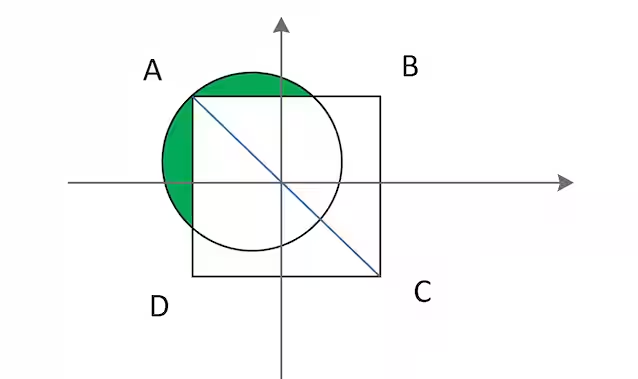
As visible in the image below, the square has area 2 dm2the circle of radius 2/3 dm has area 1,396 dm2. Having placed the circle in that position, the area that “overhangs” (the one in green in the figure) is approximately 0.254 dm2 so the one that remains covered is 1.142 dm2. Since half of the area of the circle is exactly 1, in this way it is actually possible to cover more than half of the square. So it has Cecilia is right.