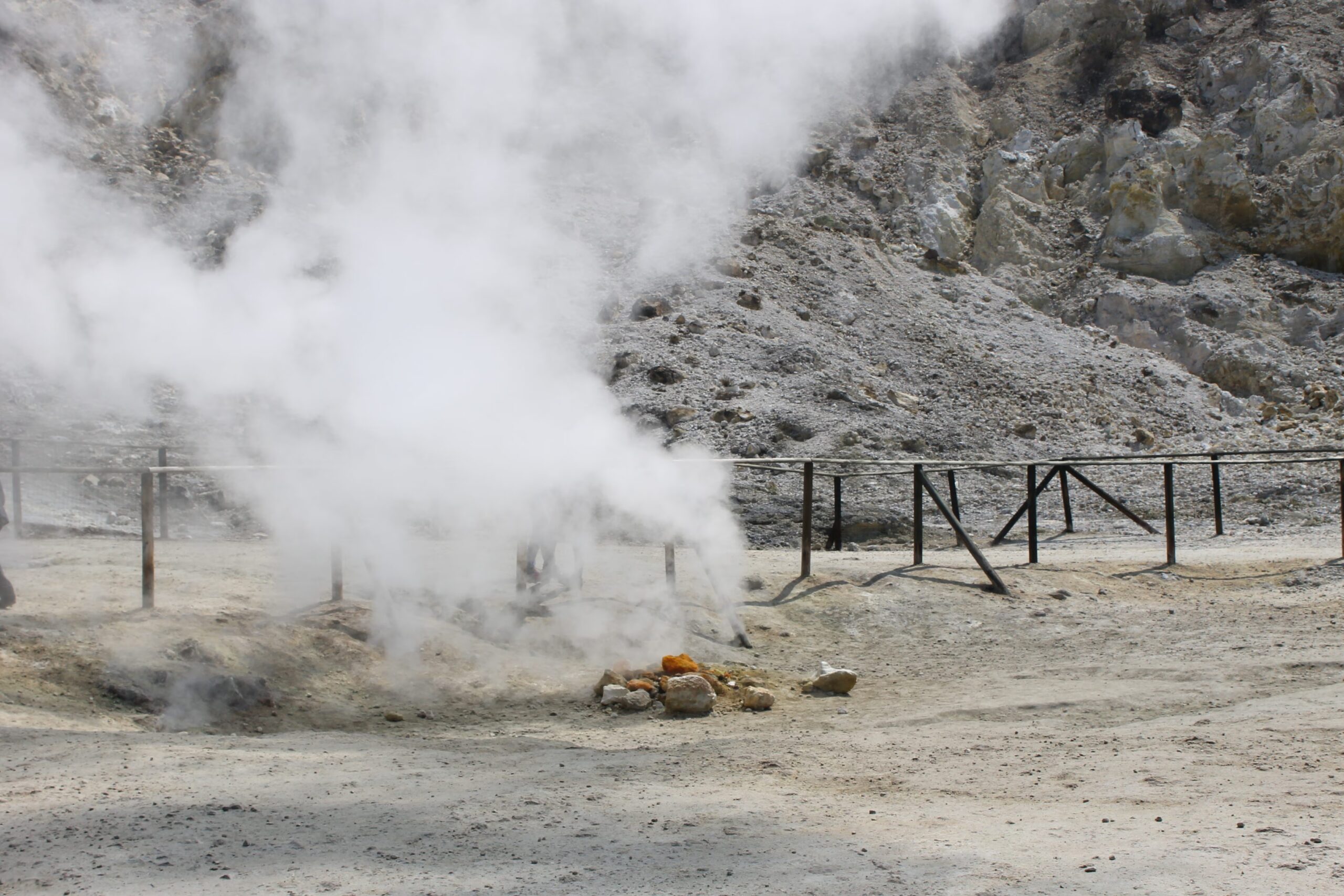
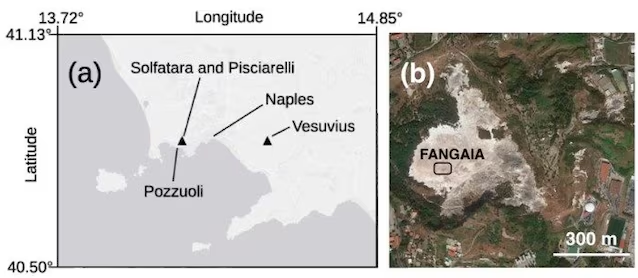
At the fumarole in the Pisciarelli areain the Campi Flegrei caldera, a special laser sensor detected high concentrations of hydrogen sulfide, a highly toxic gas for man. The concentrations are 12 times higher than the safety threshold and were detected during measurement campaigns carried out between May 2025 and February 2026 within a few meters of the fumarole. Fortunately, measurements show that the compound tends to disperse quickly thus reducing its danger. However, the sensor did not detect sulfur dioxidewhich unlike hydrogen sulfide is a sign of a direct contribution of magma to emissions. The sensor was developed by the inter-university Department of Physics of the University and Polytechnic of Bari in collaboration with the Institute of Photonics and Nanotechnologies of the CNR of Bari.
What the laser sensor discovered: Gas spikes 12 times over the threshold
The researchers carried out the surveys in the area of the caldera where the escape of gas from the ground is particularly intense. To overcome the limitations of traditional monitoring tools, which have response times in the order of minutes and are unable to follow the very rapid variations in gaseous emissions, a new laser sensor was used. This tool, however, has response times less than a second. This technology consists of a beam of infrared light that vibrates certain molecules and a quartz tuning fork that intercepts the acoustic wave that is produced by the vibration. The researchers chose to use it to analyze precisely thehydrogen sulfide (H2S): in the past INGV had hypothesized its emission in high concentrations in this area, despite traditional instruments having measured a modest concentration (3-4 ppm). The high sensitivity of the laser sensor means that other gases that are emitted from the fumarole in larger quantities, such as water vapor and carbon dioxide, do not interfere in the hydrogen sulfide measurements. The result of the analyzes confirmed the researchers’ hypotheses: within 10 m of the fumarole have been identified peaks up to 60 ppm, which exceed the threshold by 12 times beyond which even brief exposure is dangerous for humans. However, already a few dozen meters away away from the source of emissions the gas concentration falls well below the critical threshold.
What can be deduced from laser measurements
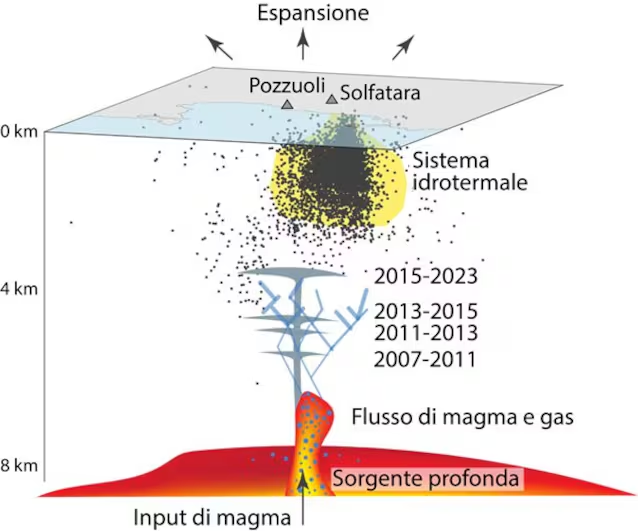
The fact that a few dozen meters away, although there are traces of the compound, these are weak, means that the gas disperses quickly on contact with the atmosphere transforming into other compounds that are not harmful to humans. Another positive aspect is that the laser sensor did not detect the presence of sulfur dioxidewhich unlike hydrogen sulfide is released directly from the magma. Hydrogen sulfide is formed when i sulphur-rich magmatic gases they rise to the surface and interact with groundwater, becoming enriched with this compound. It is confirmation that the emissions, as well as the raising of the ground and earthquakes, have an origin mainly linked to the presence of rainwater undergroundwhich are heated by the gases released by the magma at depth and therefore expand, exerting a pressure that has these consequences. Being able to monitor the variations in emissions from fumaroles in real time is essential to understand in more detail what happens underground in the caldera and improve simulations of its evolution.
