We are getting used to looking at the sky to understand how much our climate is changing. We monitor record heat waves, we look at weather models to understand where the next storm will hit, but what if we told you that to really understand the physics of tomorrow’s weather we can also look in the water? Over the period 1993-2022, global mean sea level rose on average by 3.3 ± 0.3 mm per year. This is a phenomenon that has distant roots: it began in the 19th century and then took on larger dimensions starting from 1990. According to recent studies by World Meteorological Organization (WMO) the Average sea level rises at a rate of 4.3 millimeters per yeara rise that goes hand in hand with coastal erosion.
This phenomenon, however, responds to different causes: although the main factors are warming and the melting of ice, the entire picture is also influenced and aggravated by other anthropic components, such as microplastics. Scientific studies by institutions such as the IPCC and the WMO highlight that there is a precise correlation between warming, the accumulation of microplastics and rising seas. All these elements together are the visible symptom of a planet that is accumulating energy at impressive rates.
Because rising seas are a global warming and weather problem
Why does the sea rise this way if the air warms? The answer lies mainly in an elementary physical phenomenon: thermal expansion. It works exactly like the old mercury thermometer we used as children. When a fluid heats up, its molecules begin to agitate and take up more space, consequently they dilate and the volume increases.
According to theIntergovernmental Panel on Climate Change (IPCC) more 90% of the excess heat trapped by the greenhouse effect it is absorbed by the oceans. Sea water therefore increases in volume simply because it is warmer. To this we then add the contribution of melting of the polar ice capspouring new water into the basins.
If we look at future projections for the end of the century, the data becomes even more worrying. In a high emissions scenario: Global sea level is most likely set to rise between 0.5 and 1.9 meters by 2100with a maximum value 90 cm higher than the most recent IPCC projections (0.6-1.0 metres).
The heat thus accumulated represents a gigantic basin of energywhich risks being released in the form of violent disturbances, cyclones, thunderstorms and other extremely violent atmospheric events. The temperature of sea surfaces, in fact, influences the entire mechanism of water pressure and evaporation.
There is a fundamental physical law, the Clausius-Clapeyron equationwhich dictates the following rule: for every additional degree of air temperature, the atmosphere can retain approximately 7% more humidity. Imagine the air above the sea like a sponge. The hotter it is, the larger this sponge becomes and the more capable it is of absorbing water vapor. When this invisible sponge fills, it accumulates what is called in thermodynamics latent heat.
What is it? It is the energy that water stores when it passes from the liquid to the gaseous state. This energy doesn’t disappear into thin air, it stays in there and is released all together when the vapor condenses to form clouds. This explains the real fuel for i extreme stormsfor flash floods and also for those Mediterranean cyclones (so-called Medicines) which now increasingly resemble real tropical hurricanes.
The role of microplastics in climate change
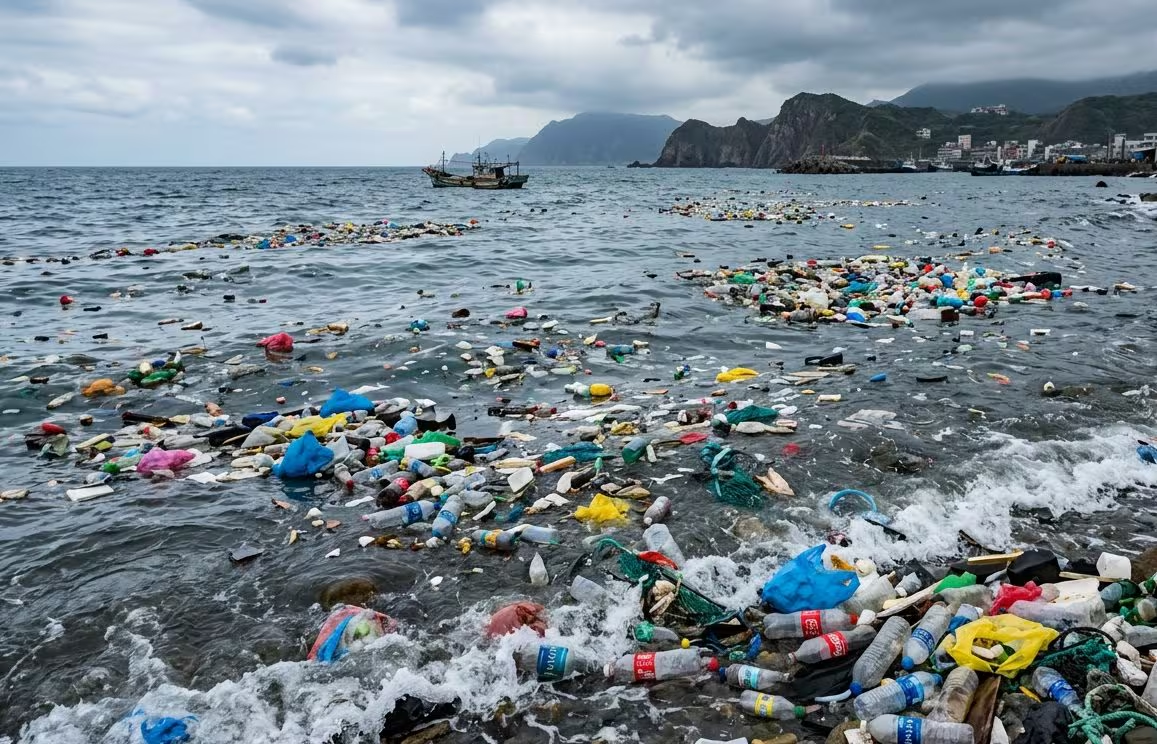
Compounding this scenario is another serious problem for our planet: i 24 trillion plastic fragments that float in our waters. Plastic in the sea does not move randomly, but is transported by surface ocean currents, generated directly by Earth’s large wind systemslike the trade winds. The famous “plastic islands” are formed not by chance within the large subtropical oceanic gyres, which geometrically coincide with the areas of semi-permanent high pressure of global atmospheric circulation. Where the atmosphere creates a calm wind under a robust anticyclone, the waters begin to spin, creating a funnel and accumulating all the debris in the center.
But the real climate problem arises when this tide of fragments degrades under the action of solar rays and hot water: the microplastics they start releasing greenhouse gases like methane and ethylenecapable of trapping further heat in the layer of air in direct contact with the sea surface. As if that wasn’t enough, all this plastic alters locally the marine albedoor the ability of the sea to reflect sunlight. Think about when you wear a white or black t-shirt in the summer: the white reflects the light and keeps you cool (high albedo), the black absorbs it and makes you sweat (low albedo). The clean sea has its own balance of reflection, but a patina of microplastics and dark debris alters this natural mirror, leading the sea to absorb even more solar radiation. The sea warms up more and the micro-heat exchanges between water and air change. Microplastics therefore act as a real accelerator of global warming.
If the ocean and the seas, which are the true energy reservoir of the Planet, continue to fill with heat at this rate, the weather of the near future will inevitably be characterized by a serious extremism. The atmosphere will discharge the accumulated heat with increasingly violent fluctuations as it passes from searing heat waves to violent storms and flash floods in a very short time. To try to stem this process I study and monitoring of the seastheir temperature and their cleanliness are as fundamental as the study and monitoring of the sky and atmospheric events themselves.
