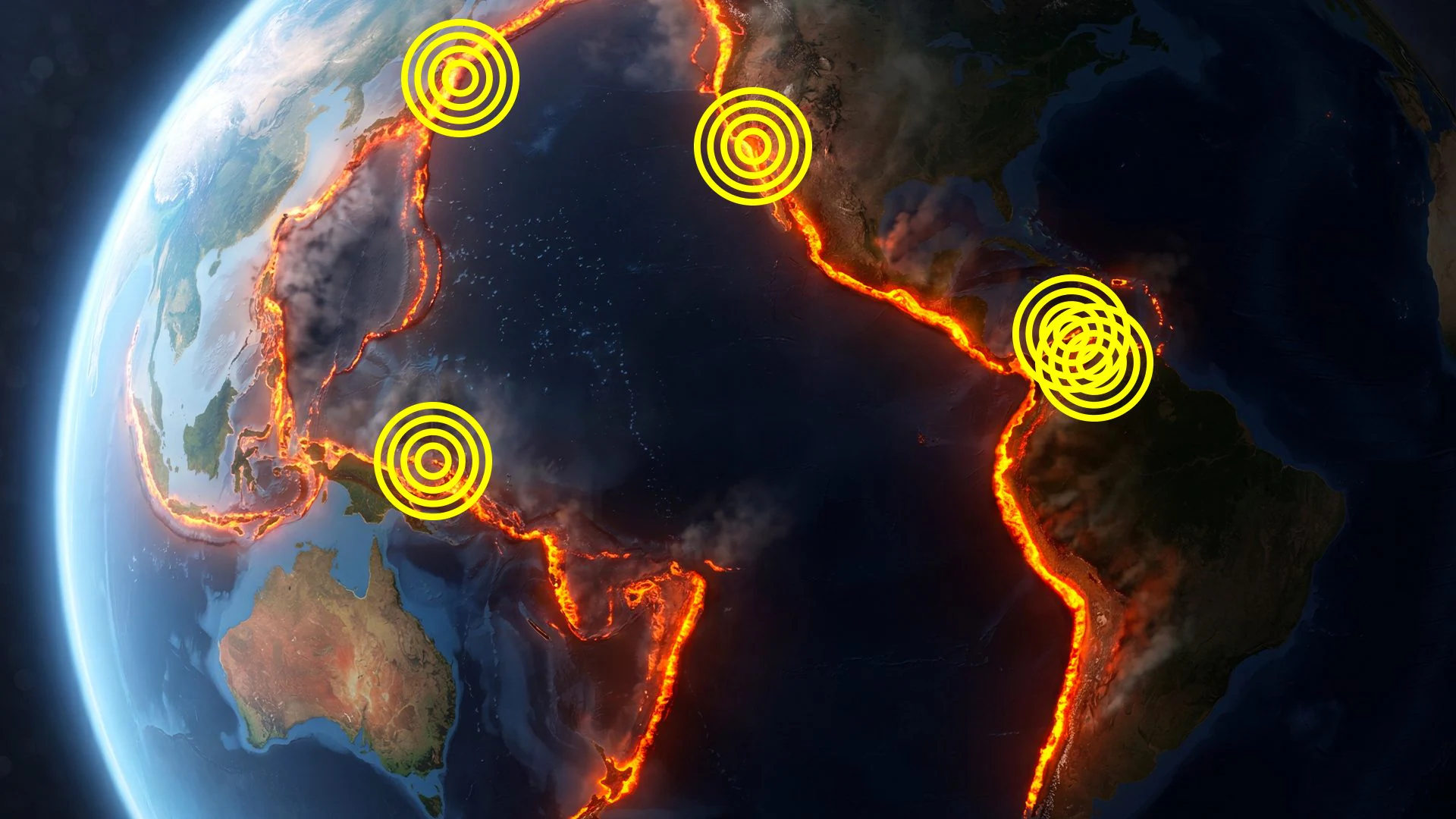
This morning the news around the world is talking about earthquakes that, in less than 24 hours, have hit four different countries. More specifically, we had a magnitude earthquake 5.4 in Papua New Guineaeast of Kokopo; then a magnitude earthquake 5.6 in Californianorth of Redwood Valley; we then move in Japanwhere a violent earthquake of magnitude 6.9 shook the northeastern coast off the Kuji; and finally, the biggest disaster, in Venezuelawhere not one, but two devastating earthquakes were recorded, a “double” of magnitude 7.2 And 7.5 within seconds of each other that they caused at least 32 victims and beyond 70o injured.
But is there a connection between these events? Actually no, and to understand why we must necessarily talk about the context in which most of them occurred: the Pacific Ring of Fire.
The role of the Ring of Fire, a geologically “alive” area
Take the Pacific Ocean. Now draw an imaginary line in the shape of a horseshoe, along the beauty of 40,000 kilometers. It starts from the southern tip of South America, from Chile, goes up along the entire Pacific coast of the Americas passing through Peru, Central America, Mexico and California, up to Alaska. It then crosses the Bering Strait, descends along the Russian Kamchatka peninsula, passes through Japan, the Philippines, Indonesia, Papua New Guinea, until reaching New Zealand. Now this is the Pacific Ring of Fire. It is not a “physical” structure that you can touch, but it is an immense tectonic boundary zone.
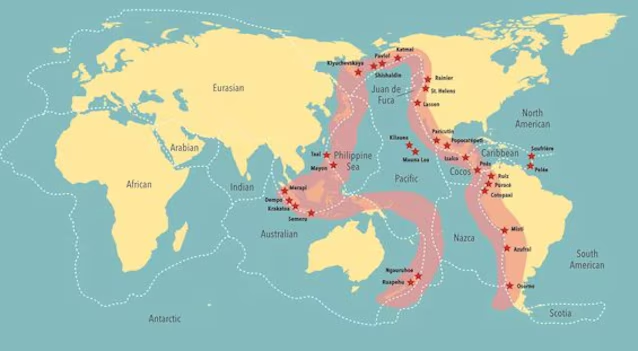
We know well that the earth’s crust is not a whole and compact shell like that of a hard-boiled egg, but is fragmented into enormous blocks, like pieces of a puzzle, which we call “plaques tectonics“. The Ring of Fire is nothing more than the boundary line where the gigantic Pacific Plate (along with some adjacent smaller plates) collides, rubs and sinks against the continental plates that surround it.
It is a geologically “alive” area. And to make you understand the numbers of this geological beast, know that most of the active and dormant volcanoes in the world are located here and is responsible for the 90% of earthquakes globally. In fact, if we look at the most violent earthquakes ever recorded in history, the main ones are located precisely in this long horseshoe, such as the Valdivia earthquake in Chile in 1960 (with magnitude 9.5) or the tragic earthquake in Japan in 2011. So, if in 24 hours there are many earthquakes in the world, it is very very likely that most of these happen right here. But from a geological point of view, why are there so many earthquakes here? The main mechanism is that of subduction.
The origin of earthquakes along the Belt of Fire
You should know that the oceanic crust, that is, the one that forms the bottom of the Pacific Ocean, tends to be larger cold and more dense compared to the continental crust. When these two enormous portions of rock collide head-on, the oceanic plate, being denser, is forced to “dive”, to slide under the continental plate, slowly sinking towards the Earth’s mantle. And right there, where the oceanic plate bends to sink, some of the most extreme and unexplored depressions on the planet are formed: I am referring to the very deep is oceanicsuch as the Mariana Trench or the Aleutian Trench.
And precisely the descent of the plate then gives rise to the magma which, rising to the surface, feeds the infinity of volcanoes of this area (and that’s why it’s called the “Ring of Fire”). But pay attention to the seismic side: the downward journey of this plate is not smooth at all. Imagine rubbing two huge blocks of very rough rock against each other. The two tectonic plates do not slide away smoothly and the friction is gigantic. The rocks get stuck, they get stuck, but the push never stops. Then the rocks begin to deform, accumulating crazy elastic energy over decades, centuries, or millennia. At a certain point, the block no longer holds. There rock breaks suddenly along the fault and the two plates make a violent leap in a few seconds to recover the movement blocked for centuries. All that accumulated energy is suddenly released in the form of seismic waves. And therefore, earthquakes.
And since we’re talking about the collision of some of the largest and fastest plates on the planet, the energy released along the Ring of Fire is often monstrous.
The double of earthquakes in Venezuela
In the past few hours, two violent earthquakes have occurred here very quickly. At 6.04pm (local time) there was a first shock of magnitude 7.2. The epicenter was west of Caracasto a depth of 20.3 kilometers. Many believed that was the end of it. But alone 39 seconds after a second, even more violent shock of magnitude 7.5to an extremely shallow depth of just 10 kilometers.
Here, however, we must make a clarification, because if we look at the map, in reality, Venezuela does not belong to the Ring of Fire. It is located further east, in an adjacent but effectively independent area. However, this is itself an extremely active area, even if it follows a slightly different mechanism. As the USGS explains, in this area north of the country we have two large plates that are “arguing”: the Plate Caribbean to the north and the gigantic Plate South American south. Unlike the subduction zones we were talking about before, here the Caribbean Plate moves eastward with respect to the South American plate at a speed of approximately 2 centimeters per year. This lateral slip creates a “slip-slip” fault, meaning the two blocks rub together horizontally, sliding past each other.
And in these hours a double event occurred right here. This tends to indicate an extremely complex fault rupture process. The sliding of a first huge block of rock on the fault would have triggered, almost in real time, the rupture of an adjacent fault block. We are talking about an immense fracture: the USGS confirms that pairs of strike-slip earthquakes of this magnitude can indicate a rupture of a fault surface tens of km long.
The superficiality of these events (barely 10km for the strongest shock) is why the impact in Caracas and surrounding areas was like this catastrophicproving to be the most powerful earthquake in this area for over a century. The extreme tremor led to the collapse of dozens of buildings and required immediate activation of the state of emergencywith unfortunately numerous confirmed victims and hundreds of injured. But unfortunately, as we have said, Venezuela was not the only country to be affected.
Earthquakes in Japan of magnitude 6.9, California (5.6) and Papua New Guinea (5.4)
In Japan we had another very strong earthquake magnitude 6.9off the coastal town of Kujiin Iwate Prefecture. In this case, what was the driving force behind this earthquake? Here instead we return to the classic engine of the Ring of Fire: the subduction. An epicenter was detected here just over 50 kilometers deep. The cause is to be found in the Pacific plate which is sinking beneath Japan and, as it sinks, accumulates enormous tensions along the Japan Trench.
Last November, again in this area, another very strong earthquake occurred magnitude 7.7. According to experts at Tohoku University, after that great event it is possible that a phenomenon called afterslipi.e. a post-seismic “slow slide”. If this hypothesis were to be confirmed, then this phenomenon would have redistributed the stress on the surrounding edges, loading a nearby area and triggering the last shock of magnitude 6.9.
Also in the last 24 there have been similar earthquakes, although weaker, one in California of Md 5.6 and one in Papua New Guinea of Md 5.4. These are similar phenomena, which have always occurred along the Ring of Fire.
Are the five shocks related to each other?
No, earthquakes are not connected in any way to each other. Of course, the macroscale context is that of the Ring of Fire or, for Venezuela, an adjacent area, but we must not think that for example the one in Japan triggered the one in Venezuela or vice versa. It’s about events totally independent and which, as we have seen, were originated by different mechanisms.
In fact an earthquake it can trigger another only in certain contexts and only at a local level – we said this a little while ago when talking about Japan – but it is impossible for this to happen a long distancesprecisely because geological structures are independent at that scale. So why do they all seem to happen at once? It’s a question statistics: considering that the Belt of Fire alone generates the 90% of all terrestrial earthquakes, as we said at the beginning, it is mathematically inevitable that on some days the calendar “clicks” closely and multiple earthquakes occur within a few hours.
The planet is therefore not “exploding” or “going crazy”. It’s just doing its job as a planet… which sometimes means having multiple devastating earthquakes in the same day.
