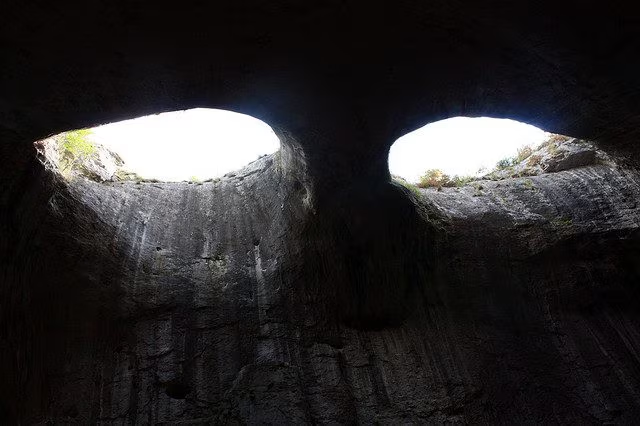
In Bulgariaabout 112 km from the capital Sofia, in the gorge of the Iskar river, in the Karst massif of Karlukovo, lies one of the most fascinating places in the whole country: the Prohodna Cave. What makes this gigantic rock tunnel, over 260 meters long, unique is the presence of two almond-shaped cracks on the ceiling which, somehow, they resemble two eyes – and for this reason the place is also called the cave of the “Eyes of God”. Right halfway along the route, you can notice these two enormous cavities that reveal the sky. Over time this charm has attracted not only tourists but also directors, who have chosen this place as a set for their films. But how was it formed? And what are its characteristics?
The structure of the cave
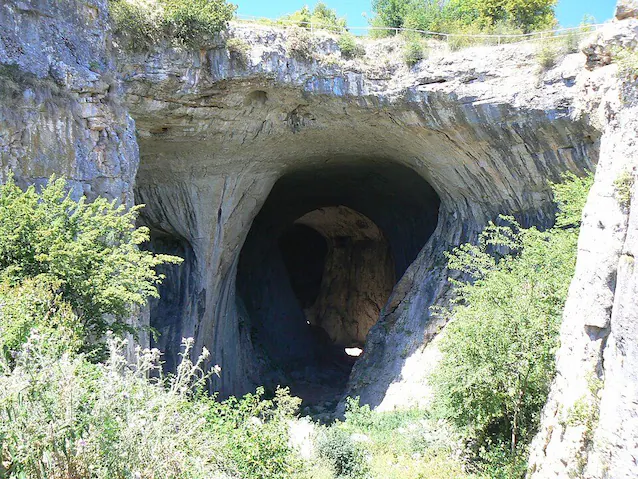
Located in the suggestive gorge of Karlukovo Prohodna Cave is a very particular rock formation with a length of approximately 262 meters. Declared a natural monument in 1962the internal structure is totally illuminated by daylight thanks to its two entrances: the first, the small one, approximately 35 meters from which the main path starts, and the Great Entrance, a huge and beautiful arch of 45 meters which represents the largest cave arch in the country.
The site can be visited for free all year round without the need for a guide, although in the winter months it requires particular caution due to the slippery ground and the presence of large ice stalactites that form on the ceiling.
How the cave was formed: the geological aspects
This particular cave was formed mainly thanks to a process of chemical dissolution caused by rainwater and groundwater, characterized by a slight acidity due to the carbon dioxide dissolved in it. Over the course of millions of years, water has been able to penetrate the cracks in the limestone massif, progressively widening them and digging the large natural gallery.
The famous “Eyes of God” (Oknata), the two symmetrical openings on the ceiling of the cave, are instead linked to phenomena of vault collapse and differential erosion. The constant action of rainwater from above, together with the cycles of freezing and thawing are all factors that, over time, have weakened the rock, causing the controlled collapse of the most fragile limestone layers at two nearby fracture joints. The subsequent action of the wind and surface runoff has smoothed the edges of these cracks, thus giving the characteristic elliptical and mirrored shape that we see today.
The Myth and Cinema of the “Eyes of God”
Certainly, the most interesting and fascinating aspect of Prohodna is that of the two spectacular symmetrical openings in the rock ceiling, shaped by erosion and called, in the local language and dialect, Oknata. These cracks are characterized by a particular almond shape which impressively resembles two gigantic ones human eyes intent on staring at visitors, so much so that they are nicknamed “The Eyes of God”; when it rains, the water dripping down the walls creates the incredible illusion that the stone face is crying. This very particular and mysterious natural scenario has always had a strong psychological impact, attracting not only photographers and tourists, but also film directors who shot several films there, including the famous Bulgarian historical film “Time of Violence” from 1988.
Extreme Sports and Speleological Architecture
In addition to its purely mystical charm, this cave is a true paradise for those who love extreme sports and adrenaline, as it hosts some of the most difficult and technical sport climbing routes in Bulgaria and also offers the possibility of bungee jumping from the monumental main entrance.
The site, included in the 100 historical Bulgarian tourist monuments, is closely connected to its neighbour National House of Speleology “Peter Tranteev”, a truly unique building, entirely built inside a rock crevice which, when viewed from above, has the shape of a bat. This structure not only serves as a refuge for visitors offering a breathtaking view of the Iskar river valley, but represents the starting point of a suggestive path that leads directly inside the cave.
