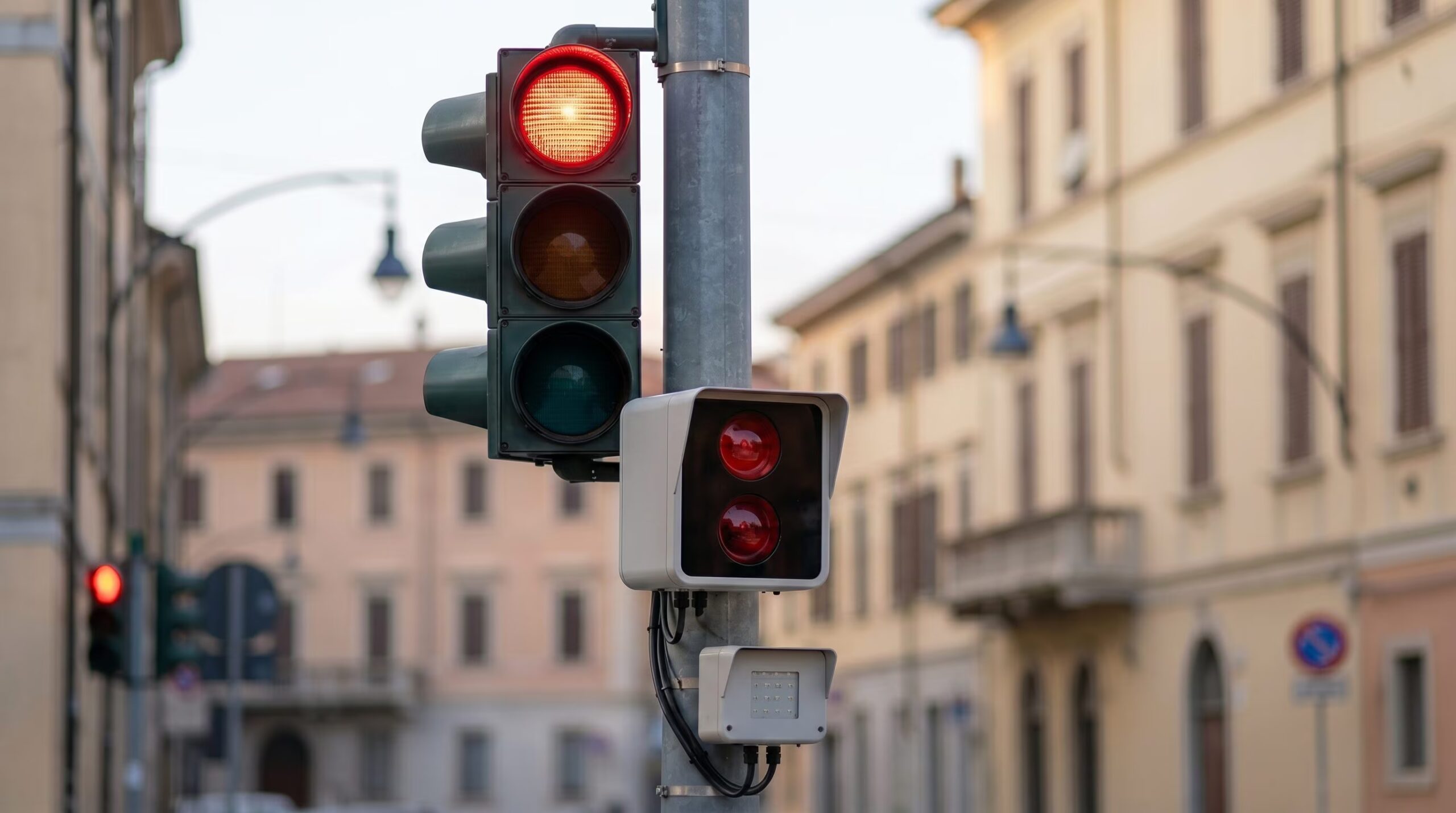
To discourage passage with the red lightmore and more Italian municipalities use sophisticated infringement detection devices, known as Photored. There are various types of systems for detecting traffic light infringements. In this in-depth analysis we will closely analyze the technology of these devices, focusing in particular on the model Photored F17Dra system that takes advantage of advanced smart cameras and sensors – such as multi-lane radars or magnetic loops placed under the road surface – to collect tests irrefutable infringements. We will see how similar instruments record a detailed sequence of two distinct photographs and a continuous 15-second film to reconstruct the exact dynamics of the transit, measuring to the thousandth of a second reaction times and the status of traffic lights. We will then examine the current regulatory scenario, which establishes how the automatic remote sanction is triggered only under certain conditions, which we will see shortly. In this way, we will be able to understand how Photored works to detect red lights and also when the fine is triggered.
What are Photoreds and how they work
To understand the technology that monitors intersections in our cities, we must look inside these devices placed on three-meter-high poles. Inside armored cabinets in galvanized and hot-painted steel we find a computer equipped with a 500 GB hard diskcapable of archiving up to 140,000 violations before the mandatory download of data, thermoregulation systems to withstand bad weather and interfaces that send protected and encrypted data via Wi-Fi or mobile networks to the central management software called Photored Manager.
The main visual apparatus relies on a sensor camera 24.2MP CMOS with resolution of 6000 x 4000 pixels, supported by modules ANPR (Automatic Number Plate Recognition), a software technology for automatic license plate recognition and reading, capable of deciphering characters up to 30 meters away and capable of capturing up to four frames per second. An HD video camera flanks the lens shooting 20 frames per second to create a 15-second footage of the event. During the night, a white light flash approved by the Ministry of Infrastructure and Transport allows you to take color photos instead of infrared, allowing you to perfectly distinguish the color of the vehicle and the status of the traffic light.
Vehicle detection occurs through two alternative methods: a radar modulewhich simultaneously monitors up to four lanes by calculating speed, length and azimuth angle (the angle of lateral orientation of the vehicle with respect to the sensor axis), or a card connected to two coils of induction cable installed in the asphalt.
When fines are triggered for vehicles running a red light
Compared to old systems that took a single image without context, current devices they capture at least two time-lapse frames or short video sequences: the first on the white line and the second in the center of the intersection. Together with the images, crucial data such as the exact time, the previous traffic light phase with its duration and the milliseconds that have passed since the red light was turned on are imprinted, useful for evaluating the latency and real braking times.
This accuracy is directly reflected on the legal protection introduced by law 177/2024, which came into force on 14 December 2024, which amended article 201 of the Highway Code regarding deferred disputes. Today the automatic sanctions without agents on site they are legitimate only for the passing the red light (article 146, paragraph 3), which provides for a fine from 167 to 665 euros And 6 points deducted from the licence. If, however, you cross the stop line and stop immediately afterwards without entering the intersection, the conduct falls under paragraph 2 of the same article with a fine provided for by 42 to 173 euros and 2 points deducted from the license.
