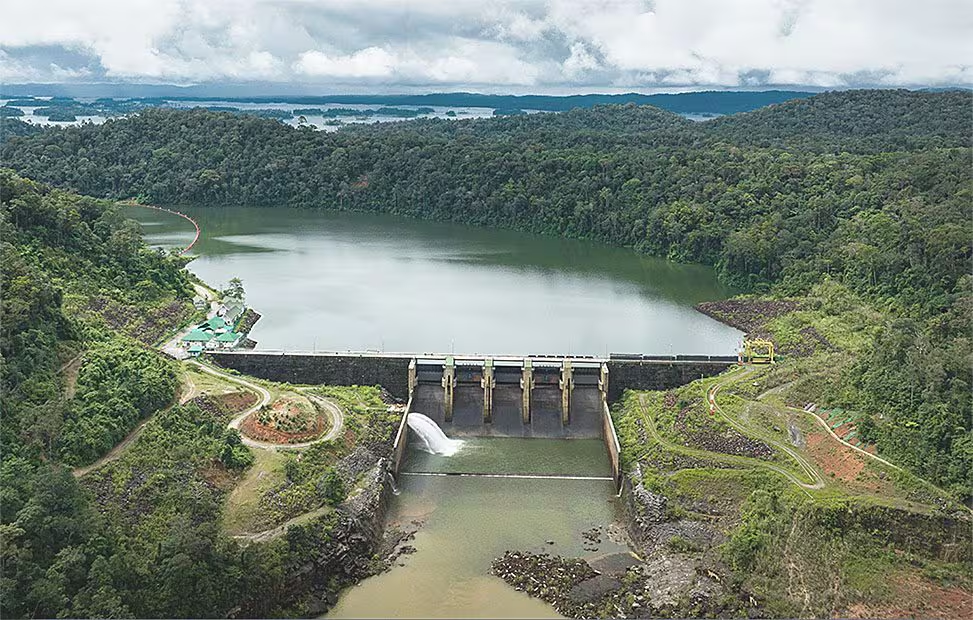
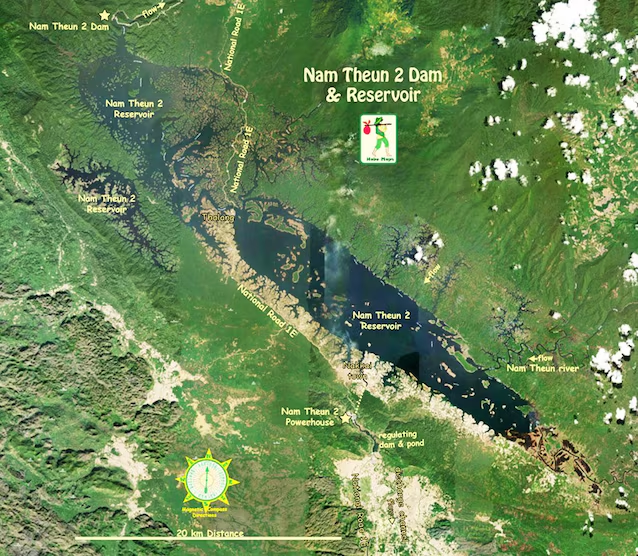
The hydroelectric project Nam Theun 2 (NT2)in Laosrepresents an unprecedented work of hydraulic engineering, not only for its dimensions, but for the unusual inter-basin diversion scheme that defines its operation. Located on the plateau of Nakai, the project completed in 2010 exploits a natural difference in height between the Nam Theun river basin and the Xe Bang Fai river valley, with the main dam blocking the river Nam Theun creating a reservoir of 450 square km.
Overall, the powerhouse hosts well six turbines: four units from 250MW each and two Pelton units from 37.5 MW.
Description of Nam Theun 2
The technological heart of the NT2 lies in its high “hydraulic head” configuration. The main dam, a high gravity concrete structure 39 meters and long 436 metersdams the Nam Theun River, thus creating a reservoir of 450 square km, with a total storage capacity of well 3.9 billion m3. The engineering peculiarity consists in the fact that the water is not released into the original bed of the river, but conveyed through an adduction channel towards a penstock which descends for a net drop of 348 meters.
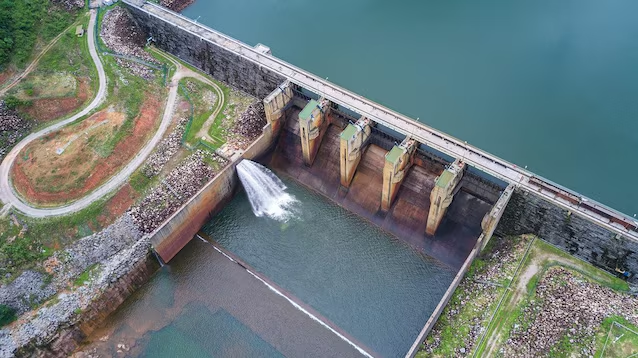
Source: official website
The power station also hosts well six turbines: four Francis units from 250MW each (dedicated to export to Thailand via a 500 kV line) and two Pelton units of 37.5 MW (for domestic consumption of Laos at 115 kV), for a total installed capacity of 1,075 MW. The system is designed to generate approx 6,000 GWh nod. A critical element is the control basin downstream of the power plant, which stabilizes the flow before introducing it into the Xe Bang Fai River through a long spillway. 27kmavoiding hydraulic water hammer and massive bank erosion.
The environmental impact of the hydroelectric project
From the point of view of environmental impact, the creation of the basin has submerged approximately 40% of the Nakai plateau, with an irreversible alteration of the local ecosystem. From an engineering point of view, the main challenge was the management of water quality due to the decomposition of submerged biomass, there were large concentrations of methane and carbon dioxide, to which were added conditions of anoxia (absence of oxygen) in deep waters.
To manage the consequences of this problem, a system has been implemented forced ventilation at the discharge gates in order to significantly increase the concentration of dissolved oxygen before entering the secondary river system. The hydrological regime of the Nam Theun River, downstream of the dam, has undergone a reduction in flow of approximately 95%requiring the release of a constant “minimum viable outflow” of 2 cubic meters/second to preserve residual biodiversity, against an average natural pre-dam flow rate of approximately 240 cubic meters/second.
The socio-economic impact
From a political and economic point of view, NT2 can be considered a Public-Private Partnership (PPP) model, managed by the Nam Theun 2 Power Company (NTPC), whose shareholders include EDF and the government of Laos. The project was conceived as the main driver of foreign exchange for the country: approximately 95% of the energy produced, in fact, it is sold to the Electricity Authority of Thailand (EGAT) thanks to a concession agreement lasting 25 years. From a financial point of view, the overall cost of the work required an investment estimated at 1.3 billion dollars. From a social point of view, however, the project entailed the forced resettlement of approx 6,300 people belonging to multiple ethnic minorities of the plateau, making the implementation necessary of 17 new villages equipped with electrical and sanitary infrastructures.
