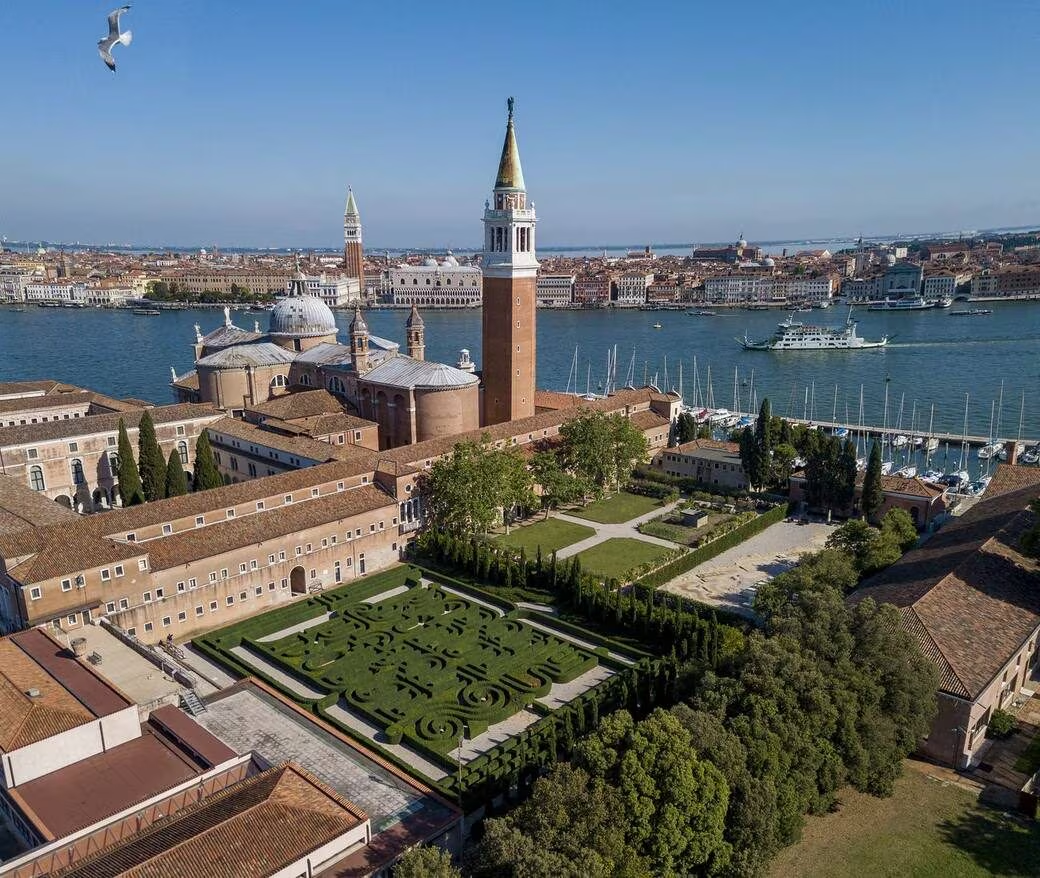
On the island of San Giorgio Maggiore a Veniceone of the most evocative and fascinating places in Italy is about to reopen to the public: the Borges labyrinth. Inaugurated in 2011 in the green spaces of Giorgio Cini Foundation in homage to the Argentine writer Jorge Luis Borges (Buenos Aires, 1899 – Geneva, 1986), the garden had been closed for an important conservative restoration project, supported by PwC Italia. Now, from July 10ththis special place finally reopens to visits.
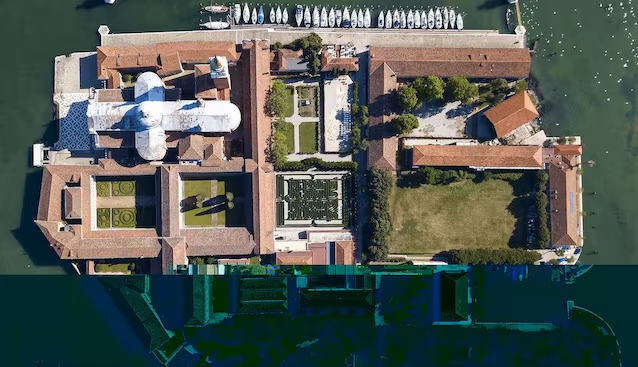
Made up of 3200 boxwood plants (Buxus sempervirens) designed by the architect, diplomat and labyrinth designer Gilbert Randoll Coate (Lausanne, 1909 – Le Rouret, 2005), the labyrinth consists of over a kilometer of paths (not too intricate) in the heart of the island of San Giorgio Maggiore. Conceived in the 1980s and inaugurated in 2011 on the occasion of the 25th anniversary of the death of the Argentine author, the labyrinth was for a long time visible only from above, from the terrace of the Vittore Branca Center of the Giorgio Cini Foundation (built inside a former convent of Benedictine monks), and was then opened to the public in 2011.
Who was the writer Jorge Luis Borges and his fascination with the labyrinth
Born in 1899 in Buenos Aires, Borges was among the most important Argentine and world writers. Student a Geneva during the First World War, it moved to Spain and participated in the birth of the ultraist poetic movement. Returning to Argentina in 1921, he began publishing his first works a couple of years later. He wrote essays, poems, short stories until the last years of his life, even after myopia had led him to blindness. From 1955, after the deposition of Perón, he became director of the National Library of Argentina and taught literature at the University of Buenos Aires. He died in 1986 in Geneva with his second wife, María Kodama, at his side.
But why was this labyrinth dedicated to the great Argentine scholar and intellectual? Randoll Coate was linked to Borges by a great friendship, and shared with him the fascination with the theme of the labyrinth, seen as an allegory of the complexity of the world, not graspable with reason alone. But there is also a specific anecdote behind the dedication.
Borges’ story that inspired the Labyrinth of San Giorgio
The story that inspired this labyrinth most of all is The garden of forking paths. This story by Borges tells the story of the Chinese professor Yu Tsun – a spy in the service of Germany who lives in England during the First World War. After being discovered and forced to flee, he reaches the scholar of Chinese language and literature Stephen Albert, through whom Tsun believes he can pass the information on to his superiors. Having met Albert, he discovers that he knows his ancestor, the writer Ts’ui Pen, famous for having composed an apparently senseless novel and for having built a labyrinth that no one had ever managed to find. Albert, however, thanks to his knowledge of Ts’ui Pen’s work, has deciphered the enigma: book and labyrinth are the same work, a creation that tries to describe all the possible outcomes of an event. The story ends with Tsun killing Albert, the news is in all the newspapers so it is read and decoded by Tsun’s boss: what he is looking for is found in Albert’s town. Meanwhile the spy is arrested.
A first version of the labyrinth narrated in this story was created, again by Coate and following the will of María Kodama Borges (then widow of the poet and president of the foundation of the same name dedicated to him) in 2003 in Mendozain Argentina. Kodama Borges herself also pushed to find a European location, in this way the collaboration with the Cini Foundation began, which led to the creation of the Venetian labyrinth. They are hidden inside the work several elements very dear to Borges such as the hourglass, the question mark, the tigerthe name Jorge Luis, the initials of his wife María Kodama.
Recovery, surgery and visits
Fifteen years after its creation, the labyrinth was subjected to a conservative intervention: the box hedges had to be standardized by returning to the original design of the vegetative structure to maintain the function of the labyrinth. The intervention covered the entire route, which extends for approximately 1,150 metres, with the support of the sponsor PwC Italia as part of the PwC project for culture. The intervention on the Borges Labyrinth is part of a broader strategy dedicated to conservation and enhancement of the historical and monumental spaces of the island of San Giorgio Maggioreone of the main Venetian cultural centers.
Now you can return to visit the labyrinth and walk along its paths, accompanied by an audio guide with an original soundtrack, composed by Antonio Fresa and performed by the La Fenice Theater Orchestra: from 10 July to 30 September, the Cini Foundation says, the visit will cost 15 euros, will last approximately 30 minutes and it will not be possible to take advantage of the panoramic view from above (the visit method after 30 September has not yet been communicated).
The largest green labyrinth in Italy is that of Masone
Although the Borges Labyrinth is large and much appreciated by residents and tourists, it is neither the most famous green labyrinth in Italy, nor the largest: the record belongs to Labyrinth of the Masone of Fontanellato (just outside Parma), which is the largest in the world. It is composed entirely of different species of bamboo plants: there are around 300 thousand of them, between 30 centimeters and 15 meters high. Conceived by the publisher, bibliophile, designer and collector Franco Maria Ricciwas inaugurated in May 2015 and is located in the Emilian countryside together with an editorial laboratory, a museum which houses hundreds of works of art (from the Renaissance to the twentieth century) and spaces for exhibitions and events.
