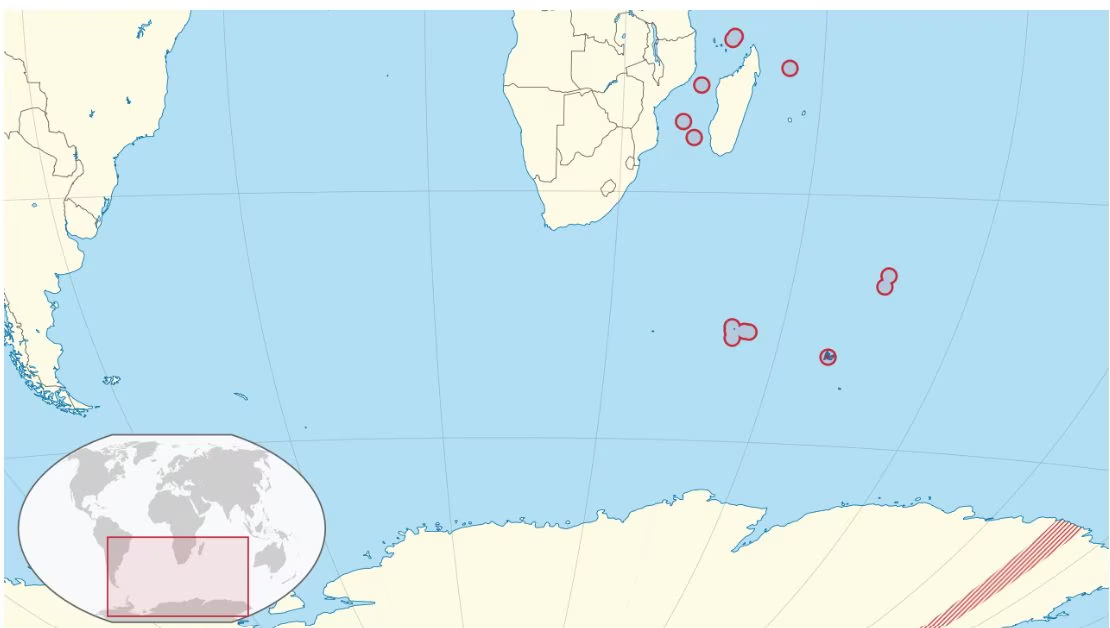
Among the numerous overseas territoriesobtained during the long and complex colonial past, the France has a truly unique and singular one, which takes the name of French Southern and Antarctic Lands. Also known by the acronym of TAAF (Southern and French Antarctic Lands), are in reality a complex of territories far apart from each other and scattered across theSouthern Indian Ocean and the continent Antarctic: officially established by the French Government in 1955, they are divided into 5 districts which develop in total over an area of 395,500 square kilometers and include the Scattered Islands, the Saint-Paul and New Amsterdam Islands, the Crozet Islands, the Kerguelen Islands archiplego and Adélie Land.
The TAAF understands for this reason very diverse environments and ecosystemsalthough they all have one fundamental aspect in common: they are almost uncontaminatedthat is, they do not have a permanent population or stable settlements. Since 2019 they have been recognized as World Heritage site by UNESCO forexceptional biodiversity marine and terrestrial and for its notable value from an environmental and scientific point of view.
1. The Scattered Islands of the Indian Ocean
The Scattered Islandsor more correctly Scattered Islands of the Indian Oceanare one of the five TAAF districts and include a atoll and different islands corals scattered, precisely, in the Mozambique Channel and off the Madagascar in the middle of the Indian Ocean.
The climate of the region is purely tropical and the islands are to all intents and purposes reserves naturalas a habitat for numerous aquatic species, such as sea turtles, and bird colonies.
As well as reduced garrisons of the armed forceswhich exercise French sovereignty over the territory, the islands host stations meteorological for the study of cyclones. The total area of the district’s territories is approximately 132 km²but only 43 of these are located permanently above sea level.
2. Saint-Paul Islands, by suns 8 km², and New Amsterdam
The district is located in the southern regions ofIndian Ocean and, as the name suggests, is made up of the two islands of Saint Paul and Amsterdam or New Amsterdamdistant from each other just over eighty kilometers.
The rocky Saint-Paul Island, of only 8 km²is the smaller of the two: in fact it does not reach 6 kilometers at its widest point and is completely devoid of trees. The island consists of the summit section of a ancient volcanowhose walls, partially collapsed over time, allowed sea water to penetrate inside, flooding the large central crater.
With a surface of 58 km²the island of Amsterdam is the larger of the two. Also from origin volcanicrises to its highest point 881 meters above sea level and then falls through a very steep cliff directly into the sea.
The climate of the two islands is typical oceanictemperate but constantly windswept.
3. Arctic winds in the Crozet Islands
The archipelago of islands Crozet develops inSouthern Indian Ocean bordering the icy Antarctic waters. It is composed of four main islands: in the western section we find thePig Island (the’Ile aux Cochons), introduced in the past by European settlers and now extinct, thePenguin Island (Île des Pingouins) and the little ones Islets of the apostles (Îlots des Apôtres); in the eastern section, about a hundred kilometers further east, we find theÎle de la Possessionthe only one to host a permanent scientific station – the base Alfred Faure – el’Île de l’Est.
The strong Antarctic winds constantly pound the barren cliffs of the volcanic islands, resulting in a climate Freddo, humid And unstable for most of the year. Although uninhabited and apparently inhospitable, the islands of the archipelago are actually very precious biodiversity reserve and provide habitats for four different penguin species, as well as seals, elephant seals and albatrosses.
4. The archiplegous of the Kerguelen Islands
The islands Kerguelenin the heart ofSouthern Indian Oceanare among the most isolated territories on the planet: they are in fact located 5,300 km from the Cape of Good Hope, 4,800 km from Australia and 2,000 km from Antarctica.
The main island, called Great Lands but also known by the name of Isle of Desolation (Île de la Désolation), has a surface area of 6,675 km² and an extremely irregular coastline, bathed by cold and perpetually agitated ocean waters. The landscape of the island is bare, at times almost alien, and characterized by mountains, glaciers and fjords, shaped by a climate made extremely harsh by the persistent Antarctic winds.
About 300 smaller islands and several rock outcroppings surrounding the main island.
5. Terra Adelia, the Arctic district
There Earth Adelia it is the only truly Antarctic district of the TAAF: it is characterized, in fact, by a thin strip of land that from coast of Antarctica reaches up to Pole South. French sovereignty over the territory is regulated by Antarctic Treaty of 1959, which “freezes” territorial claims on the continent (that is, claims of territorial sovereignty are suspended indefinitely, without however being expressly denied), sanctioning a peaceful and collaborative permanence for scientific research purposes.
The permanent scientific base Dumont d’Urvillelocated near the coast, is the heart of French activity in the district. The researchers deal with glaciological, meteorological and biological studies. The coastal climate is characterized by very low temperatures and particularly strong winds, especially moving away from the sea towards the interior. The biodiversity along the coastal stretch is remarkable and includes colonies of penguin emperor And penguin Adelia.
