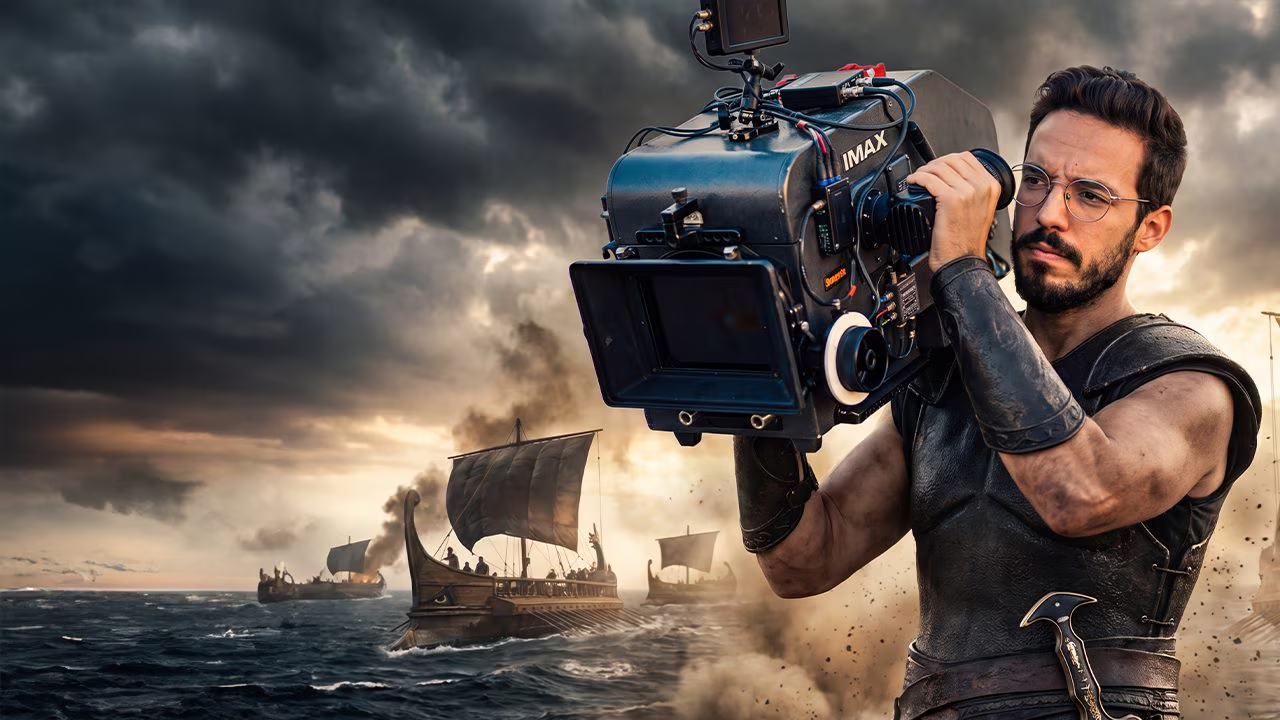
The Odyssey Of Christopher Nolaneven before it was released in theaters on July 16, 2026, earned the distinction of first film shot entirely in IMAX analog. This is an incredible technology that allows for unattainable visual performance, despite having very stringent technical limits.
IMAX differs from traditional cinema because it does not use the classic 35mm film that runs vertically, but a 65mm ribbon running horizontally: the frame becomes huge (15 perforations), with one resolution estimated between 12K and 18K (versus the 2K/4K of modern digital projectors).
Among other things, to shoot with live audio and eliminate the noise of the equipment, Nolan had a very heavy soundproofed “blimp” built for the camera, so cumbersome to prevent the correct shot of the looks between the actors. The solution was a mirror systemwhich allowed the actors to look at their reflections while the lens remained hidden to the side.
What is IMAX and how to use 65mm film when shooting
Let’s start from the basics. IMAX stands for “Image Maximum“, Meaning what “Maximum Image“. The objective is clear already from the name: push visual quality to the maximum limit. To understand what this maximum image consists of, we must make a comparison with the traditional films that we are used to seeing at the cinema. These, historically, are filmed in film from 35 millimeters. This tape runs inside the camera vertically, and each frame takes up the space of about 4 perforations (those little holes on the sides of the film), offering a useful width of about 24.9 millimeters.
IMAX, on the other hand, uses film stock 65 mm during shooting. But here’s the real stroke of genius from the IMAX engineers: instead of running the film vertically, they ran it horizontally!
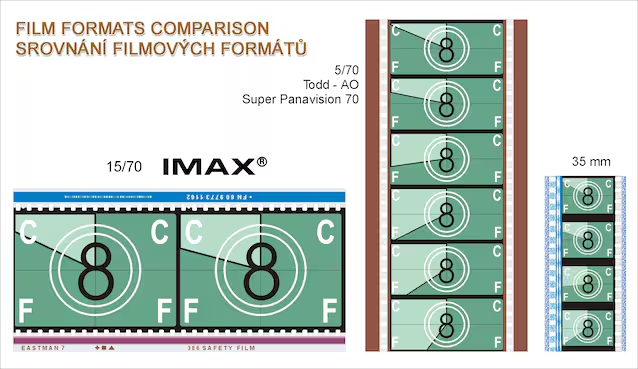
By scrolling horizontally, the frame is not limited by the width of the film. Every single IMAX frame is well long 15 perforations. This mammoth format, known as 15/70is about 10 times larger than a standard 35mm frame. And in practice, what changes? First of all, the resolution.
If we tried to translate the quality of an IMAX film into digital pixels, we would be talking about one stunning resolution estimated between 12K and 18K. This means that the image has a incredible sharpnessrich textures and almost invisible cinematic grain, offering an aesthetic and color rendering that no digital sensor today can match in the same way.
Secondly, there is a question of optics And depth Of field. Having such a large film changes the field of view, allowing you to achieve a much shallower depth of field. So there are wide shots but with a blurred background, and this allows you to isolate the characters and give the film an epic and three-dimensional look.
Then there’s the format of the shot. Native IMAX has a ratio of 1.43:1which is much taller and “squarer” than typical widescreen screens, which are very wide and low. This format gives the viewer up to 26% more image above and below.
And the projectors? They are monstrous machines as much as movie cameras. An analog IMAX projector weighs more than 2 tonsthe equivalent of a small car! It uses 15,000 watt water-cooled xenon lamps and there is even a vacuum system which sucks the film against a glass panel to keep it aligned with the lens. When the film is projected on screens up to 30 meters high (so more or less like an 8-story building), the image completely fills your peripheral field of vision.
The incredible thing is that until today, directors who used IMAX – including Nolan himself – did not do so for the entire film, but only for some specific sequences. Let’s say, the film Tenetabout half were shot with this technique. But with the Odyssey it changes, because here everything is shot in IMAX, from the first to the last scene.
Limitations and problems of IMAX: The equipment weighs over 100 kg
The first problem is the weight of the equipmentgiven that an IMAX camera weighs more than 100 kg! To move it you need special supports and to assemble and disassemble it you need several people at a time. I’ll let you imagine how difficult it can be to take a dynamic shot with a beast like that.
The second limitation of this technology is duration. Due to the gigantic size of the tape that runs inside it, the IMAX movie camera can only hold approx 300 meters of film at a time. Do you know how many minutes of recording corresponds to? Between two and a half minutes and three minutes maximum. Imagine the pressure on the actors, who have to be perfect knowing that every mistake is very expensive, given that the film costs up to $2,000 for every minute shot!
The third problem with IMAX, perhaps the most important one, is the noise deafening. The reason behind this noise is purely mechanical and physical. The machine has to pull a huge amount of film at an impressive speed (i.e. 24 frames per second) through the internal gears. With such noise, recording live audio – therefore the actors’ voices while they act – is essentially impossible, and usually forces productions to re-dub all the dialogues in post-production. Nolan, however, is not a super fan of redubbing. He wanted original audio for his Odyssey, even with IMAX. And how did he do it?
He worked closely with IMAX engineers to create an ingenious solution: a “blimp“, that is, a special soundproofed, lead-lined housing for the movie camera. Matt Damon described this protective shell as a thing of “size of a coffin” which, once assembled, brought the total weight to over 136 kilos. It weighed so much that they had to build special steel plates on the trolleys to support it.
But inserting the camera into this gigantic “coffin” created a new problem: the blimp was so large that, in dialogue scenes between two actors, it prevented positioning the camera lens in the right place to capture the correct line of gaze. The solution? An ingenious system of mirrors! The actors positioned themselves next to the bulky camera and looked into a mirror, which in turn reflected their image straight into the camera lens, thus preserving the intimacy of the shot.
Let’s take a moment. We’ve seen what this IMAX technology is, how it works, and what the big technical limitations filmmakers face when they choose to use it. But once the film has been shot, what happens?
Mounting in IMAX with a special glue
In a world dominated by digital, where directors cut films by clicking with a mouse on a computer, how do you edit a behemoth in analog IMAX? Well, the old fashioned way. You take two pieces of 70 millimeter IMAX film, you use a small jar of glue special to apply the adhesive with surgical precision to the edge of the cut negative, and physically join the two strips.
Imagine the responsibility of handling a million-dollar negative with scissors and glue. But the result is one flawless jointperfect, so much so that it doesn’t even seem cut. This is madness, considering that the film lasts almost three hours. But when I buy a ticket that says IMAX, what exactly am I going to see?
Where they show films in IMAX in Italy
In fact, there is a big difference betweenthe real IMAX” (or classic IMAX) and “the digital IMAX“. TheClassic IMAX it’s the one we’ve seen so far, the one that uses gigantic 2-ton projectors and the mammoth 70 mm film with 15 perforations that we talked about. This format gives us stunning visual resolution and is projected in its native aspect ratio of 1.43:1. It’s a very tall, almost square image that covers the entire wall in front of you and completely fills your peripheral vision.
However, in 2008, the IMAX company wanted to expand its brand into regular multiplex theaters. To do this, it was impossible to install those huge and expensive analog projectors everywhere, so they created the IMAX digital projectors. This digital technology has made it possible to bring IMAX all over the world, but it has major technical limitations compared to film. First of all the resolution is significantly lower (we’re talking about 2K or 4K versus 12K/18K). Secondly, these proportions force a “cut” of the image: it is no longer 1.43:1 but it goes down to 1.90:1. This means that the image becomes more squashed horizontally, and the entire portion of the upper and lower image recorded natively by the director is literally cut away!
In Italy there are IMAX theaters, but they all fall into the category ofIMAX digital. This means that if you want to live the “purist” and 100% analog experience desired by directors like Christopher Nolan, unfortunately you will have to get on a plane and go to cities like London or Prague.
But don’t despair! Going to a digital IMAX theater in Italy still remains a clearly high quality visual and sound experience. In short, whether on film or digital, the mission of these technologies is always the same: to make us daydream in front of the largest and most immersive screen possible.
