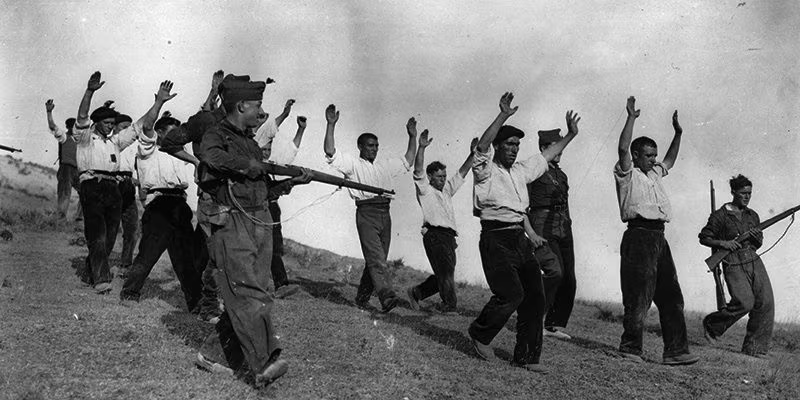
There Spanish civil war was fought between 1936 and 1939. Started on July 17, 1936 with the coup d’état led by the generals Francisco Franco and Emilio Molathe conflict saw i nationalistsled by some generals and supported by the Church, the middle-upper classes and some foreign countries (such as Nazi Germany and fascist Italy). On the other hand there were the Republicanssupported by a large part of the workers, by the trade unions, by anti-fascists from all over Europe, by the Soviet Union. It was considered a “general test” of the Second World War because, on an ideological level, it saw the blocs that actually clashed during the Second World War opposed: the German and Italian air forces, among other things, intervened directly in the clashes with the famous bombings on the city of Guernica.
The war, fought with extreme brutality and characterized by numerous crimesofficially ended on 1 April 1939 with the victory of the deployment nationalistthanks to which the bloody dictatorship of Francisco Francowhich lasted until 1975 with the death of the “caudillo”.
Spain in the twentieth century: political and social tensions
In the first decades of the twentieth century, the Kingdom of Spain found itself in a very difficult situation. In the centuries of the modern age it had been a great power, but it had lost this role and at the end of the nineteenth century it had undergone a military defeat at the hands of the United States of America, definitively losing the last colonies (Cuba, Puerto Ricothe Philippines And Guam).
The Kingdom of Spain, then, had remained outside of the First World War, but had been affected by very heated political and social tensions. The population mostly belonged to rural classes and lived in conditions of poverty, while aristocrats, landowners and industrialists had greater wealth. They were lined up in support of the workers the trade unions and the left-wing partieswhile the owners enjoyed the support of the right, a large part of the military and the clergy.
In 1923 the dictatorship of Miguel Primo de Riverasupported by the king, Alfonso XIII: the regime remained in power until 1930.
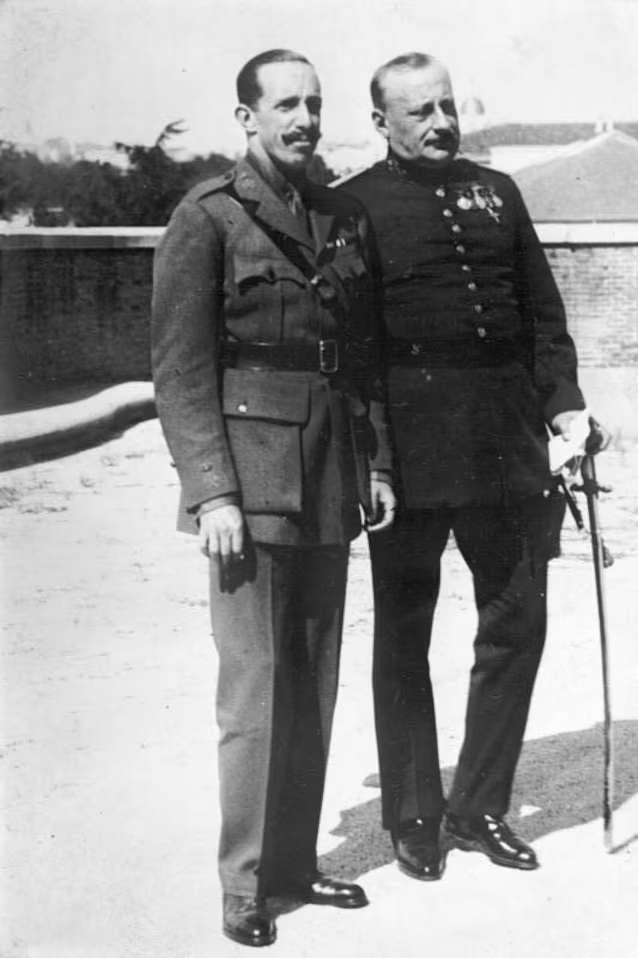
At elections of 1931 the parties established themselves Republicans: with many tensions, the sovereign was forced to abandon power and the Republic. Tensions were very strong and already in 1932 some army departments, led by the general Jose Sanjurjothey attempted to take power with a coup d’état, which however failed.
In 1933 new elections brought to power a Conservative governmentbut at the next consultation, convened in February 1936the Popular Front, made up of socialists, communists of various tendencies and republicans, emerged victorious.
The coup d’état that led to the outbreak of the Spanish Civil War
The right did not resign itself to defeat. Some generals, among them Jose Sanjurjo (exile in Portugal), Emilio Mola and Francisco Frankbegan planning to overthrow the government in a coup. They put their purpose into action July 17, 1936ordering the army to oust the political class from power.
The coup d’état, however, succeeded only in some areas of Spain: the Spanish territory in Morocco (the enclaves Ceuta And Melilla), where the coup began, and a sector of territory in Center and North of the countrywith the cities of Salamanca, Zaragoza and Valladolid. The republican government, however, retained control over Madrid, Catalonia, Andalusia, the Basque Country and other regions.
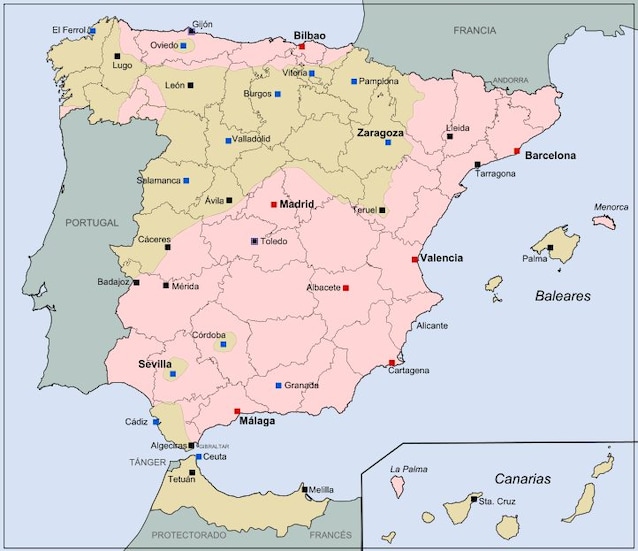
The conflict began between the two areas of the country civil war. He emerged in the nationalist camp Francisco Franco which, after the death of Sanjurjo (20 July 1936) and Mola (3 June 1937), both of whom died in a plane crash, became the recognized leader. The Church, the aristocracy and the fascist party of the Spanish Falange were aligned in the majority at his side.
On the Republican side, the party offaithful army in government, the trade unions, the autonomist movements of the Basque Country and Catalonia.
International involvement in the Spanish war
The conflict involved combatants and volunteers of other countries. It should be remembered, in this regard, that in the years between the First and Second World Wars in Europe a heated confrontation took place between democratic political systemsin power in countries such as France and the United Kingdom, fascist regimeswho controlled Germany, Italy and other states, and socialist partiesin power in the Soviet Union. Supporters of other regimes were present within many countries, to the point that some historians have defined the period in question as “European civil war”.
It is not surprising, therefore, that they also intervened in the Spanish war military units of other countries And foreign militiamen. The regimes of Italy and Germany lined up alongside Francisco Franco, sending army and air force units to fight against the “subversives”.
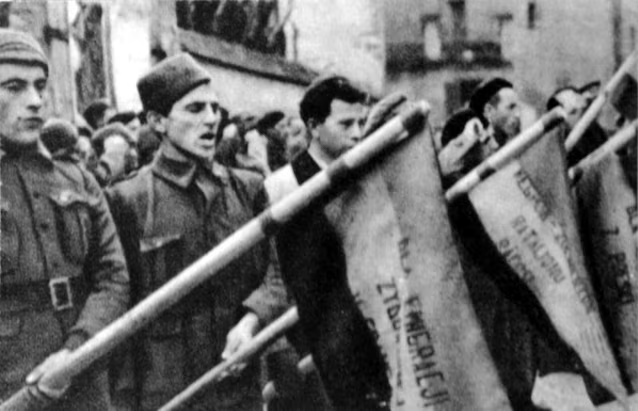
They were on the Republican side other countries are ideologically alignedlike France, which however preferred not to send military contingents. THE’Soviet Unionfor its part, supported the Spanish communists, but the distance prevented it from providing substantial aid. However, volunteers from numerous countries sided with the republicans and formed the International Brigades. Among them there were also Italian anti-fascists, who considered the war in Spain the prelude to the liberation of Italy.
Francisco Franco’s advance and the end of the conflict
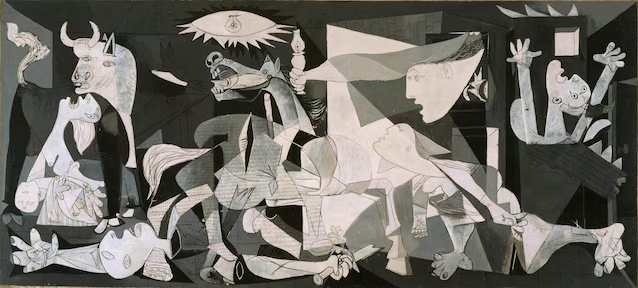
The balance of power was all in favor of the Francoist camp, which enjoyed the support of the main centers of power within Spain. It turned out to be important too the contribution of the Germans and Italianswhich, among other things, the first experienced during the war carpet bombing of cities. In 1937 a Basque town was hit by German and Italian bombs, Guernica. The attack profoundly affected public opinion, because until then bombings of that size had never been carried out, and it was immortalized by Pablo Picasso in a famous painting.
As time passed, the republicans, although managing to inflict some defeats on the Francoists, they had to retreat. In January 1939 Barcelona fell and, in the following March, the Francoists entered Madrid. The war he finished officially the 1 April 1939. For Spain, a long dictatorshipwhich would end only after Franco’s death in 1975.
War crimes: executions and stolen children
The war was fought with extreme brutality and bloody crimes were committed on both sides. Republicans were responsible for killing members of the clergy and landowners. The Francoists, for their part, they murdered opponents throughout the conflict and the executions continued even after the conquest of power, eliminating, in total, more than 100,000 people. The total number of victims of the conflict, including those who died under bombing, is estimated at between 300,000 and 500,000.
Hundreds of thousands more went in exile after Franco’s victory. Among them were some of the most important artists and intellectuals of the twentieth century: painters such as Pablo Picasso, Joan Miró and others; writers like Antonio Machado and Rafael Alberti; directors like Luis Buñuel. Federico García Lorca, one of the most important Spanish writers of the 20th century, was killed by Franco’s supporters, while the British writer Ernest Hemingway he participated in the war among the volunteers of the International Brigades.
The Francoists were also guilty of another crime: abduction of children from mothers to entrust them to couples close to the nationalist camp or simply willing to pay. Mothers, belonging to the humblest social classes, were told that their children had died during childbirth. The extent of the phenomenon, which continued beyond the end of the civil war, is not never been fully clarified and the number of abducted children is not known which, according to some scholars, amounts to several tens of thousands.
Sources
Antony Beevor, The Spanish Civil War, Milan, Rizzoli, 2006,
Paul Preston, The Spanish Civil War 1936-1939, Milan, Mondadori, 2004
Santos Julià, The Spanish civil war: from the Second Republic to the Franco dictatorship, 2019
