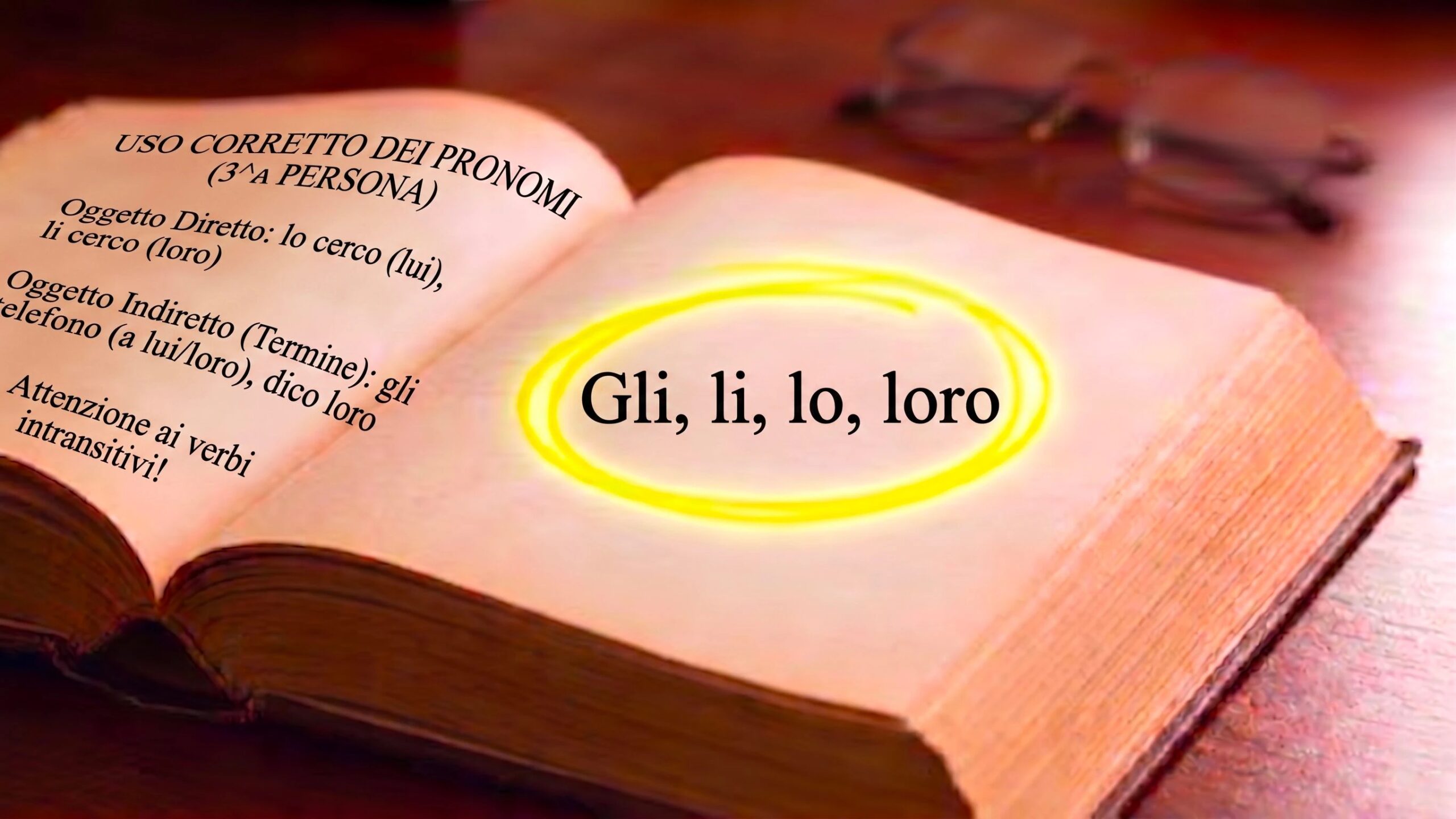
«I obliged them»; “I’m going to visit my parents and bring them some apples.” They are phrases that you may happen to say or hear said but which are what they are grammatically incorrect. Confusion is created in particular in the couple of pronouns The And there (to which they are added I, I, I And They): they are the so-called third person clitic pronouns, that is “particles” unstressed, without proper accent, which they rely on the verb.
The bad news is that these pronouns put the whole of Italy in difficulty, from south to north, as the Accademia della Crusca itself has recorded by collecting questions and requests for clarification for years. The good news is that even in this case you only need to understand one rule to remove the doubt forever.
Because the third person is the only one who puts us in difficulty
We are not wrong with the first and second person, because the same pronoun allows us to make direct object complement and indirect object complement (or term), i.e. the recipient of the action: the me it works both for «you see me» (see me) and for «you give me» (dai to me). The same goes for you (tea And to you), There (us ea us) And you (you ea you).
The problem arises with the third personwhere Italian uses different forms depending on the grammatical “role” of the pronoun, which can be:
- Direct object (he who directly suffers the action, without preposition): in the masculine it is the in the singular e there in the plural. The I see, there I see.
- Indirect object (the recipient of the action, the one who answers “to whom?”): in the masculine it is The in the singular e They in the plural. The I’m talking, I’m talking They.
The And there they are not interchangeable forms, but two different clitic pronouns, with different syntactic functions, even if they look similar and are easy to confuse: The means “to him”; there means “they” in the sense of “they”, as direct object.
The trick to solving the doubt: his or them?
There is a very quick way to avoid making mistakes: before choosing the pronoun, try to replace it with the extended form. If the sentence holds a «to him» / «to them» (with the preposition to), then the pronoun is indirect and wins The (or They), so «I telephone him» becomes «I telephone him». If instead a simple one holds “him” or “They” without preposition, the pronoun is direct and wins him/her, and “I see them” becomes “I see them”.
The choice depends on the verb and the function performed by the pronoun in the sentence: if the verb is transitive (holds a direct object, such as “see”, “oblige”, “call”) calls the And there; if it is intransitive and holds a complement of term (such as “to telephone to” or “to speak to”) it asks The And They.
The most common errors and examples
You don’t say or write “I’ll call him”, but “I’ll call him” or “I’ll call them”. It is the most widespread mistake and arises from the contagion of calling. Since “I telephone him” is correct (to telephone is intransitive, you telephone someone), and that to call is often used as a synonym for telephone, we tend to treat them the same way. However, calling is transitive: you call someone, not to someone. In the same way, it is not said and written “I forced them”, but rather “I forced them”. In fact, forcing is also transitive: you force someone (to do something). The direct object therefore serves the masculine plural there. Same logic for “I made them get out of the car” (I made them get out), not “I made them get out”.
«I’ll bring them some apples» is incorrect, they say and write «I’ll bring them some apples». Here the error is reversed: I bring something to someone, therefore the person is the object indirect. He wins Theor, in the plural, They: «I bring them some apples». According to grammars, the form “they” is the only truly correct form for the plural, while it is considered colloquial. The fact that li has two syllables and does not “fit” well into the family of monosyllabic clitics (mi, ti, lo, gli etc.) is for Crusca one of the reasons why even the plural is much more widespread in speech The.
Why we make mistakes: phonetic patterns, the influence of dialects and origins
There are two reasons that lead us to make mistakes and both have to do with where we come from. The first is phonetics: The And there they resemble each other and in quick pronunciation – thanks in some areas to dialect phonetics – they tend to exchange or reduce both to a simple the. La Crusca specifies that it is a “execution” errorquick to pronounce, which must not affect competence, that is, our ability to distinguish the two pronouns when we use them in written form.
The second root is the so-called prepositional objecttypical of southern dialects and their regional varieties, where the direct object, if it is a person, is often introduced by “to”: «I saw Giuseppe». Be careful, however: even in these cases, for grammar purposes, the pronoun remains that of the direct object (“I saw him”, not “I saw him”).
There is also a historical reason. The And there originally they were the same word. The shape there derives from the Latin dative ĭllī and in ancient Italian it was used as an indirect object, in the sense of “to him” and “to her”.
The problem is that it also coincided with the there plural masculine direct object: the same form but two functions – as happens again with the feminine le, which applies to both “a lei” and “esse”. The there dative underwent one palatalization, transforming when faced with words that began with the vowel in The. The paradox is that centuries later we have returned to the starting point: in everyday speech The it is eating its neighbors again, taking the place of theOf They and sometimes even of the. As always, language shows its recurring dynamics, making immense turns which then, sometimes, return.
Sources
Accademia della Crusca (P. D’Achille, 2016)
Treccani, Personal pronouns
Luca Serianni, Italian grammar. Common Italian and literary language, UTET
