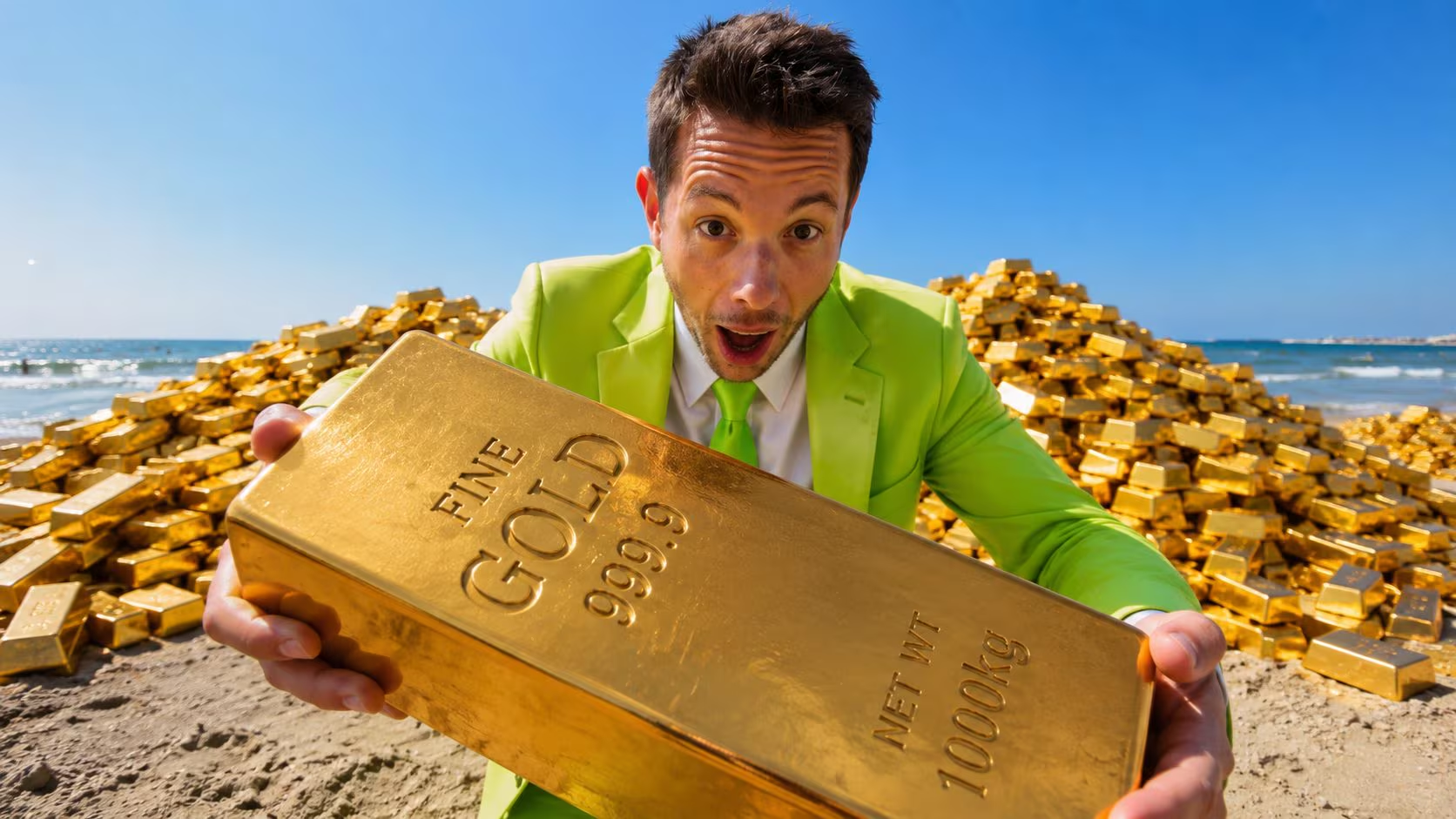
Let’s take it all the gold in the worldlet’s melt it and put it in a single block: how many meters do you think the side of this will be cube? Ben 22 meterspractically a seven-story building. All this gold, al current market value – considering around 115 euros per gram in July 2026 for 24 karat gold – it would be worth around 24,400 billion eurosa value comparable to the GDP of the United States!
But why is gold so precious? What is so special about this metal from a chemical-physical point of view? The reasons certainly have to do with the rarity and difficulty of extraction, but also with its extreme workability and its chemical inertia: it is in fact a metal that does not oxidize or rust.
The answer to these questions therefore has to do with the chemistry, geology and even astrophysics. Small spoiler: gold was not formed on Earth, but comes from space.
Why gold is so precious: chemistry first of all
The answer is not romantic, but chemical. Gold is inert: does not react with almost anything, does not rust, does not oxidize, does not deteriorate. An ingot mined today will look identical in a thousand years. No other base metal can make this promise.
To this we add one extreme workability. With one gram of gold you can produce a wire two kilometers long. It can be spread in leaves so thin that they become semi-transparent – the ones that cover the domes of baroque churches, so to speak. The melting point is relatively low, which made it workable even with ancient technologies.
But the most important reason is the rarity. Gold cannot be manufactured. It does not print like a banknote. It is extracted with enormous effort, in physically limited quantities, and this makes it impervious to devaluation. This is why central banks use it as a strategic reserve: it is the credibility of a state transformed into metal.
When you hear about 24 carats and 18 carats you are talking about purity. 24K is 100% pure gold. 18k is an alloy – 75% gold and 25% silver or copper – which serves to make it harder, because pure gold is soft and would scratch easily.
How much gold exists on the planet and who owns the most: Italy is third in the world
In the history of humanity they have been approximately 212,000 tons of gold mined. A huge number in absolute value, microscopic if you stop to think about it: we are talking about the whole of human history, from the Egyptians to today’s industrial mines. If you fused everything together, you would get a cube measuring 22 meters on each side. Or, if you prefer, four Olympic swimming pools filled with molten metal.
To the current prices – around 115 euros per gram at the end of July 2026 – that cube is worth approx 24,400 billion euros. Approximately what the entire US economy produces in a year.
More than two-thirds of this total was extracted after 1950, a sign of how modern industry has accelerated compared to millennia of previous history.
The reserves still in underground – those economically convenient to extract at current costs – are around 50,000 tons. Not an absolute physical limit: as the price rises, deposits that are too expensive today become profitable. Gold doesn’t “run out” in twenty years – it just gets harder and more expensive to get out of it.
As for Italy: the Bank of Italy owns 2,452 tons of gold as gold reserves, third in the world among sovereign states. Above us only the United States, with 8,133 tons, and Germany, with 3,350. Here is the complete ranking of the top ten:
- United States – 8,133 t
- Germany – 3,350 t
- Italy – 2,452 t
- France – 2,437 t
- Russia – 2,332 t
- China – 2,298 t
- Swiss – 1,040 t
- India – 880 t
- Japan – 845 t
- Netherlands – 612 t
We have more gold than Russia, more gold than China, more gold than France, which is just fifteen tons behind us. With current prices (updated in July 2026), our reserves are worth around 280 billion euros, around 13% of Italian GDP.
Italian gold is not all in Rome. The 44% is in the vaults of the Bank of Italy in Via Nazionale, il 43% are in the United StatesThe 6% in Switzerland and the 5.7% in the UK. It’s not improvisation: it’s risk diversification. Keeping reserves close to the markets where gold is traded allows them to be sold quickly if necessary, while also minimizing transportation costs.
Up to $4,050 per ounce today: How the price has changed over the last 10 years
In 2015, gold was at its lowest point in the decade: around $1,060 per ounce. Solid American economy, strong dollar, optimistic investors. Gold loses its appeal in these moments — you don’t need a refuge when you’re not afraid.
The first rebound arrived in 2016. Stock markets fall, the Brexit it sows uncertainty, and in a few months the price rises by 16%. The real leap, however, is in 2020: the COVID-19 pandemic paralyzes the planet, central banks print money at unprecedented rates and for the first time gold in history exceeds $2,000 per ounce. Since then he has never returned below.
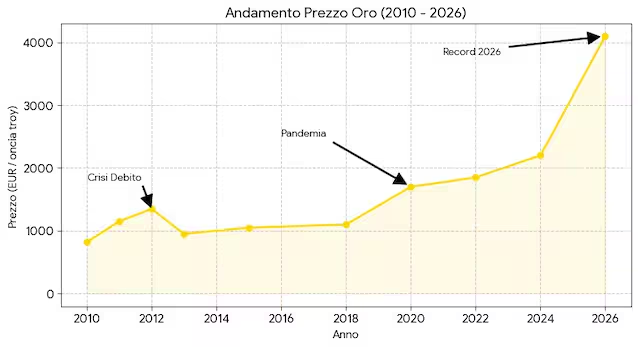
THE’Russian invasion of Ukraine in 2022 the race will accelerate. In 2023 the $2,000 becomes the floor. In 2024 the 2,500 mark will be reached. In March 2025 we are approaching 3,000. In September 2025 the quota will be exceeded 3,800 and in 2026, due to geopolitical instability, gold reaches its historic highexceeding the threshold of $5,100 an ounce. At the end July 2026 gold trades around $4,050 per ounce (the video included in this article refers to data from April 2026, when it was recorded).
In ten years, therefore, the price has more than tripled. The logic is always the same: gold is the thermometer of global fear. When the world trembles (pandemic, war, energy crisis, geopolitical instability) investors they buy goldconsidered a “safe haven”. And this is what happens mechanically: the prices of other assets fall, uncertainty increases and capital seeks refuge in the one thing that does not depend on any government and cannot be printed.
Where does gold come from: the answer is in space
Gold did not form on Earth. This is the starting point to understand the true history of this metal.
In stars like the Sun, nuclear fusion occurs continuously: hydrogen atoms fuse, forming helium, then carbon, oxygen, increasingly heavier elements, up to iron. But we stop at the iron. Beyond iron, nuclear fusion no longer produces energy, but consumes it. Therefore, in a star like the Sun, elements heavier than iron cannot be formed.
Gold, however, is much heavier than iron. But how was it formed? For decades the answer was supernovae. When a massive star explodes, the energy released is enough to trigger the formation of very heavy elements. Supernovae still contribute – this is worth saying clearly, because the scientific picture is not yet closed.
But in the 2017 one arrived discovery who redesigned the map. For the first time, the gravitational waves produced by collision of two neutron stars (ultradense remains of exploded stars, so compact that a teaspoon of their matter would weigh billions of tons). That collision generates a kilonova: an event of intensity difficult even just from imagine.
In this explosion, extreme physical conditions occur – very high neutron densities, enormous temperatures – which trigger what physicists call the r process, or rapid neutron capture process. Under these conditions, atomic nuclei capture neutrons in very rapid succession, much faster than beta decay can stabilize them.
The result is the formation of increasingly heavier and unstable nucleiwhich then progressively decay towards stable elements. Among these elements is gold. The spectroscopic analysis of the GW170817 event – this is the technical name of the observed kilonova – showed for the first time the unequivocal signature of heavy elements produced in real time.
It’s worth adding that the search is still open: Recent studies from 2025 suggest that flares from magnetars (neutron stars with extreme magnetic fields) could also contribute up to 10% of the heavy elements in our galaxy. The complete picture is therefore: supernovae, kilonovae and probably magnetars. Three different mechanisms, all of unimaginable violence, all necessary to explain the gold we hold in our hands.
How did it get to Earth? The most accredited hypothesis is the meteor bombardment: billions of years ago, the Earth was hit by an intense shower of asteroids containing heavy metals. That gold remained in the crust and is what we mine today.
There’s a number worth stopping to consider: if we could recover all the gold which over time has sunk towards the earth’s core, where we will never arrive, we could cover the entire surface of the planet with one four meter high layer of gold. What we extract in the mines is only the part that was delivered to us by the asteroids.
How gold deposits are formed and where the largest mines are located
The gold deposits they are formed in two ways fundamentally different. The deposits primariescalled hydrothermals, are created when very hot fluids and at high pressure they rise from the subsoil through fractures in the rock created by earthquakes or tectonic movements. These fluids carry dissolved metals, including gold.
When they reach the fractures and they cool, they deposit everything they brought, forming gold-bearing veins or veins. Gold is often not visible to the naked eye: to detect and measure it you need an optical or electronic microscope. Tunnel mines almost always work on this type of deposit.
The secondary deposits, the placers, arise from the erosion of the primary ones. Over millions of years, the veins are eroded and the fragments dragged by the rivers. During this transport the gold (much heavier than common sand) tends to sink and accumulate in specific places of the river bed: curves, differences in level, meanders. It is exactly these accumulations that the gold seekers of the Far West were looking for with the sieve. In the Po Valley, along the Alpine rivers, there are traces of gold. They arrive, through erosion, from the primary deposits of the Alps.
There most important mine of history is the Witwatersrand complex, in South Africa: that’s where it comes from 30% of all the gold ever mined from humanity. It was discovered in 1886 and triggered a real gold rush. Today it is in decline and produces about 4% of global gold.
For current production, in first place is the Nevada Gold Mines in the United States, with over 115 tons per year. Then Uzbekistan with the Muruntau mine, 66 tons, and Russia with the Olimpiada mine, 43 tons. However, the country that produces the most gold remains China, with around 11% of global production distributed in hundreds of underground mines.
The 60% of active mines today it is open-air (huge craters in the ground from which banks of rock with explosives break away). The the remaining 40% are excavated tunnels in the rock. What is extracted is never pure gold: it is rock containing traces of metal. The rock is ground, reduced to powder, and then chemically treated. The main method is cyanidation: cyanide-based solutions selectively bind to the gold, separating it from other minerals.
It’s a closed loop processwith containment systems that prevent dispersion into the environment – although historically the environmental impact of the gold mining industry has been heavy, and remains an issue that should not be ignored. In Italy extraction has stopped since the 1960s. The last large active mine was that of Pestarenain Valle Anzasca, closed in 1961.
