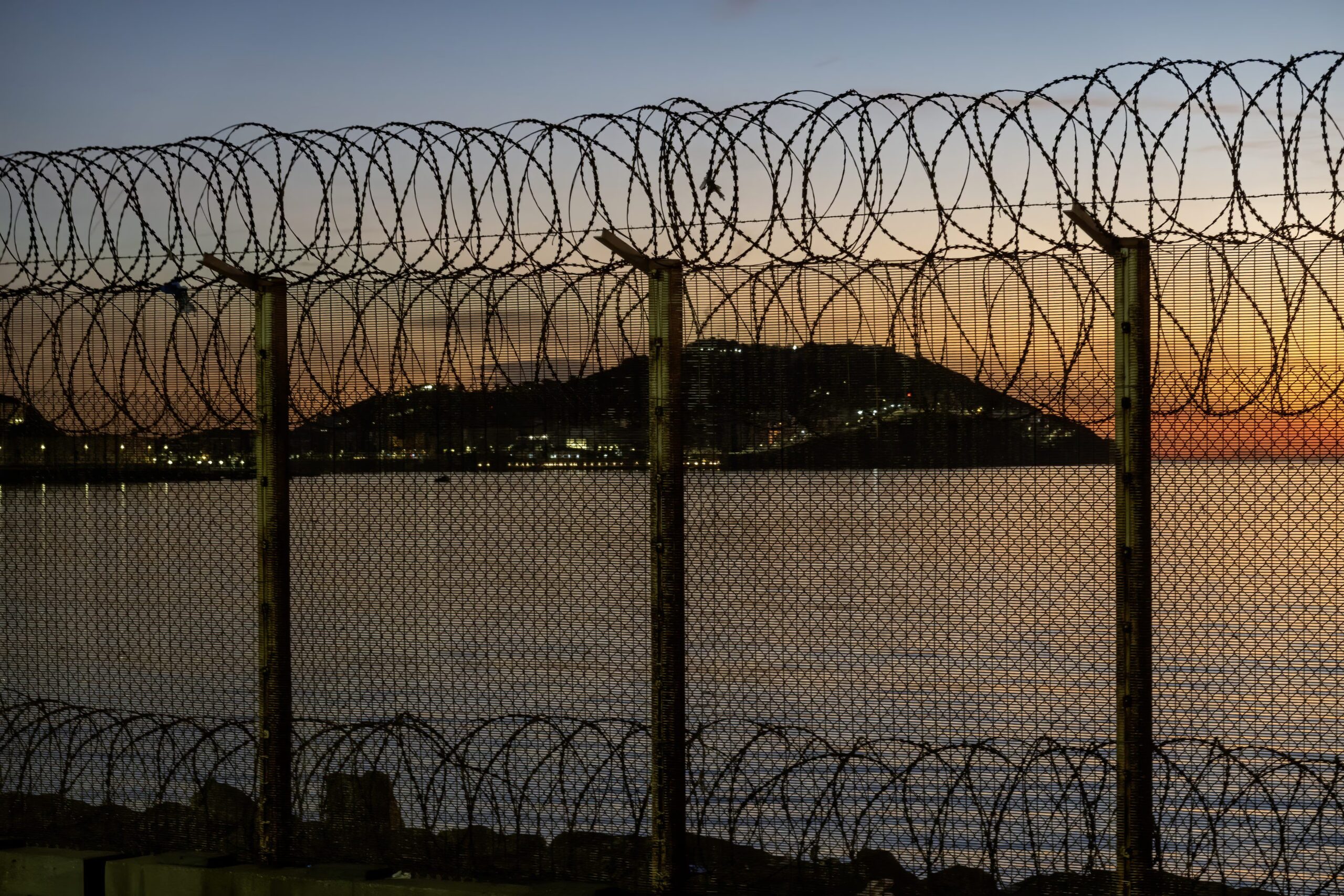
In recent days, tens of thousands of people have crossed the border between Morocco and Ceuta, the Spanish exclave on the North African coast, in just a few hours. Twenty-four hours later the Italian government announced the restoration of border controls with Spain, described by newspapers as a “suspension of Schengen”: it is in force from August 1st and lasts one month. The assumption of the measure is that a wave could move from Ceuta towards Italy. The data from Frontex (the European border and coast guard agency) do not confirm that assumption: in the series of surveys at the external borders of the European Union a canal between Morocco and the Italian coast almost never appears. In 2025, Moroccan citizens detected on the central Mediterranean route, the one leading to Italy, were 814 out of 66,551: 1.2% of the total.
What happened in Ceuta: 70 thousand migrants crossed the border
Ceuta is a portion of Spanish territory with approximately 80 thousand inhabitants surrounded by Morocco, separated from the Iberian peninsula by the Strait of Gibraltar. Between July 30 and 31, according to the Spanish authorities, around 70 thousand people crossed the border illegallymany swimming around the breakwater, others climbing over the barriers. Madrid deployed the army alongside the Guardia Civil. The death toll – at the time of writing – recovered at sea exceeded 80 people.
There has been much discussion about the causes. At the beginning of July, the Spanish Supreme Court ruled that anyone intercepted at sea while trying to reach Ceuta and Melilla cannot be summarily returned to Morocco, and that ruling was indicated as a trigger. But the interviews of El País to the migrants who arrived in those hours they denied the reconstruction.
However, two questions about Morocco’s behavior remain unanswered: why in the first hours the security forces allowed very large groups to advance towards the border, and why thousands of people who left Casablanca, Rabat, Tangier and Marrakech were able to move north without the communication routes being closed. In the following hours most returned to Moroccoalso due to the absence of accommodation and assistance: the reception center in Ceuta is designed in fact for around 500 people.
Because the Italian government has decided to restore controls with Spain
The diplomatic crisis began on the evening of July 30, with a post by Giorgia Meloni on social media: “Italy will not stand by and watch”wrote the Prime Minister, announcing her willingness to intervene with extraordinary tools, including the suspension of the Schengen area with Spain. Shortly before, Matteo Salvini and Antonio Tajani had expressed the same opinion, linking the arrivals in Ceuta to the regularization campaign launched by the Spanish government. That link, however, is not proven: the regularization had concluded over a month earlier and the migrants who arrived in those days would not have had the requirements to access it anyway.
Madrid reacted summoning the Italian ambassador: Foreign Minister José Manuel Albares spoke of disappointed expectations towards a partner country, from which we expect “European solidarity and not party demagogy”. Prime Minister Pedro Sánchez responded by publishing Frontex data on irregular entries between 2021 and 2026 and recalling that compliance with the treaties and data is not optional. The Italian decision arrived on the evening of July 31st, after a meeting of the Analysis Committee on immigration and border security chaired at the Interior Ministry by Minister Matteo Piantedosi.
What does the restoration of border controls with Spain really entail?
Formally no treaty was suspended. The provision applies the Schengen Borders Code – il Regulation (EU) 2016/399reformed in 2024 by Regulation (EU) 2024/1717 – and in particular the procedure that thearticle 25 bis reserve for unforeseeable events: allows a Member State to reintroduce controls immediately and without notice, for a maximum of one monthsimultaneously informing the Commission, European Parliament, Council and other Member States. This is why the measure lasts exactly thirty days: in the notification registered by the Commission it goes from 1 August to 1 September 2026. Any extensions cannot bring the total beyond three months.
On the merits, the measure it only concerns third-country nationals arriving from Spanish ports and airports and translates, in practice, into document checks defined by the Interior Ministry as “targeted” and “selective”, i.e random checks. Anyone with an Italian, Spanish or other EU country passport does not undergo additional checks. In the justification sent to Brussels, Italy indicates the risk of “secondary movements” within the Schengen area after the mass arrivals in Ceuta: it is the assumption on which the entire measure is based, and it is also the first to not stand up to the test of facts.
What does the Schengen Borders Code provide?
The first measurement problem is geographical. Ceuta is not located in continental Europe but in North Africa, and for this very reasono the Schengen Borders Code reserves special rules for it. The European Commission reconstructed them in a response to a 2022 parliamentary question: theacquisition of Schengen applies in full to Ceuta and Melilla, but identity and document checks must be carried out upon departure towards peninsular Spain or another country in the area. The control that Italy restored upon leaving Ceuta already exists and is mandatory.
Added to this are two practical details. In the exclave there is no commercial airportso the only way to the peninsula is the ferry, where documents are checked upon boarding. AND Italy and Spain do not share any land borders: anyone wishing to reach Italy by land would have to cross France, which has already reintroduced controls at the Spanish border on its own.
What the Frontex data say about arrivals from Morocco to Italy
The second problem is the numbers. The European Border and Coast Guard Agency publishes findings on illegal crossings of the Union’s external borders every month, broken down by route, type of border and nationality. We analyzed the complete series indraw of 8 June 2026which covers data through April.
The big picture shows two routes of very different sizes. In 2025 the central Mediterranean route, the one leading to Italy, registered 66,551 detections; that of the western Mediterranean, which leads to Spain, 19,195. In the cumulative period between 2021 and April 2026 the gap is 473,294 versus 92,123. It is the same asymmetry that Sánchez referred to when responding to Rome.
However, the data that most closely concerns the Ceuta crisis is another: how many Moroccan citizens actually arrive in Italy. The answer is: very few, and for years. In 2023 there were 347, in 2024 348, in 2025 they rose to 814, equal to 1.2% of detections on the route. In the first four months of 2026 they are 136 out of 8,577. It is not a channel that opens and closes depending on the crisis: it is a marginal and stable share.
The reason is that the two routes transport different populations. In 2025 the first five nationalities detected on the Spanish route were Algeria (10,375), Morocco (3,551), Somalia (1,593), Mali (1,133) and Guinea (919). On the Italian route Bangladesh (20,416), Egypt (9,154), Eritrea (7,585), Pakistan (4,399) and Sudan (4,204). No nationality appears in both rankings. Those who leave Libya for Sicily and those who leave Morocco or Algeria for Andalusia belong to distinct migratory chains, with different networks, costs and destinations.
A final figure helps to measure the exceptional nature of what happened on July 30th. The land border of the Western Mediterranean route, i.e. the Ceuta and Melilla crossings, recorded a total of 3,949 detectionswith a monthly high of 612 between September and October. The entire year is worth less than 6% of what happened in a single day. Ceuta was hit by an event on a scale completely different from its normality, and it is this – not a structural flow towards Italy – that makes the day so impressive.
It must be said that the Spanish route in the first four months of 2026 is growing: 5,394 detections against 3,447 of the same period of 2025. It is the only main route that is increasing, in a European context that is instead decreasing: the Union total in the first four months stops at 29,001 detections, 39% less than in 2025and Frontex certified a decline of 37% in the first half of the year. But the increase on the western route is driven above all by departures from Algerianot from Morocco and not from Ceuta.
What the European Union said about the Ceuta crisis
The clearest confirmation came from the Union itself. On August 4, the twenty-seven Interior Ministers met via videoconference in an extraordinary session, at the request of a letter signed by 22 countries with Italy and Denmark as the leaders. The outcome overturned the expectations of the day before: unanimous solidarity with Spainappreciation for the speed of management, condolences for the victims. No mention of Spanish regularization, no new measures to combat immigration, no mention of the Italian decision.
Above all, the Council’s final document contains the finding that dismantles the basis of the Italian measure: the vast majority of those who had crossed the border illegally were repatriated and, we read, “there were no further movements to mainland Spain or other Member States“. The secondary movement that the controls at ports and airports should have intercepted, according to the Spanish authorities and the Commission, there wasn’t.
Why the choice is above all political and what happens now
If the practical effect is modest, the political performance is high. The restoration of controls has come as Italy approaches political elections and as the government is pressed to the right by General Roberto Vannacci’s new party: showing firmness on immigration has an internal value independent of real flows. Commission sources have also recognized this, according to which the Italian electoral calendar is influencing the tone with which the heads of government comment on Ceuta. Then there is the external target: Sánchez’s government is the one with the most open positions on immigration in Europe, and the crisis has offered the opportunity to present it as a negative model.
The cost, meanwhile, falls on travellers: additional checks at ports and airports in August could lead to queues and delays in the height of the tourist season. The provision expires on August 31st and Piantedosi defined it as reviewable: it can be extended, reduced or allowed to lapse. The European match, however, was postponed: the Council of 4 August ended without operational decisions, with the postponement to the next ministerial meeting and the October European Council.
