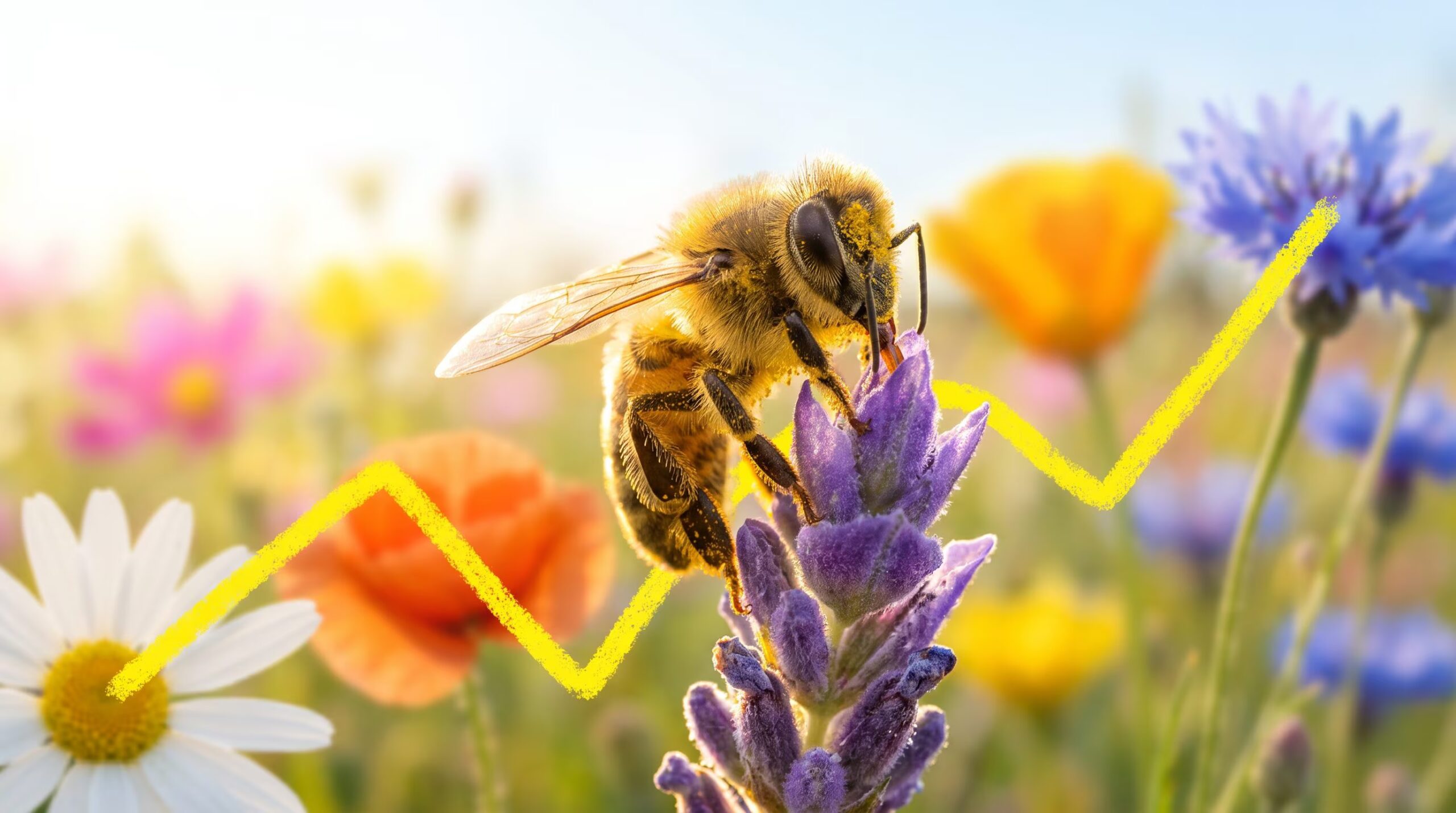
The bees could orient themselves thanks to a real “biological compass” internal, based on tiny particles capable of perceiving the Earth’s magnetic field. This is suggested by a recent study published in Science Advanceswhich adds a vital piece to a story that has fascinated scientists for decades. The discovery, which occurred on 74 of the 96 bee species analyzed, could help explain how these insects manage to travel distances in flight and then return to the hive. The exact functioning of this “sixth sense”, however, still remains to be clarified.
What is magnetoreception?
For us human beings the Earth’s magnetic field it is completely invisible. Yet, for many animals it represents a precious point of reference for orientation during travel. This ability is called magnetoreceptionor the ability to perceive the Earth’s magnetic field and use it as a natural compass.
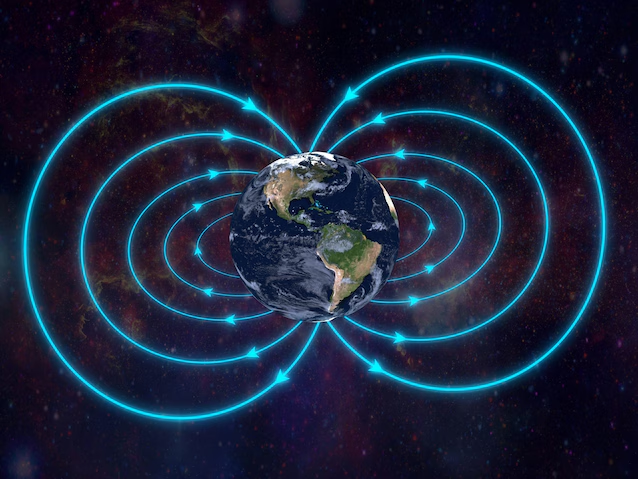
Among the animals that seem to possess this ability are migratory birds, sea turtles or salmon. For them the Earth’s magnetic field would represent a reference point additional when moving, especially when other signals, such as the Sun or landscape landmarks, are not sufficient.
How it works, however, remains largely a mystery. One of the most accepted hypotheses is that some animals possess tiny crystals of magnetitea mineral composed of iron oxide that reacts to magnetic fields. These particles could behave like a compass needle, aligning with the Earth’s magnetic field and sending information to the nervous system. As for bees, scientists have long suspected that they may possess this ability, but there was still one piece of evidence missing which indicated how widespread this phenomenon was among the thousands of bee species present on the planet.
The study: found magnetic particles in over three-quarters of the species analyzed
To answer this question, the researchers analyzed 96 species of beesbelonging to different evolutionary groups and characterized by very different habits. In addition to social bees, such as the honey bee (Apis mellifera) and bumblebees, the study, published in the journal Science Advancesincluded numerous solitary species and 47 non-bee insects as the outgroup.
To verify the presence of magnetic materials, the specimens were dried, powdered and analyzed with a magnetometeran extremely sensitive instrument capable of detecting even very weak magnetic properties. In this way the authors were able to identify the presence of particles containing iron compatible with magnetic minerals such as magnetite.
The results were surprising: 74 of the 96 species examined they showed a magnetic response significant. Even more interesting is the fact that these particles were observed in very different groupssuggesting that this is not an exclusive characteristic of social bees, but probably a much more widespread trait.
The analysis also highlighted some differences. Larger species tended to have a higher amount of magnetic material compared to smaller ones, while social bees generally showed a more intense magnetic response than solitary species. According to the authors, this could be linked to greater orientation needs required by life in the colony, although further studies will be necessary to confirm this hypothesis.
Do bees really have an “internal compass”?
Despite the enthusiasm aroused by the results, the researchers themselves urge caution. The study, in fact, it does not prove that bees actually use the Earth’s magnetic field to orient themselves. It only demonstrates that many species have structures compatible with a possible magnetoreception system.
The difference may seem subtle, but it is fundamental. Find magnetic particles in an organism is equivalent to discovering a component that could be part of a compass: it does not automatically mean that that compass is used, nor that it is connected to the nervous system in the way necessary to provide information about the environment.
To clarify this aspect they will be essential new behavioral experimentsin which bees will be observed while the magnetic field is artificially altered. Only in this way will it be possible to understand if they change their way of orienting themselves and how much magnetism really contributes to their movements.
Although many questions still remain, the research nevertheless represents an important step. The presence of magnetic particles in such a large number of species suggests that this characteristic may have evolved much earlier than previously thought and that the magnetic sense may be more common in the world of insects than previously imagined.
Once again, the bees show that they care amazing abilities and they remind us how much there is still to discover about their behavior and their relationship with the environment.
Sources
Joseph L Kirschvink, Michael M Walker, Carol E Diebel, Magnetite-based magnetoreception, Current Opinion in Neurobiology, Volume 11, Issue 4, 2001, Pages 462-467, ISSN 0959-4388 Laura Russo et al. ,Broad presence of ferromagnetism in bees and relationship to phylogeny, natural history, and sociality.Sci. Adv.12,eaed7391(2026). Lohmann KJ, Lohmann CMF. There and back again: natal homing by magnetic navigation in sea turtles and salmon. J Exp Biol. 2019 Feb 6;222 Wiltschko W, Wiltschko R. Magnetic orientation and magnetoreception in birds and other animals. J Comp Physiol A Neuroethol Sens Neural Behav Physiol. 2005
